What is in this guide
A dog that ignores an expensive bed and lies on the kitchen tiles is not being ungrateful. It is choosing between things that matter to it, and the bed is losing on at least one of them.
Dogs choose a sleeping spot on four criteria, roughly in this order:
- Where the people are
- Temperature
- A view of the entrance, or at least of the room
- Comfort
Comfort is fourth. That is the whole reason an expensive orthopaedic bed in a quiet spare room goes unused while the dog sleeps against a doorway on a hard floor.
Where the people are
Dogs are social sleepers. A bed in a room nobody uses will not be used either, however good it is.
The practical version: put the bed in the room the household actually sits in, in the evening, with the television on. For most houses that is the lounge room, and it is the single most reliable placement there is.
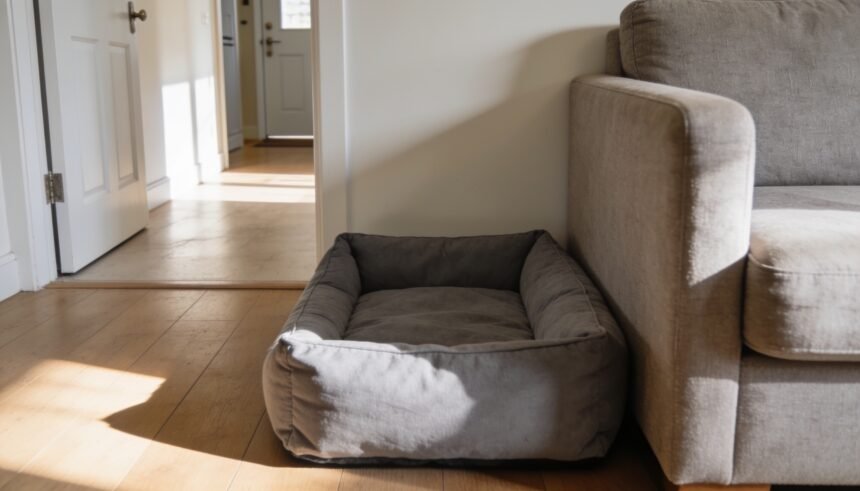
Not in the middle of the room. Against a wall, in a corner, or beside a couch. Dogs prefer their back covered and a wall gives them that.
Not in the traffic. Beside the path between the kitchen and the back door is a spot where a dog is stepped over forty times an evening. They do not settle there.
The sweet spot is usually the edge of the room the family is in: near the people, out of the walkway, back to a wall, eyes on the door.
Temperature, which in Australia is the big one
For most of the year in most of the country, heat is the reason a dog is not on its bed.
A padded bed is insulation. A dog that is too warm will leave it for tiles, concrete, floorboards or the bathroom floor, because those surfaces pull heat away. That behaviour is information rather than rejection.
What follows from that:
- Expect the sleeping spot to move with the seasons. Most dogs have a winter spot and a summer spot, and fighting that is pointless
- Have two options available in summer: the bed, and an uncovered cool floor nearby. Let the dog choose
- Keep the bed out of direct sun, including the patch of sun that arrives at 3pm and was not there when you placed it. This is the most commonly missed one, because people position beds in the morning
- Not next to a heater or a ducted vent in winter, which overheats a dog that cannot move away easily
- Raised or trampoline beds allow air underneath and suit hot climates much better than a thick cushion. Elevating a bed is often more useful than cooling the room
A dog that is panting heavily, restless, drooling, or seeking cold surfaces urgently is a different situation from one that has simply moved to the tiles. Heat stress in dogs is a veterinary emergency rather than a bedding question, and it needs a vet, not a rearranged room.
Spots that reliably fail
- The laundry. Common, and usually chosen for the household’s convenience rather than the dog’s. Hard surfaces, a closed door, no people, and often the noisiest appliances in the house
- Beside an appliance. Washing machines, dryers and dishwashers are loud at exactly the times a dog wants to settle
- In a corridor. Traffic, no wall at the back, and constant interruption
- Under a window facing the street, if your dog is a barker. A view of the footpath is stimulation, not rest
- A spare room with the door closed. The most expensive mistake, because the bed is usually the good one
- Directly under a ceiling fan for a nervous dog. Some dogs dislike the moving shadow more than they enjoy the air
More than one bed, which is the real answer
Most households solve this properly by having two or three beds rather than one perfect one.
A bed in the lounge room for the evening, something in the bedroom or hallway for overnight, and a cool spot for summer afternoons. They do not all have to be expensive. A folded blanket in the right place beats a premium bed in the wrong one.
If one of those places is a crate, what goes inside it is its own question, and crate covers and bedding covers it.
The same placement logic applies to the other fixed thing in a dog’s day, which is where it eats. A feeding station in a small kitchen is the same problem with different constraints.
This also solves the problem of a dog that wants to be near the household but is not allowed on the furniture, which is a much easier rule to hold when there is an obvious alternative six feet away.
Introducing a new bed
Dogs are conservative about where they sleep, and a new bed often fails because it is new rather than because it is wrong.
- Put it in the spot the dog already chooses, not where you want the dog to be. Move it later, gradually
- Put something that smells like home on it, including an unwashed item of your clothing for the first few nights
- Feed a treat on it, or scatter a few, so the bed becomes somewhere good things happen
- Do not wash it immediately. A new bed smells like a factory, and a week of the dog’s own scent makes it theirs
- Give it a fortnight before concluding it has failed
Older dogs
Placement matters more as a dog ages and it changes in specific ways: away from draughts, off cold hard floors, out of reach of anything they now have to jump or climb to get to, and on the level they spend the day on rather than up or down stairs.
A bed with a low entry side is easier for a dog that is stiff. Making the house easier for an older dog covers the rest of that.
One thing worth taking seriously: a change in where an older dog chooses to sleep, or restlessness at night that is new, can be a sign of pain or of something else going on. That is a conversation with a vet rather than a bedding adjustment.
The short version
Near the people, against a wall, out of the walkway, out of the sun, and with a cool alternative available in summer. Then let the dog choose between them, because it will anyway.
If the problem is not where the bed is but what it is made of and whether it survives a wash, that is washable dog beds. And if the room itself is the problem in summer, the fixes are much the same as they are for a kids room: shade the glass, close it up in the day, and move air through it in the evening.
The one-page family week
One printable page that holds the whole week: meals, school, activities and who is doing the pickup. Free, and we send one useful email a week.
One email a week. No spam, unsubscribe in a click.