What is in this guide
Where the bowls go decides how much mess you deal with and, in a multi-pet household, whether everyone eats peacefully. It is a placement problem far more than a product one.
The five placement rules
1. Out of the walkway. Bowls in a thoroughfare get kicked, stepped over and pushed around, and a pet eating in a busy path is interrupted constantly. The corner of a room beats the middle of a galley kitchen.
2. Not in front of a cupboard or appliance you open. Obvious once you have done it wrong.
3. On a surface you can clean. Tile, vinyl or a mat rather than carpet or an unsealed timber floor, both of which absorb what gets spilled.
4. Where the pet feels safe. A pet with its back to an open room, or cornered with no exit, eats faster and more anxiously. This matters more for cats and for nervous dogs, and it is the same principle as the litter tray requirements in where to put the litter tray in a small home.
5. Not beside the litter tray. The one thing to never do. Cats do not eat where they toilet and many will reject one or the other outright. In a small home both get pushed into the same corner, and it is the most common placement mistake there is.
Making it fit a small space
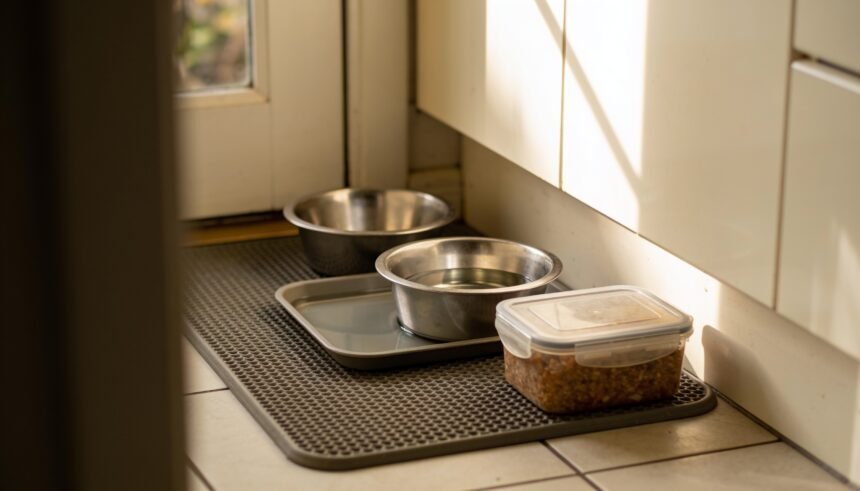
A mat under the bowls contains spills and defines the spot. It also stops bowls travelling across a hard floor while a dog eats, which is the main cause of food ending up under the fridge.
A tray with a lip for enthusiastic drinkers and messy eaters.
Under a bench or in a cabinet toe-kick recess, where the bowls are out of the walkway entirely.
A corner, which uses space that is otherwise wasted.
Vertical for cats. A cat bowl on a bench, a shelf or a cat tree keeps it away from a dog and out of the floor space entirely. This also fits the vertical space principle in keeping a cat happy indoors.
Store the food nearby, in a sealed container. A sealed container is the ant control point as well as the freshness one, and it prevents the bag of biscuits living on the floor.
Do not put water in the same spot as the food if your cat objects. Many cats prefer their water away from their food, and a cat drinking less than it should is a genuine health consideration rather than a preference to ignore.
The multi-pet problem
Resource competition is common and largely invisible to owners.
Feed separately. Different rooms, a closed door, a crate, or one on a bench and one on the floor. A pet eating fast because another is nearby is a real and frequently missed cause of gulping, as covered in stopping a dog inhaling dinner.
Do not use a shared bowl.
Watch for blocking, where one animal positions itself so another cannot get to food or water. It is quiet, it is easy to miss, and it is a genuine welfare issue in a small home.
More water bowls than pets, in different locations, which is standard advice for multi-cat households and is sensible for dogs too.
Pick up bowls after meals if competition is an issue, rather than leaving food down.
Keep dog food away from cats and cat food away from dogs, because the two are formulated differently and a dog that regularly eats cat food is a veterinary conversation.
The Australian problems
Ants. The constant one, and worse in summer and after rain.
A tray of water with the bowl standing in the middle is the traditional moat and it works.
Do not leave wet food down in warm weather, because it attracts ants and spoils quickly.
Store dry food in a sealed container, not in the opened bag.
Wipe up spills immediately, since a single biscuit under a cupboard is a trail within hours.
Do not use ant baits or sprays near a pet feeding area. Pesticides and pet food do not share a space, and any pest control product near a pet needs to be checked as safe for that use, with the product instructions and your vet as the reference.
Heat. Water bowls empty and warm faster in an Australian summer.
More water, in more places, and refreshed more often. A large heavy bowl that cannot be tipped, in the shade, and a second one inside.
Ice cubes in the water bowl on a hot day, and a frozen bottle of water in a large outdoor bowl.
Wet food spoils quickly in heat and should not be left out.
Bowls, briefly
Stainless steel and ceramic are easy to clean and do not scratch the way plastic does. Scratched plastic holds bacteria and is harder to get clean.
Wide and shallow suits many cats, which dislike their whiskers touching the sides.
Heavy or non-slip, so the bowl stays put.
Wash them properly and daily. A water bowl develops a film quickly, particularly in warm weather, and it is one of the more neglected cleaning jobs in a household.
Raised feeding suits some pets and not others, and whether it is appropriate for your dog is a veterinary question rather than a general recommendation.
No product or brand is named in this article, because the placement decisions above matter considerably more than what you buy.
The vet questions
Portion sizes, diet changes and weight are veterinary matters rather than guesses.
A change in appetite or water intake in either direction is worth a veterinary appointment, since increased drinking in particular can indicate a treatable condition.
Next: stopping a dog inhaling dinner covers the competition problem in detail, where to put the litter tray in a small home covers the other placement decision, and keeping a cat happy indoors covers using vertical space.
The one-page family week
One printable page that holds the whole week: meals, school, activities and who is doing the pickup. Free, and we send one useful email a week.
One email a week. No spam, unsubscribe in a click.