What is in this guide
Some dogs eat as though the bowl is about to be taken away. It is common, it is usually not a sign of anything wrong, and it is still worth slowing down.
Before the methods, the part that matters most.
The emergency you should know about
Bloat, and its severe form gastric dilatation volvulus, is a genuine veterinary emergency. It is most associated with large and deep-chested breeds, and it can be fatal within hours.
Signs to act on immediately:
- A swollen, hard or distended abdomen
- Retching or trying to vomit and producing nothing
- Restlessness, pacing, inability to settle or lie down
- Drooling, panting, obvious distress
- Collapse
If you see these, go to a vet immediately, including after hours. Do not wait to see if it passes.
Whether eating speed causes bloat is a question for your veterinarian, not for an article. What can be said is that vets commonly advise slowing fast eaters, and that a dog in a high-risk category warrants a specific conversation with your own vet about feeding, exercise timing and what to watch for.
The other reasons to slow it down are less dramatic and more certain: choking, regurgitating the meal whole, gas and discomfort, and the fact that a meal gone in twelve seconds does nothing at all for a dog’s day.
Six ways to slow it down that cost nothing
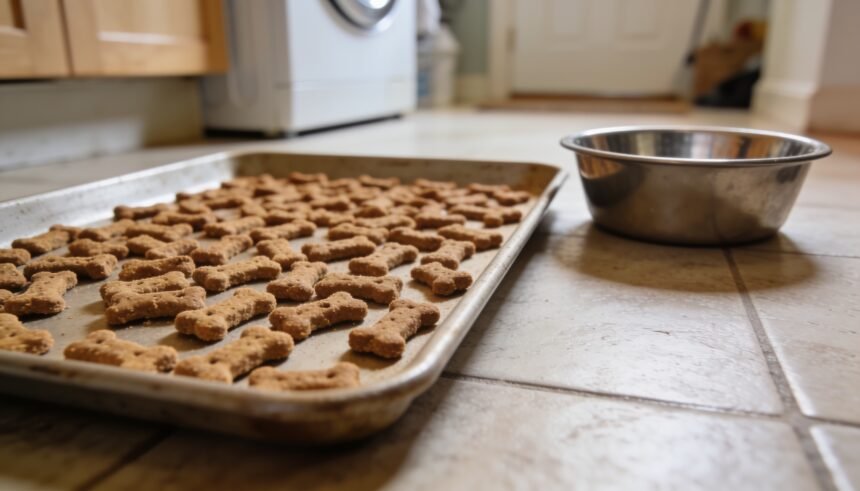
1. Spread the food out. On a baking tray, a flat plate or a clean floor surface. A dog that cannot get a mouthful in one scoop has to work. This is the simplest method available and it works immediately.
2. Put an object in the bowl. A large ball, a clean rock too big to swallow, or an upturned smaller bowl inside the larger one. The dog eats around it. The object must be far too large to swallow, which is the only caution.
3. Scatter feed. Throw the biscuits across the lawn or across a room and let the dog find them. This converts ninety seconds of eating into fifteen minutes of searching, and searching is genuinely tiring in the way covered in how much exercise does my dog actually need.
4. Split the meal. Half now, half in ten minutes. Or the day’s food across four small meals rather than one large one. Also worth discussing with a vet for a dog in a higher-risk category.
5. Feed by hand, during training. The whole meal, one handful at a time, paid for behaviours. Slow, useful, and it turns dinner into a training session.
6. Use the meal in a puzzle or a stuffable toy. Free if you already own one, and it occupies a real part of the morning.
If none of that is enough
Slow feeder bowls exist and they work, using moulded ridges or a maze pattern. They are the obvious purchase in this category, and how to choose a slow feeder bowl covers the pattern depth and the cleaning problem that decide whether one gets used.
No specific product is recommended here because none has been verified for this article, and the free methods above are effective for most dogs. If you buy one, the practical points are that it should be stable enough not to slide across the floor, deep enough that food does not scatter everywhere, and dishwasher safe, because a maze bowl cleaned by hand is unpleasant.
Some dogs defeat them by picking the bowl up and tipping it out, which is worth knowing before spending.
Why the dog is eating like that
Understanding the cause sometimes removes the problem entirely.
Competition. The most common cause in a multi-pet household, and it is frequently invisible to the owner. A dog that is eating fast because another animal is nearby will slow down markedly if fed separately, behind a closed door or in a crate. Try this first in any multi-pet house, because it is free and it is often the whole answer.
History. A rescue dog, a dog from a large litter, or a dog that has been genuinely short of food will eat fast for a long time and may always do so.
Hunger. A dog on too little food, or on food that does not satisfy it, eats fast. Portion sizes are a veterinary question rather than a guess, and reading an Australian pet food label covers what the packaging actually tells you.
Simple enthusiasm. Some dogs are just like this, and slowing them down is management rather than correction.
The Australian timing point
Feeding and exercise timing matter more here than in cooler countries.
Do not feed immediately before or after hard exercise, and discuss the appropriate gap with your vet, particularly for large and deep-chested breeds.
In summer, both meals and exercise move to the cooler parts of the day. A dog fed at four in the afternoon in February and walked at four thirty is being asked for something unreasonable.
Water available at all times, and particularly with dry food in hot weather.
When to involve the vet
Any of the emergency signs above, immediately.
A sudden change in how a dog eats, in either direction. A dog that has always eaten slowly and now inhales, or a dog that has always eaten well and now picks, is telling you something.
Regurgitating the meal regularly, which is different from occasional vomiting and is worth investigating.
If your dog is a large or deep-chested breed, ask your vet directly about bloat risk, feeding practice and what they recommend for your dog. This is a five-minute conversation at a routine visit and it is worth having before you need it.
Weight, portion size and diet changes are veterinary questions.
Next: how much exercise does my dog actually need covers scatter feeding and mental work, stopping a dog from destroying things when left alone covers using meals to occupy a day, and reading an Australian pet food label covers what you are actually feeding.
The one-page family week
One printable page that holds the whole week: meals, school, activities and who is doing the pickup. Free, and we send one useful email a week.
One email a week. No spam, unsubscribe in a click.