What is in this guide
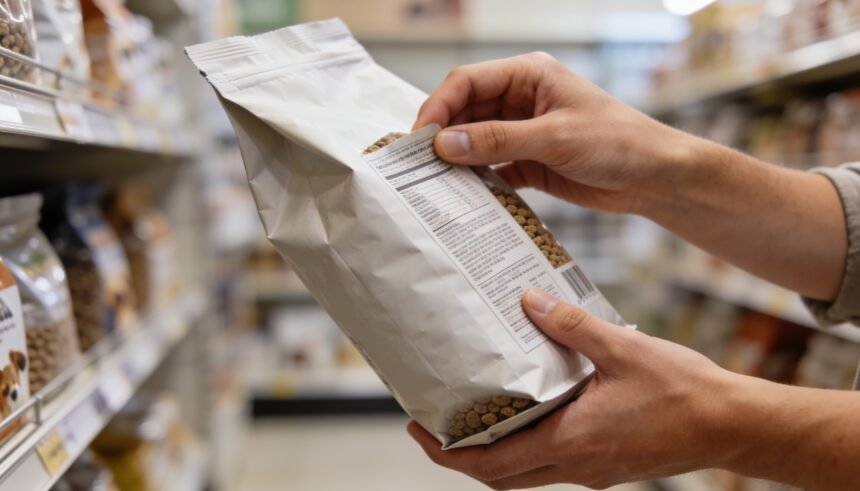
Ingredients are listed in descending order by weight, and that one fact explains most of what looks confusing on a pet food bag. Fresh chicken weighs far more than dried chicken meal because it is mostly water, so a bag listing “chicken” first can easily contain less actual chicken protein than one listing “chicken meal” second.
Australian pet food sits under an industry standard rather than government regulation, which means the label is a marketing surface as much as an information one. It still tells you a lot, if you read the right parts.
Start with the ingredients, and read the first five
The first three to five ingredients make up the large majority of the food. Everything after that is usually present in small quantities, however impressive it sounds.
Two things to watch for.
Water weight. “Chicken” on a dry food label means fresh chicken, weighed before the moisture is cooked out. “Chicken meal” is the rendered, dried version, so it is far more concentrated by the time it is in the bag. Neither is automatically better. They are just not comparable as listed.
Ingredient splitting. If a food lists chicken first, then rice, then rice flour, then rice bran, the three rice fractions might collectively outweigh the chicken. Split into three entries, each one sits lower down the list. This is legal, common, and the single most useful thing to look for.
Then the analysis panel, and check which kind it is
This is where most people stop reading, and it is where the actual signal sits.
Guaranteed analysis gives minimum or maximum values for named nutrients: crude protein, crude fat, and often moisture, ash and fibre. Minimums for the things you want more of, maximums for the things you want less of. It is a guarantee, which means the manufacturer is committing to it.
Typical analysis gives averages instead. It is not a commitment, and it tends to appear on cheaper brands. If two similar foods are priced differently and one offers a guaranteed analysis while the other offers a typical analysis, that is a meaningful difference.
“Crude” does not mean low quality. It refers to the laboratory method used to measure the nutrient, not the grade of the ingredient. A lot of people read “crude protein” as a warning and it is not one.
Comparing two bags properly
You cannot compare a dry food and a wet food on the printed percentages, because the wet food is mostly water. A wet food at 10 per cent protein and a dry food at 30 per cent are much closer than they look.
To compare fairly, take the moisture out of the equation. Subtract the moisture percentage from 100 to get the dry matter, then divide the protein figure by that dry matter figure. Do it for both foods and compare the results. It is one calculation and it is the only way the numbers on two different formats mean anything against each other.
Feeding guides are a starting point, not an instruction
The feeding chart on the bag is calculated for an average animal of that weight with average activity. Your dog is not average, and the chart cannot know whether they are desexed, whether they spend the day asleep or running, or what treats they get on top.
Use it as the opening position, then adjust based on the animal in front of you over a few weeks. How much to feed your specific pet is a conversation with your vet, particularly if weight is already a concern, and this article does not attempt to answer it.
What the label cannot tell you
Being honest about the limits is more useful than pretending the panel is complete.
- It does not tell you ingredient quality. Two foods can list identical ingredients sourced very differently.
- It does not tell you digestibility, which is what actually determines how much of that protein the animal can use.
- Marketing words on the front are not defined terms. “Premium”, “natural”, “holistic” and “human grade” carry no consistent regulatory meaning in Australia. Read the back of the bag, not the front.
- A short ingredient list is not automatically better. It is sometimes a sign of a limited-ingredient formula for a specific reason, and sometimes just a smaller recipe.
A workable routine in the aisle
- Read the first five ingredients. Look for split fractions of the same base ingredient.
- Note whether the meat is fresh or meal, and remember they are not comparable as printed.
- Check whether the panel says guaranteed or typical.
- If you are comparing formats, do the dry matter calculation.
- Check it states the life stage the food is formulated for. Puppy, adult and senior formulations differ for real reasons.
- Ignore the front of the bag entirely.
Changing foods
Whatever you decide, transition gradually. Australian veterinary and retailer guidance is consistent on roughly seven to ten days, moving from mostly the old food to mostly the new one, to avoid gastrointestinal upset. An abrupt switch is the most common cause of a very unpleasant week for everybody.
If your pet has an existing health condition, is losing or gaining weight, or has ongoing digestive problems, the food decision belongs with your vet rather than with a label and an article.
Next: if you are travelling, road trips with a dog covers why pre-measured food matters more than it sounds.
The one-page family week
One printable page that holds the whole week: meals, school, activities and who is doing the pickup. Free, and we send one useful email a week.
One email a week. No spam, unsubscribe in a click.