What is in this guide
Australian road rules do not generally require a dog to be restrained inside the cabin of a car, which surprises most people. What they do require, everywhere, is that the driver has proper control and an unobstructed view, and driving with a dog on your lap is an offence in every part of Australia. Tethering a dog on a ute tray is separately required almost everywhere. Restraint inside the car is a safety decision rather than a legal one in most states, and it is still the right decision.
The rest of the trip comes down to two things people underestimate: how often you need to stop, and how quickly a parked car becomes dangerous.
What the law actually says
The position varies, so check your own state before you rely on any of this.
- Everywhere in Australia: a dog on the driver’s lap is an offence. Every state and territory requires the driver to have proper control of the vehicle and a clear, unobstructed view.
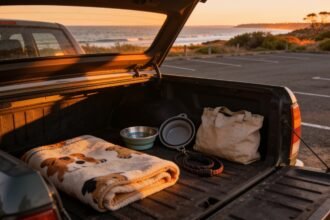
- Utes and open vehicles: failing to tether a dog on a ute tray is an offence in all states and territories except the Northern Territory.
- Tasmania is the outlier on cabin travel and requires a dog in a vehicle to be restrained.
- NSW and Queensland have no legal requirement to restrain a dog inside the cabin, but Transport for NSW strongly recommends a suitable restraint, harness, carrier or crate.
- Western Australia prohibits an animal being anywhere it could distract the driver or obstruct their vision.
There is also a welfare dimension. An unrestrained animal that causes injury can bring an animal cruelty issue into play, not just a traffic one, which is why the RSPCA position on open vehicles is firm.
The practical read: restrain the dog because an unrestrained animal becomes a projectile in a sudden stop and a hazard to the people in the car, not because a police officer is likely to pull you over for it.
The heat problem, which is the real one
A parked car in Australian conditions heats far faster than people expect, and leaving a dog in one is the single most dangerous thing on this list. Cracking a window does not solve it. Shade does not solve it for long, because shade moves.
The workable rule is that the dog does not stay in the parked car. That has consequences for how you plan the trip: your coffee stop becomes a takeaway, your lunch stop becomes a park with a bench, and anyone who wants to go into a shopping centre goes in while someone else stays with the dog.
Plan the stops around that constraint before you leave, not at the first servo.
Stops, and how often
A useful default is a proper stop every two hours. Not a fuel stop with the dog left in the car, a real stop where the dog gets out on lead, has water, and has a chance to toilet.
For a dog that has never done a long drive, do a practice run first. Thirty to forty minutes each way to somewhere they will enjoy at the other end. You learn two things: whether they settle, and whether they get car sick. Both are much easier to deal with on a Sunday near home than three hours into a holiday drive.
Restraint options, in rough order of protection
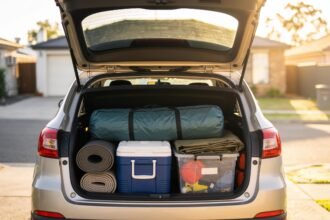
- Crate or travel carrier secured in the boot or cargo area. The most protective option for most vehicles, and the one that stops a dog moving around at all. It needs to be actually secured, not just placed.
- Cargo barrier plus the boot space. Good for larger dogs in wagons and SUVs. Stops the dog reaching the cabin, does not restrain them in a crash.
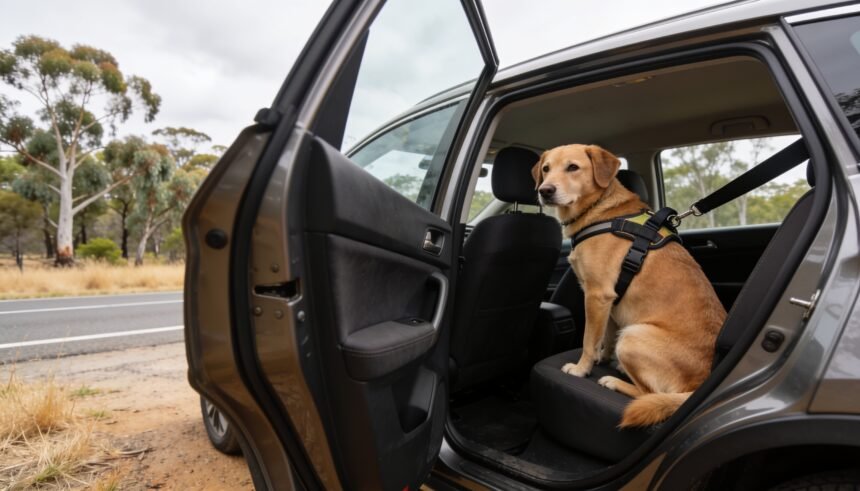
- Crash-tested car harness clipped to a seatbelt anchor. The practical middle ground for back-seat travel. Look for a harness sold specifically for vehicle use and tested to a published standard, not a walking harness with a clip added.
- A walking harness and a seatbelt clip. Better than nothing, and commonly used, but a walking harness is not built to take crash loads.
Whatever you choose, the dog travels in the back. Front-seat airbags are a genuine hazard to an animal.
Car sickness
Car sickness in dogs is common in puppies and often improves with age. It usually shows up as drooling, lip licking and restlessness before anything else happens, so you often get warning.
What helps: an empty-ish stomach, so feed a few hours before rather than just before. A forward-facing position rather than sideways. Fresh air and a cooler cabin. Shorter trips built up gradually. If it is severe or persistent, that is a conversation with your vet, not something to manage with advice from a blog.
The day-of plan
- Walk the dog properly before you leave. A dog that has had a decent run settles far better than one loaded straight from the backyard.
- Feed early, not at departure. A few hours of gap makes car sickness less likely.
- Toilet stop immediately before getting in. Every time, even if they went an hour ago.
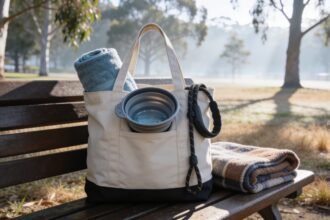
- Water in the car, not just at stops. A spill-resistant bowl or a bottle with an attached trough.
- Check the ID tag before you go. A dog is never more likely to bolt than at a strange rest stop three hours from home, and this is the one time a current phone number on the collar actually matters.
- Stop every two hours. On lead, every time, at an unfamiliar place.
- Nobody leaves the dog in the parked car. Build the stops around this.
What usually goes wrong
The dog will not settle for the first hour. Normal. Most dogs settle once the car is at a constant speed. Resist the urge to keep turning around to reassure them, which tends to keep them alert.
Someone gets carsick, and it is not the dog. Pack a roll of paper towel, a spare towel and a plastic bag within reach, not in the boot.
You arrive and the dog will not toilet. Common in a new place. Take them to the same spot two or three times rather than walking further each time.
The accommodation is less pet-friendly than advertised. Confirm the specifics before you book: whether the dog can be left alone in the property, whether they are allowed inside, and whether there is a secure yard.
Start with the short version
If this is your first long drive with a dog, do a forty-minute practice run this weekend before you commit to a six-hour one. You will find out more in that trip than in any amount of planning.
Next: the weekend away packing list covers what actually goes in the car, the day out list is the shorter version, and ID tags and what Australian law requires matters more on the road than at home.
The one-page family week
One printable page that holds the whole week: meals, school, activities and who is doing the pickup. Free, and we send one useful email a week.
One email a week. No spam, unsubscribe in a click.