What is in this guide
Check where dogs are allowed before you book anything. Dogs are prohibited in most Australian national parks, which removes a large share of the country’s best-known camping from your list immediately. State forests, council reserves, privately run campgrounds, caravan parks and many state conservation areas are where dog-friendly camping usually happens.
Get that right and the rest of the trip is manageable. Get it wrong and you find out at the gate.
Where to check, in order
- The managing authority’s website for the specific campground, not a general dog-friendly listicle
- The rules for the site itself, which are often stricter than the wider area: on lead at all times, not left unattended, not in amenity blocks
- Whether dogs are allowed on the tracks, which is a separate rule from whether they are allowed at the campsite
- Fire restrictions and seasonal closures, which affect whether you can go at all
A phone call to the campground answers all four in three minutes and is worth it for a first trip.
Before you go
- Parasite prevention current, particularly paralysis tick prevention if you are anywhere on the east coast or in coastal bushland. Check the date the last treatment was given
- ID tag legible with a current number, and microchip registry details up to date. A dog is never more likely to bolt than on its first night in a strange campsite
- A recent photo on your phone
- The nearest emergency vet to where you are going, found and saved before you leave
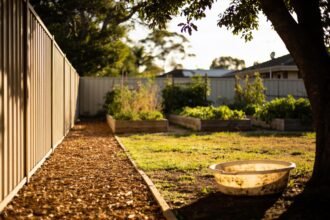
- A practice night if the dog has never slept in a tent. A night in the tent in the backyard tells you a great deal for no cost
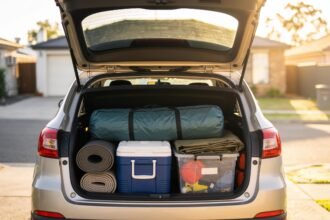
What to pack beyond the usual
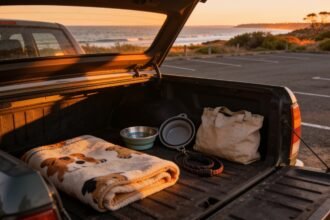
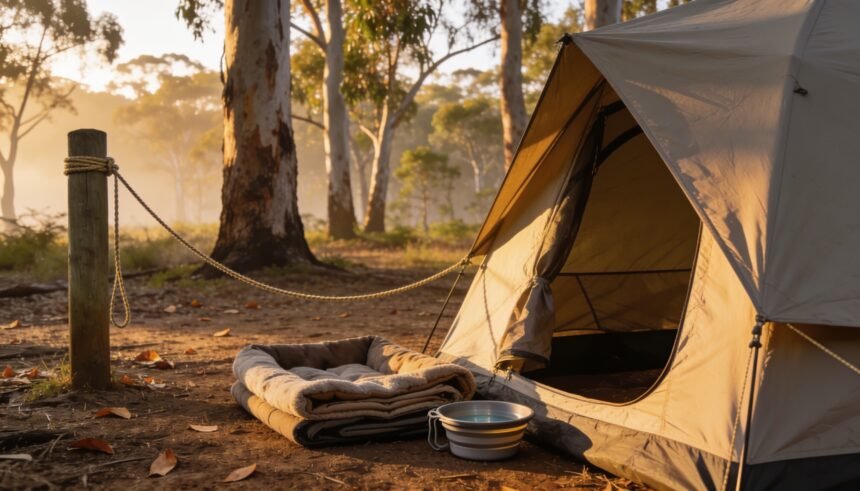
- A long line or a tie-out, plus something solid to attach it to. Most dog-friendly campgrounds require dogs restrained at all times
- Their own bed or mat from home, because it smells right and gives them a defined place
- A blanket for cold nights. Australian inland nights get genuinely cold even after hot days
- Water, and more water. Do not assume the campground has a supply or that creek water is safe
- Collapsible bowls
- Pre-measured food in daily portions, plus a spare day
- A towel, and then another towel
- Poo bags in quantity, and the expectation that you carry the waste out
- A basic first aid kit including tick removal tweezers, and the knowledge that anything beyond a scratch is a vet job
- A torch or a light for their collar, because a dark dog at a dark campsite disappears instantly
Heat, which is the real risk
An Australian campsite in summer offers less shade than you expect and shade moves through the day.
- Walk early and late. The middle of the day is for lying in the shade
- Use the seven second test on any hot surface. If you cannot hold the back of your hand to it, it is too hot for paws
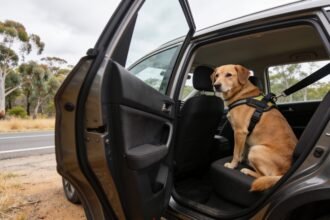
- The car is not shade. A dog never waits in a parked car, and at a campsite that rule is harder to keep because the car is right there
- Watch for heat stress rather than waiting for it. Heavy panting, drooling, unsteadiness and distress are the signs to act on, and acting means cooling and a vet, not waiting to see
Wildlife and the things in the grass
Australian camping introduces hazards most overseas advice does not cover.
- Snakes. Keep dogs on lead and on paths, away from long grass, wood piles and rock crevices. A suspected snake bite is an emergency vet situation immediately, not a wait-and-see
- Ticks. Do a full check every evening, systematically rather than by patting
- Bait stations. Some rural and conservation areas use 1080 baiting for wild dogs and foxes, which is lethal to pets. Baited areas are signposted. Read the signs at the entrance and take them seriously
- Toads and other wildlife in northern Australia
Night one
Expect a dog that will not settle. Every noise is new and there is no door.
What helps: their own bed inside the tent rather than outside, a walk before bed to burn off the day, keeping to the normal feeding time, and staying calm about the barking rather than reacting to it. Most dogs settle by the second night.
If your dog has never slept in a tent, the backyard practice night is the single best preparation available.
Campsite etiquette
- On lead, always, unless there is a clearly signed off-lead area
- Never left alone at the site, which most campgrounds require anyway
- Pick up immediately and carry it out
- Barking is the reason dog-friendly campgrounds become non-dog-friendly. If your dog barks constantly, that is a reason to reconsider the trip rather than a thing to apologise for afterwards
Next: road trips with a dog covers getting there, the weekend away packing list is the broader version, what to pack for a day out is the short version, and camping with kids for the first time covers the other half of a family trip.
The one-page family week
One printable page that holds the whole week: meals, school, activities and who is doing the pickup. Free, and we send one useful email a week.
One email a week. No spam, unsubscribe in a click.