What is in this guide
Almost everything a dog needs mentally can be made from cardboard, a towel, a container and the food you already buy.
The one thing that has to come first is the supervision question, because homemade enrichment is safe for some dogs and not for others, and the difference is entirely how your dog behaves.
Work out what kind of dog you have
Watch your dog with a cardboard box for five minutes.
The shredder that does not swallow tears things apart and leaves the pieces. Most homemade enrichment is fine, and you clean up afterwards.
The swallower eats the cardboard, the towel or the container. Homemade enrichment involving destructible materials is not appropriate unsupervised for this dog, and possibly not at all. Ingestion and intestinal obstruction are serious and are a veterinary emergency.
The careful worker removes the food and leaves the container intact. Everything below works.
When in doubt, supervise. And anything you are unsure about is a question for your vet, particularly for a dog that has swallowed things before.
The long ones: thirty minutes or more
Frozen food in a container. Wet food, soaked biscuits or plain yoghurt frozen in an ice cream container or a mug, then turned out. In an Australian summer this is cooling as well as occupying, which is why it is the highest value item on this list for much of the year.
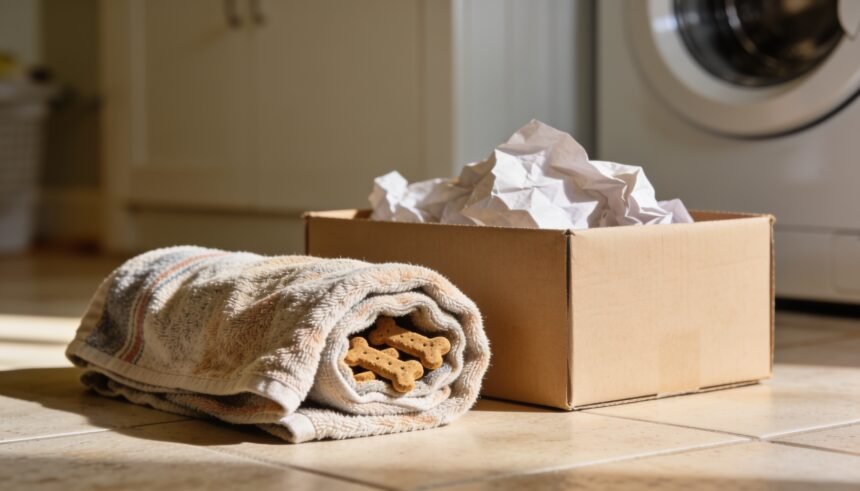
A frozen towel roll. Wet a towel, scatter food through it, roll it, freeze it. Long-lasting and it uses no equipment.
Scatter feeding in grass. The entire meal thrown across the lawn. Fifteen to thirty minutes of searching, and sniffing is more tiring than walking, as covered in how much exercise does my dog actually need.
A cardboard box with paper and food. Food hidden in scrunched paper inside a box. Cheap, endlessly renewable and the mess is contained.
A dig box. A shallow box or a designated patch of dirt with things buried in it. For a dog that digs, this redirects the behaviour rather than fighting it.
Muffin tin puzzle. Food in the wells, balls or rolled towels on top.
The medium ones: ten to twenty minutes
A towel roll, unfrozen. Same idea, faster.
Food in a plastic bottle with holes cut in it, lid removed. Remove the lid and the ring, because both are swallowable, and supervise.
Stacked containers the dog has to nose apart.
Food under cups. Three cups, food under one, let them work it out. Genuinely engaging and it takes ten seconds to set up.
Food inside a knotted old t-shirt.
Egg carton with food in the wells, lid closed loosely.
The short ones: a few minutes
A cardboard tube with the ends folded, food inside.
Find it. Hide food around one room, release the dog.
A new smell. A branch from a different part of the yard, a box from somewhere else, a towel that has been somewhere new. Novelty alone is genuinely engaging for a dog and costs nothing.
Non-food enrichment, which people forget
A sniffing walk, where the dog chooses the route and the pace.
Somewhere new, even a different street.
Training, five minutes. Mental work and relationship at once.
A window with a view, if it does not become barking.
Digging permitted somewhere specific.
Being taken along. A dog that comes on the school run, to the hardware store car park, or to sit outside a cafe has had a more interesting day than one that had a puzzle feeder.
The safety rules
Remove anything swallowable before you hand it over. Bottle lids and rings, tape, staples, plastic windows in egg cartons, string, elastic.
Supervise the first time with anything new, every time, so you learn how your dog handles it.
Never leave a dog unsupervised with something it can swallow. Obstruction is life-threatening and requires surgery.
No cooked bones. Ever. They splinter. Raw bone feeding is a debated area with genuine risks and is a question for your vet rather than for an article.
Check the food you use. Several common human foods are toxic to dogs, including chocolate, grapes and sultanas, onion and garlic, macadamias, and anything containing the sweetener xylitol, which is also sold as birch sugar. RSPCA Australia and the Australian Veterinary Association publish lists and they are the reference, and for a suspected poisoning the Animal Poisons Helpline and your vet are the immediate call.
Use the day’s food allowance rather than adding on top. Weight is a veterinary conversation.
Cardboard is not food. A dog eating rather than shredding it needs a different approach.
Making it a routine rather than an occasional thing
Rotate. The same three ideas become invisible. Four or five rotating through a week stays interesting.
Attach it to a time. Before you leave in the morning is the highest value slot, as in enrichment for a bored dog when you work full time.
Keep the materials. A box of clean cardboard, old towels and saved containers in the laundry means enrichment takes thirty seconds to set up rather than being a project.
Use the meal. Feeding from a bowl is the single biggest missed opportunity in most households, and stopping a dog inhaling dinner covers why that matters beyond boredom.
Next: enrichment for a bored dog when you work full time covers the daily routine, stopping a dog inhaling dinner covers slowing meals down, and how much exercise does my dog actually need covers why mental work tires a dog.
The one-page family week
One printable page that holds the whole week: meals, school, activities and who is doing the pickup. Free, and we send one useful email a week.
One email a week. No spam, unsubscribe in a click.