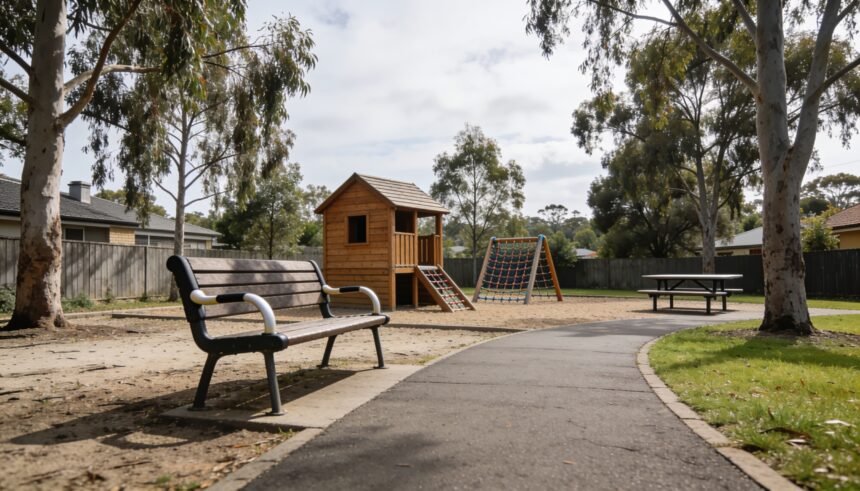
A genuinely good playground offers play your children want to use, access that works for your household, and the facilities you need for the visit. When deciding what to look for in a playground, start with those three things before letting a photograph of the biggest slide settle the choice.
Look for different ways to play
Compare the activities available, rather than counting pieces of equipment. Look for a mix that suits your children: movement, make-believe, things to explore and somewhere to pause.
NSW Government’s Everyone Can Play guidance includes imaginative play, sensory elements and quiet spaces alongside more active options. Its equipment guidance also recognises that the surrounding landscape contributes to play.
For your shortlist, ask what each child would choose first and what they could do next. A climbing structure might be the main attraction for one child; another might prefer a pretend shop or a sand area. Neither preference needs to win the whole outing.
A useful comparison: would you choose a park with several similar climbing structures, or one with a smaller climber, a play shop and a garden to explore? Choose the mix your children would actually use. More equipment is only useful if it adds something they want.
Check the route all the way into play
Getting through the entrance is only part of access. NSW’s equipment guidance considers whether people can reach and use the play features, including the surfaces around them. Its practical inclusion tips also emphasise connecting paths to seating and picnic areas.
If someone in your group uses a wheelchair, mobility aid or pram, check the complete route you would take. That means the arrival point, entrance, chosen activities and somewhere to sit together.
Treat a general description such as “accessible playground” as a starting point for questions. Ask the council about the particular feature you need: a step-free route to a play area, space beside a picnic table or the toilet facilities. Match the details to your household rather than assuming a label answers everything.
Give the adults’ needs a place on the list
NSW guidance includes shade, seating and clear views across play areas. Its practical tips recommend supportive seats with backs and armrests, plus connections between paths and places to rest.
Check where those features sit in relation to the activities your children would choose. A shaded bench at the far end of a reserve may not be the spot you want for this visit. Look at wide photographs or a site plan as well as close-ups of equipment.
For a grandparent joining the outing, make a suitable seat part of the choice from the beginning. For siblings with different interests, consider whether their preferred areas are close together. These are useful reasons to favour a compact layout over a larger destination.
Match the facilities to the visit
NSW’s inclusion tips identify picnic settings, drinking fountains, bins, toilets and changing amenities as supporting features, particularly at larger destination playgrounds. You do not need to make every facility a requirement for every outing.
Use the following as an editorial comparison, adjusting it to your household.
| The visit you want | Put these details first | A possible compromise |
|---|---|---|
| A short play close to home | Convenient route and a favourite activity | A smaller range of equipment |
| Siblings choosing different activities | Variety and a layout that keeps their interests nearby | Less spectacular individual structures |
| Play followed by a packed lunch | A usable eating spot and the toilet facilities you need | A longer journey if it suits your day |
| A visit with particular access needs | Confirmed routes, usable activities and suitable amenities | Fewer destinations on the shortlist |
| A quieter outing | A place to pause and alternatives to busy group activities | Skipping the park with the biggest attraction |
One playground does not have to provide everything. The NSW guidance makes that point about local playground networks; for a household, it is permission to choose different parks for different kinds of visit.
Check the details before making a special trip
Start with the council’s park listing, then look for a map, facility descriptions and any closure notices. If a toilet, changing facility or particular play feature is essential, confirm that detail with the operator when the listing is unclear.
For a hypothetical after-school visit, you might favour the nearby park with one favourite activity. For a weekend picnic, you might accept more travel for the seating and amenities you need. Neither choice requires calling one park universally better.
Next: write down three must-haves for your next outing, then compare two playgrounds against them. Choose the one that meets those needs with the most manageable journey.
How we checked this
Checked on 21 September 2026 against NSW Government’s Everyone Can Play guidance. The family comparisons are editorial suggestions based on those design considerations. No playground visits or equipment testing are claimed.
The one-page family week
One printable page that holds the whole week: meals, school, activities and who is doing the pickup. Free, and we send one useful email a week.
One email a week. No spam, unsubscribe in a click.