
What is in this guide
Missed school notices are not a memory problem and they are not a character flaw. They are a structural problem, and the structure is this: notices arrive through five or six different channels, none of which contains all of them.
The app has some. Email has others. A paper note is in the bottom of the bag. The newsletter mentioned it once. Another parent posted it in a group chat. The teacher said it at pickup.
No amount of trying harder fixes a system with six inboxes and no destination. What fixes it is a pipeline: every channel empties into one place, and that place is a calendar.
The four places notices actually disappear
Worth naming, because the fix targets each one.
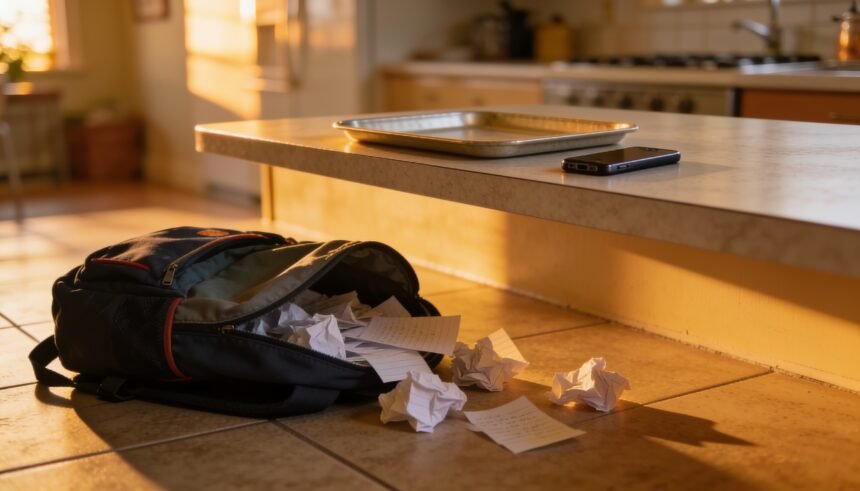
The bag. Paper notes that are never taken out. This is still the largest single loss point in primary school despite everything being digital.
The app notification. Read on a phone while doing something else, dismissed, and gone. Reading a notice is not the same as recording it, and the moment of reading is exactly when the recording does not happen.
The email that was read on a phone. Same failure, plus the email is now marked read so it never resurfaces.
The newsletter. A single mention of something four weeks out, in a document nobody opens twice.
The pipeline
Four steps. The whole system is that every notice must reach step three or be deliberately discarded at step two.
Step 1: Collect
One bag check, at the same time every day. After school or after dinner, but the same time, done by the same person or by the child as part of their routine. Everything comes out: notes, forms, readers, the lunchbox.
Turn on notifications for the school app and leave email alerts on. This is the one context where more notifications is correct, because the alternative is missing something.
Do not rely on the group chat. It is useful as a backstop and it is not a channel you can build a system on, because it is unstructured and it is not from the school.
Step 2: Triage, daily, in about two minutes
Every item is one of four things:
A date. Excursion, camp, photos, dress-up day, assembly, sports carnival, parent-teacher night. Goes to step three immediately.
A task with a deadline. A form to sign, a payment, a permission slip, a costume to find. Goes to step three as a date, set two days before the actual deadline.
Information with no action. Curriculum update, a policy change, a principal’s letter. Read it and bin it, or file it if it is a policy you will want later.
Nothing. Most of it. Bin it now rather than putting it on the bench.
The discipline is binning at this step. A pile of undecided paper on a kitchen bench is where a system dies, because everything in it has to be re-read.
Step 3: Record, in the one calendar
The rule is absolute: if it is not in the calendar, it does not exist.
Use the child’s colour, so a glance shows who it affects.
Enter the event and a reminder with lead time. Anything needing a purchase gets a reminder two weeks out. Anything needing a booking gets a month. A dress-up day gets a week, which is how long it takes to discover you do not own a pirate costume.
Put the deadline two days early. Forms due Friday go in the calendar on Wednesday. This absorbs the day everything goes wrong.
Record the payment amount in the entry if there is one, so the money side is visible when you look at the week.
Step 4: Review, ten minutes weekly
Sunday evening, or whenever the week actually starts for your household.
Look at the week ahead in the calendar. Out loud, with the other adult if there is one. This is the single highest value ten minutes in the household week and it catches everything the daily triage missed.
Check the app and email for anything that arrived and was not processed.
Look two weeks ahead as well, because that is where the things needing a purchase or a booking are.
The paper problem
Paper notes need a physical destination or step two does not happen.
One tray or one spot, emptied at every triage. Not a pile, a tray with a rule that it is empty by the end of the triage.
Photograph anything you might need later and bin the paper. A photo in a phone album is more findable than a piece of paper in a drawer.
Forms that need signing get signed immediately and go straight back into the bag. The gap between signing a form and returning it is where most late forms are lost. Sign it and put it in the bag in the same motion.
The two-household version
Split households have the same pipeline with one addition: the calendar has to be shared and both households have to write into it.
Whichever household received the notice records it. Notices that arrive at one house and not the other are the most common failure here, so it is worth asking the school to send communications to both parents, which most Australian schools will do on request.
What to do with what you keep
A term generates a surprising volume of things you might want later: reports, medical forms, the permission slip that has the camp details on it. The family paperwork system covers what is worth keeping and for how long.
The common mistakes
Two calendars. Both incomplete. One must be the master.
Recording the event but not the preparation. The excursion is Thursday, but the thing you needed to know was that a packed lunch and a hat were required, which was in the note. Put the requirement in the calendar entry, not just the event.
Reading the app instead of processing it. Reading is not recording, and the feeling of having dealt with something is exactly the problem.
Leaving it all to one parent. The person who does the triage holds the entire school year in their head, which is both unfair and fragile. It should be in the calendar, where anyone can see it.
Starting a new system mid-term. Start it at the beginning of a term. Setting up the family year in January is the annual version of this.
Next: setting up the family year in January covers the dates you can know in advance, the family paperwork system covers what to keep, and the back to school checklist covers the start of the year.
If the next step is buying the board rather than deciding what goes on it, family planners and command centre boards covers what to look for and the mounting problem in a rental.
The one-page family week
One printable page that holds the whole week: meals, school, activities and who is doing the pickup. Free, and we send one useful email a week.
One email a week. No spam, unsubscribe in a click.