What is in this guide
Choose five familiar lunch combinations, assign them to the days people need a packed lunch, and repeat the pattern next week with small changes. A useful lunchbox rotation for family life records who needs lunch, what is planned and who packs it, so another person can follow the same plan.
Start with your household’s existing favourites. You do not need five new recipes or matching lunches for everyone. The example below provides a planning pattern, with room for different appetites, preferences and school arrangements. It is not a complete nutrition plan or a direction to prepare five days of food at once.
1. Count the lunches before choosing the food
Write Monday to Friday across a page and list each person underneath. Mark whether they need a packed lunch, will eat at home or have another arrangement. Include work lunches if they belong in the same household shop.
A child with a planned canteen lunch on Wednesday does not need a duplicate packed main. An adult working from home may want the same ingredients without needing a container. Record these differences before choosing quantities.
For a household with weekend shifts or activities, add Saturday and Sunday using the same columns. Otherwise, leave those days outside the packed-lunch rotation. A week-long plan should reflect your week rather than create extra packing jobs.
Put excursions, changed work shifts and other exceptions beside the day they affect. If your commitments already live on a one-page family week planner, add the lunch count there instead of maintaining a second calendar.
2. Give each day a familiar starting point
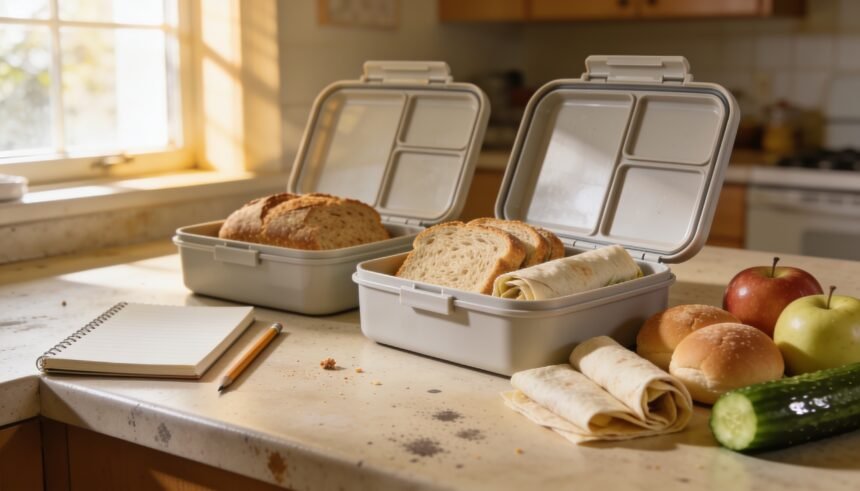
Choose a few main formats people already eat, then assign them to days. Repeating a format is fine. Two sandwich days can have different fillings, or the same filling if that is what someone wants.
Here is an illustrative school-week rotation. Choose fillings and accompanying foods that suit your household’s existing requirements and the school’s current instructions. Quantities depend on the person eating; the table is an organising example, not a serving guide.
| Day | Main to write on the plan | Accompanying food examples | Planning note |
|---|---|---|---|
| Monday | Familiar sandwich | Usual fruit and chosen snack | Start with an established favourite |
| Tuesday | Wrap with an accepted filling | Preferred vegetables and snack | Use a filling that also suits a sandwich |
| Wednesday | Bread roll | Fruit and another usual lunch item | Change the bread format without requiring a new recipe |
| Thursday | Separate bread, spread and other familiar components | Usual fruit or vegetables | Use this option for someone who prefers components apart |
| Friday | Repeat the week’s preferred main | Accompaniments selected from the shopping plan | Keep a repeat available instead of requiring a fifth new idea |
Write the actual filling beside each person’s name. “Sandwich” alone leaves the packer with another decision. “Usual cheese sandwich, apple, chosen snack” is a more usable instruction where those foods suit that person.
For someone who wants different main formats, choose an option from lunchboxes that are not sandwiches. Keep recipe exploration separate from the weekly allocation: first choose something acceptable, then give it a day.
3. Share ingredients without insisting on identical lunches
Look across the plan for ingredients used more than once. Bread might appear on Monday and Thursday, while a familiar filling works in both Tuesday’s wrap and Wednesday’s roll. That gives each purchased item a named use without requiring everyone to eat the same combination.
For siblings with different preferences, try a shared base with one recorded variation. One might want the filling inside the bread while another wants it separate. Write both versions down rather than expecting whoever packs to remember.
Avoid adding an unfamiliar ingredient solely to make the table look varied. If nobody wants it, replace the entry with an accepted repeat. There is no requirement for a different fruit or main every weekday.
The trade-off is repetition. Some households welcome a predictable lunch; others want two or three alternatives. Agree on that range before shopping so variety has a place in the plan rather than becoming a morning negotiation.
4. Turn the rotation into a counted shopping list
Check the ingredients already at home, then total the missing amounts against the actual lunch entries. Count the things you can count directly, such as wraps, rolls or individual pieces of fruit. For fillings, use the amount your household normally puts in those lunches rather than guessing from the number of days.
For example, if two people each choose one wrap on Tuesday and one on Thursday, those entries require four wraps. That is an arithmetic example, not a recommended portion. Change the calculation when someone usually eats more or has another lunch arrangement.
Keep lunch quantities distinguishable from dinner ingredients. If the same bread or filling is also planned for meals at home, include those uses before deciding what is missing. Otherwise, the written lunch plan may depend on ingredients already allocated elsewhere.
Choose one familiar fallback and include its requirements too. It can be a repeat of Monday’s lunch. A fallback requiring a separate shopping trip is less useful on the morning the original plan falls through.
5. Assign the jobs as well as the menu
Beside each day, name who checks supplies, who packs and who confirms the lunch is ready to leave. One person can do all three, but write the arrangement clearly when adults share the task or work different shifts.
Children can choose between agreed options or help with a particular packing step where appropriate. Give a concrete task, such as finding their container or checking the written choice, with whatever help they need. The routine should not depend on a child managing the whole job alone.
Place the plan where the packer will use it. That might be a kitchen cupboard door or the household’s family command centre. A single shared note is enough; no new organiser is required.
Use an existing evening household reset to check tomorrow’s attendance, locate containers and flag missing ingredients. Keep that organisation check distinct from deciding when particular foods should be prepared or packed.
6. Review what changed before repeating the week
At the end of the week, ask which lunches people wanted again, which entries changed and whether the quantities matched what was needed. If food came home, ask what happened before changing the menu. Record the explanation rather than assuming the food itself was the problem.
Make specific edits: replace Tuesday’s filling, reduce the roll count for a work-from-home day, or assign Thursday’s packing to the person actually at home. Leave successful entries in place. Rewriting the whole rotation would remove the repeatable part you have just established.
For next week, copy the five days, update attendance and name one familiar main for each packed lunch. Then check the missing ingredients and agree who will handle the next packing job.
The one-page family week
One printable page that holds the whole week: meals, school, activities and who is doing the pickup. Free, and we send one useful email a week.
One email a week. No spam, unsubscribe in a click.