
What is in this guide
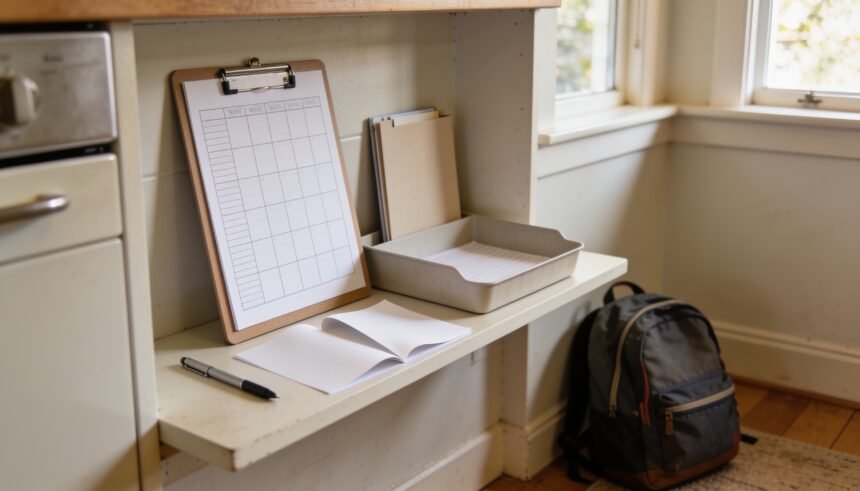
Build your family command centre around three things: this week’s plan, actions with a named owner, and a place for paper that still needs attention. Put it where your household already pauses, choose one calendar as the master, and agree when everyone will check and update it.
Start with a sheet of paper, a pen and a tray or folder you already own. Try the arrangement before adding anything permanent. If you are collecting family command centre ideas, use them to solve a specific daily problem: who is doing pickup, what needs returning, or what must be packed tomorrow.
1. Choose the problem before the position
Ask the people who will use the station what they need to find without asking someone else. Pick a short starting list. For example:
- Who is collecting each child today?
- What needs to leave the house tomorrow?
- Which household task needs a decision this week?
Then choose the location around those questions. For packing and returning items, try the place where bags are unpacked. For shared planning, try a kitchen spot people can read without moving a pile of belongings.
Walk through the normal arrival-home routine before deciding. Can someone put a note down, read tomorrow’s plan and find the pen from that position? Keep doorways and working bench space clear.
In a rental or small flat, begin with a folder on an existing shelf or a clipboard stored beside the paper tray. You do not need to attach anything to a wall to try the system.
2. Give the station three clear jobs
Use these zones as a starting layout. They can occupy one sheet and one folder; they do not need separate boards.
| Zone | Put here | Keep elsewhere |
|---|---|---|
| This week | Changes to the usual routine, pickups, activities and things to bring | The full year’s dates |
| Action needed | A specific next step, its owner and its due date | Vague reminders such as “school stuff” |
| Paper to process | Forms or notes awaiting a decision or return | Finished work and long-term records |
Give paper an exit as well as an arrival point. Once a form is ready to return, place it in the relevant bag. Move records you need to keep into your filing system. The family paperwork guide covers the separate question of what to retain.
Leave meal plans, chore lists and shopping lists out of the first version unless one is the problem you chose to solve. Add a section only when someone can explain what they will use it for and who will maintain it.
3. Decide which calendar holds the complete plan
Choose one master calendar for future commitments. That might be paper or digital. If you also display a weekly view, treat it as a copy of selected information, with a named person responsible for refreshing it.
| Arrangement | Choose it when | Maintenance to agree on |
|---|---|---|
| Paper master at the station | Planning usually happens at home and everyone can read it there | Record commitments made while out when you return |
| Shared digital master | Adults need to check the plan away from home | Agree who enters changes and how others are told |
| Digital master plus paper weekly view | Adults plan on phones but children need a visible home view | Update the weekly sheet after a relevant calendar change |
Avoid copying every detail into both places. A weekly sheet might show “Thursday: swimming, pack towel” while the master holds the booking details.
For a same-day pickup change, contact the adult involved and get confirmation. Updating the station is an additional record, not confirmation that the person has seen or accepted the change.
4. Write actions someone can finish
Give each task an owner, a next step and a deadline. These are illustrative entries, not a real household schedule:
| Instead of | Write |
|---|---|
| Library | Child: put library books in bag Wednesday evening |
| Excursion | Parent: submit permission form by Tuesday |
| Sport | Collecting adult: confirm Saturday lift by Thursday |
Ask the person before assigning the task. Where a child needs help, make that part visible too: “Pack swimming bag with an adult after dinner.”
Raising Children Network describes family routines as a way to clarify responsibilities and timing. It also recommends roles that feel fair and involving children in planning as they grow older. Apply that here by agreeing on the jobs together, rather than presenting everyone with a finished roster.
In a household with one adult, name the action just as clearly, but keep the list within what is manageable. The station does not need a task in every box.
5. Introduce it with tomorrow’s actual plan
Show each person where to find tomorrow’s information and where to put something that needs attention. Ask them to locate one relevant item. If they cannot find it, change the layout or wording before adding more detail.
Use names or initials alongside any colour coding. For a child who is not reading yet, try a simple drawing for the item they need, and explain it together. Keep adult coordination tasks with the adults.
If school messages are the missing input, use the school notices system to organise how they reach the calendar. This station is where the agreed plan becomes visible; it does not replace checking the original notice.
6. Attach the reset to something you already do
Choose a repeatable moment, such as after weekend breakfast or when the next work roster arrives. At that reset:
- Remove completed actions and last week’s information.
- Check the master calendar for the coming week and any preparation needed beyond it.
- Agree who handles each pickup or task that needs coordination.
- Process the paper tray and return ready items to bags.
- Write the date of the next reset on the weekly sheet.
For shift work, plan around the roster rather than insisting on Sunday night. For two households, agree which information needs sharing and through which existing channel; keep each home’s local packing list separate if that is clearer.
What should you change if it is ignored?
Use the first week as a trial, not a deadline for forming a habit. Check the specific obstacle before replacing the whole setup.
| What you notice | Change to try |
|---|---|
| People still ask who is doing pickup | Make pickup arrangements a clearly labelled line |
| The weekly view disagrees with the calendar | Reduce copied details and clarify who updates the view |
| Paper stays untouched | Give processing it a named owner and a routine moment |
| One person rewrites everything | Ask each capable participant to maintain their agreed part |
| Nobody looks at the station | Revisit the location and whether its information is useful |
Start today with tomorrow’s arrangements, one pending action and a place for incoming paper. Choose the first reset time with the people who will use it.
How we checked this
Reviewed on 21 September 2026 against Raising Children Network’s guidance on family routines. The layouts, sample entries and trial period are Dovelyne editorial suggestions. No household trial or product testing was conducted, and continued use is not guaranteed.
The one-page family week
One printable page that holds the whole week: meals, school, activities and who is doing the pickup. Free, and we send one useful email a week.
One email a week. No spam, unsubscribe in a click.