What is in this guide
- 1. Walk through an arrival before choosing the spot
- 2. Choose a layout that fits the pause
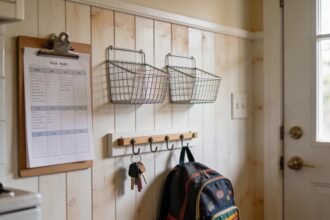
- 3. Display what someone needs before leaving
- 4. Give incoming paper a different destination
- 5. Reserve the outgoing spot for the next departure
- 6. Check it before the morning departure
- Try it for a week before adding more
Set up a family command centre near the front door with a short tomorrow list, a place for incoming paper and a separate spot for things ready to leave. Use an existing surface or folder first, and position it where you can pause without standing in the doorway.
Keep its job narrow: help people arrive, put down what needs attention and collect the right things on the way out. The general family command centre guide covers the complete planning system. This doorway version brings only the relevant part of that plan to the point of departure.
1. Walk through an arrival before choosing the spot
Come in carrying what you normally bring home. Notice where you put your bag, where you take off your shoes and where you could comfortably read a note. Then walk out with tomorrow’s likely load. Can you reach the proposed station without putting everything down again?
Try a position beside the door rather than behind its opening swing. Open the door fully during the trial, and check the arrangement with bags in place. Leave the passage clear rather than using it as overflow storage.
If the household mainly enters through the garage or laundry, put the working station there. You can keep the front entry simple for visitors. There is little reason to maintain two identical boards unless someone has a clear job for each.
Before adding furniture, separate this decision from the storage question. The small entry drop zone guide deals with where bags, hats and shoes belong. Your command centre needs to sit alongside that arrangement, not take over every available surface.
2. Choose a layout that fits the pause
Start with things you own. A sheet in a folder, an envelope for incoming notes and a defined section of an existing shelf are enough to trial the arrangement.
| Available space | Layout to try | Trade-off |
|---|---|---|
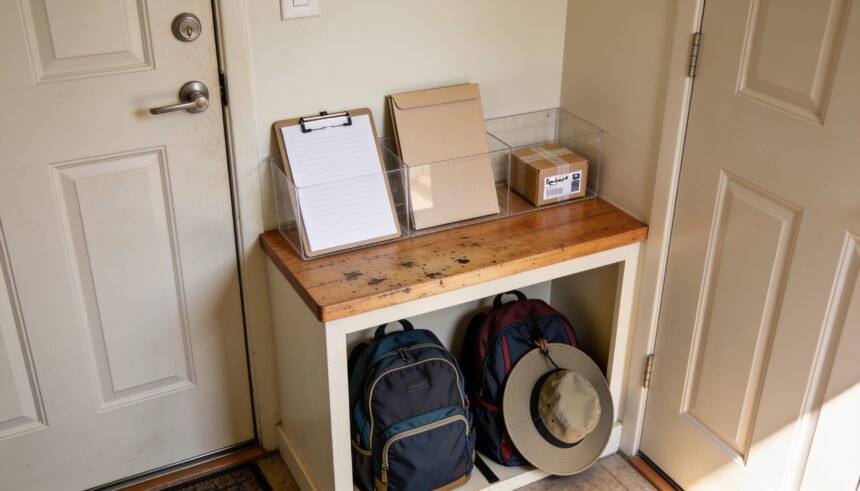
| An existing entry shelf | Tomorrow sheet at the back, incoming folder beside it, outgoing items in front | Limit the outgoing pile so the sheet stays visible |
| A narrow hallway with no surface | Keep a slim folder at the nearest existing bag-storage spot | Someone needs to open the folder to check it |
| An entry opening straight into a living room | Use one end of an existing shelf just inside the room | Make the boundary clear so unrelated items do not join it |
| A shared or frequently visited entrance | Display a brief departure list and keep detailed paperwork in a closed folder elsewhere | Adults may need to consult the private plan separately |
If you rent or are still deciding on the location, keep the trial portable. A wall display is optional. Do not add a new cabinet simply to hold a page that could sit on an existing surface.
3. Display what someone needs before leaving
Give the sheet a specific heading such as “Tomorrow, Thursday”. Add the date when there could be confusion. Choose entries that change what a person carries, when they leave or which adult handles a departure.
These are illustrative entries:
- Sam: library books in school bag.
- Alex: swimming towel in activity bag.
- Leaving adult: take the sealed return parcel.
- Friday morning: earlier departure agreed with collecting adult.
Keep appointment details, contact numbers, booking references and the full work roster in the main calendar or private folder. The doorway sheet only needs the instruction relevant to leaving home. Consider what a visitor could read from the open door before putting family details on display.
Choose one person to refresh the sheet, or agree which line each adult maintains. When tomorrow’s plan changes, update the sheet after confirming the arrangement with the person involved. A written pickup change is not a substitute for that conversation.
For children, use wording they understand and ask them to show you where their reminder is. A simple drawing can accompany the words if useful. Keep adult coordination responsibilities with adults rather than asking a child to interpret the household calendar.
4. Give incoming paper a different destination
Put an envelope, pocket or closed folder beside the sheet for paper that still needs attention. Do not mix it with signed forms or packed bags that are ready to leave.
Agree what happens when a school bag is unpacked. For example, the child puts a paper notice in the incoming pocket, then the responsible adult reads it at the agreed checking time. Digital notices stay in their existing channel until an adult turns them into an action or calendar entry.
The school notices system covers that processing step in more detail. Here, the important boundary is between “needs a decision” and “ready to return”. Once a form has been completed, move it into the relevant bag rather than leaving it beside unopened notes.
Give other arrivals an onward destination too. Put a lunchbox where it will be emptied and washed; put a wet towel where it will be dealt with. The entry station is a handoff point, not storage for everything carried through the door.
5. Reserve the outgoing spot for the next departure
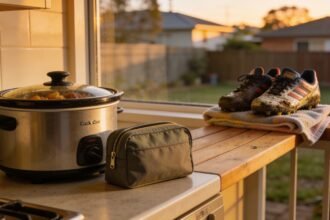
Use a small, clearly defined space for loose items that must leave next. A return parcel, borrowed book or activity bag might belong there. Everyday school bags can stay in their usual storage position with the extra items already packed inside.
Attach the destination to anything ambiguous. A borrowed book with no reminder may need a note saying who should take it. Keep that note inside the outgoing folder if you do not want names visible at the entrance.
Avoid creating a general donations pile here. A bag with no collection or delivery plan can go in longer-term storage until a departure is arranged. Likewise, next month’s excursion equipment does not need to occupy tomorrow’s space.
Where children leave for different schools or activities, give each person’s ready items a distinct position. Use names as well as any colours. In a very small entry, pack items directly into bags and let the station hold only the reminder sheet and incoming folder.
6. Check it before the morning departure
Choose a moment when someone can act on the list, such as after unpacking school bags or before the evening routine finishes. Checking while everyone is already putting on shoes leaves little room to find a missing towel or complete a form.
At that check, read tomorrow’s line, pack what is ready, identify anything still missing and remove reminders that no longer apply. Agree who will handle the unfinished item. If your household already uses an evening reset routine, add this check to that existing moment.
For shift work, use the next departure rather than a fixed evening time. For children moving between households, display only what needs to leave this home and confirm shared arrangements through your agreed adult communication channel.
Try it for a week before adding more
Use one ordinary school or work week as a suggested trial. Look at specific problems: was the list unreadable behind a bag, did unprocessed paper end up in the outgoing spot, or was the station at a door nobody used?
Change the part that caused the problem. Move the sheet, reduce its contents or pack return items straight into bags. Add another section only when someone can explain what it is for and who will maintain it.
For the first setup, write tomorrow’s departure reminders and choose the incoming and outgoing destinations. Walk through the door with your normal bag once more before leaving the arrangement in place.
How we checked this
Reviewed on 7 October 2026 against the topic scope and neighbouring Dovelyne coverage. The layouts, examples and suggested trial are editorial recommendations. No household trial, product testing or measured time-saving assessment was conducted.
The one-page family week
One printable page that holds the whole week: meals, school, activities and who is doing the pickup. Free, and we send one useful email a week.
One email a week. No spam, unsubscribe in a click.