
What is in this guide
- The problem nobody had thirty years ago
- Ages three to five: money is finite
- Ages six to eight: earning and waiting
- Ages nine to twelve: choices and comparison
- Ages thirteen to fifteen: the real money conversation
- Ages sixteen to seventeen: independence mechanics
- The lesson almost everyone skips
- Where to get material
Money lessons fail when they are pitched at an age that cannot use them. Explaining compound interest to a six year old is a pleasant conversation that changes nothing. Handing a fifteen year old their first ever budgeting responsibility is roughly a decade late.
The sequence below is ordered by what a child can genuinely do at each stage. It contains no products, no accounts and no apps, because a money education that arrives attached to a financial product is marketing.
The problem nobody had thirty years ago
Australia is close to cashless, and that has removed the best teaching tool there was.
When a five year old handed over a note and received coins back, they learned that money is finite and that spending reduces it. A card transaction teaches none of that. To a young child, a card is a thing that always works, which is precisely the wrong lesson.
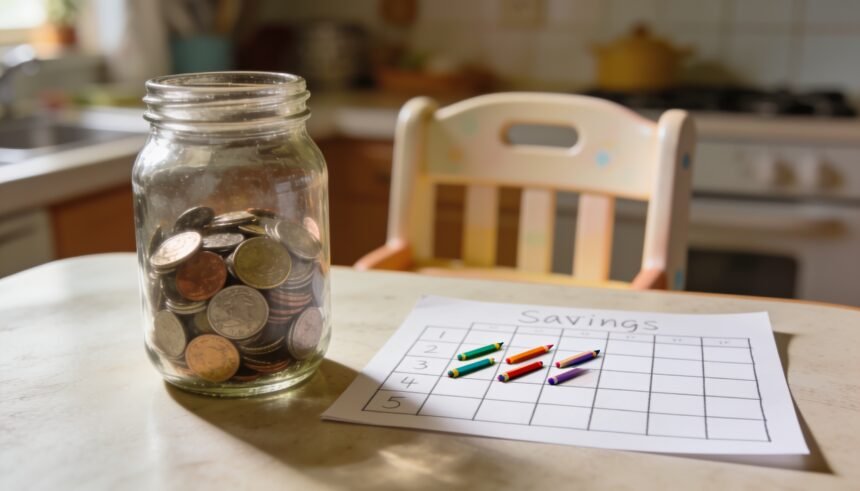
The practical fix is to deliberately use cash with young children even though you personally do not. Pocket money in coins, a physical jar, and a real transaction at a real counter where they hand it over and watch it go. This is artificial and it is worth doing anyway, because the concept has to land physically before it can land abstractly.
From about ten, the reverse applies and digital becomes the more useful teacher, because that is the world they will actually operate in.
Ages three to five: money is finite
The concept: things cost money, money runs out, and you cannot have everything.
What works: a coin jar they can see and touch. Letting them pay at a counter and take the change. Naming the trade out loud: “if we buy that, we are not buying the other thing.”
What does not work: any explanation involving saving for the future. Three year olds have no meaningful concept of next month.
The realistic goal is that a child understands that the jar empties. That is enough at this age and it is the foundation of everything after it.
Ages six to eight: earning and waiting
The concept: money comes from somewhere, and waiting gets you something better.
What works: regular pocket money, in cash, on a fixed day. Two jars, one for spending and one for saving towards something specific the child chose. A visible chart marking progress, because six year olds cannot hold an abstract goal but can absolutely follow a chart.
The critical move at this age is to let them buy something bad. A child who spends three weeks of savings on a toy that breaks in two days has learned something no lecture can teach, and the cost of the lesson will never again be this low. Intervening prevents the lesson.
What does not work: paying for everything. If chores are all paid, nothing is done because it needs doing. A common split is that basic household contribution is unpaid and extra jobs can be paid.
Whether pocket money should be tied to chores at all is a genuine parenting disagreement with reasonable people on both sides. Kids pocket money: how much, how often and for what goes through it.
Ages nine to twelve: choices and comparison
The concept: money is a set of trade-offs, and prices are not fixed facts.
What works: giving them a real budget for something that matters to them. A birthday party budget, a holiday spending money amount, the school clothes budget. Real money, real constraint, and they keep what is left.
Price comparison becomes teachable here. Take them to a shop, compare two versions of something, work out cost per unit. Children of this age find this genuinely interesting, which they will not at fifteen.
This is also the right age for the advertising conversation. Explain that advertising exists, that influencers are paid, that in-game purchases are designed to be easy, and that the design intent is to separate you from money. Children of this age are the direct target of a great deal of it and are old enough to be indignant about it, which is an effective motivator.
What does not work: abstract savings goals without a specific object. “Save for the future” means nothing at ten. “Save for the bike” works.
Ages thirteen to fifteen: the real money conversation
The concept: what things actually cost, including the ones you do not see.
What works: telling them the truth about household costs. Not the whole picture if that is uncomfortable, but real numbers for things they use. What the phone plan costs. What their sport costs a season. What groceries cost for the family each week. Teenagers consistently guess low by a very large margin and the correction is genuinely useful.
A larger, less frequent allowance covering things they now have to manage: transport, some clothes, social spending. Monthly rather than weekly, because running out in week two and living with it is the lesson.
First job conversations. Many Australian teenagers start work at this age. Pay rates, tax file numbers, superannuation, payslips and the fact that an employer must pay correctly are all real and immediately relevant. Fair Work Australia publishes pay rate information and is the authority to point them to.
What does not work: taking over when they run out. The whole value is in the shortfall.
Ages sixteen to seventeen: independence mechanics
The concept: the systems adults actually operate in.
What works: reading a payslip properly, including tax, super and what a deduction is. Understanding what a contract commits you to. Knowing what interest means on money borrowed rather than saved. Learning that buy now pay later arrangements are credit arrangements regardless of how they are presented.
Practical admin skills: how to check a bank statement, how to query a charge, how to recognise a scam, and what to do about one. Scam awareness is arguably the single highest value money lesson for this age group, and Scamwatch, run by the National Anti-Scam Centre, is the Australian reference.
What does not work: starting here. Everything in this section assumes the earlier stages happened.
The lesson almost everyone skips
Talking about money at all.
Many Australian households treat money as private to the point of silence, and children raised in that silence arrive at eighteen with no framework, no vocabulary and no idea what anything costs. The single most effective intervention is not a particular lesson at a particular age. It is that money is discussed openly and unanxiously in front of children, including the trade-offs and occasionally the mistakes.
Children do not need to be told the household is struggling. They do need to hear an adult say “that is more than I want to spend” without embarrassment, and they need to see a decision being made rather than just an outcome.
Where to get material
Moneysmart, run by ASIC, publishes free money guidance including material aimed at teaching children and teenagers, with nothing being sold. Financial capability also appears in the Australian Curriculum, so schools cover some of this, though the depth varies considerably.
This article names no bank, account, app or product deliberately. A great deal of children’s money education material in Australia is published by financial institutions and ends at an account application. Free independent material exists and is better.
Next: a family budget that survives a real month is the adult version, Christmas and back to school covers the spending spikes children notice, and what back to school actually costs per child is a good real number to show a teenager.
The one-page family week
One printable page that holds the whole week: meals, school, activities and who is doing the pickup. Free, and we send one useful email a week.
One email a week. No spam, unsubscribe in a click.