What is in this guide
One baking session covers several weeks of lunchboxes, and the whole thing depends on freezing it correctly rather than on the recipe.
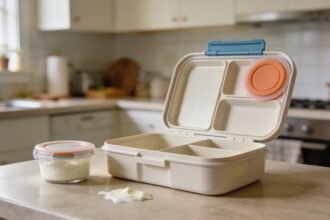
The key move: freeze in single serves and pack it frozen. A frozen muffin packed in the morning is thawed by recess, and on the way there it keeps the rest of the lunchbox cold, which matters considerably in an Australian summer as covered in keeping lunchboxes cold.
Before anything: the school’s rules
Most Australian schools operate nut-aware or nut-free policies and many have rules about specific foods. Some also restrict certain items entirely.
Check your school’s current policy before you plan a baking session, because a batch of something that cannot go to school is a wasted morning. The policies differ between schools and change, and the school is the only authority on its own.
If there is an allergy in your own household, or you are baking for a class event, that needs proper handling rather than a general article. ASCIA publishes Australian allergy guidance and the family of an allergic child is the source for what is safe for them.
Practical substitutions that usually satisfy a nut-free policy: seeds instead of nuts where texture is the point, and checking labels for “may contain” statements, which are common on dried fruit and chocolate.
What freezes well
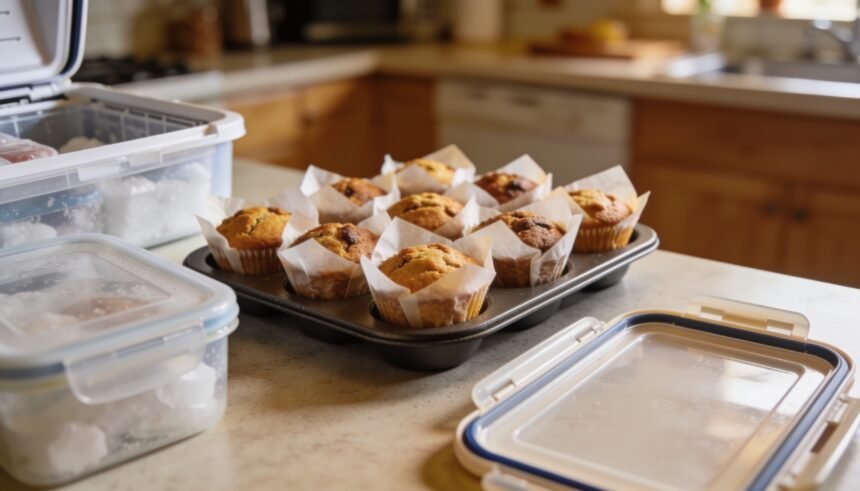
Muffins. The most reliable item on this list. Savoury and sweet both freeze well, thaw quickly and hold their texture.
Slices with a cake or oat base. Anything dense and cakey survives. Oat-based slices freeze particularly well.
Scrolls and savoury pinwheels. Cheese and vegemite, ham and cheese, pizza scrolls. Freeze individually and they thaw by mid-morning.
Pikelets and pancakes. Freeze flat with baking paper between them.
Banana bread, sliced before freezing so single pieces come out.
Savoury muffins and mini frittatas. Underused and a genuine improvement on a lunchbox of sweet things.
Bliss balls and oat balls. Freeze solid, thaw fast, and are the closest homemade equivalent to the bought bars.
Bread and wraps, which most people already do.
What does not freeze well
Worth stating plainly so a batch is not wasted.
Anything with a cream or custard filling, which separates.
Icing, particularly a glaze, which goes sticky and wet on thawing. Ice after thawing if it matters.
High-water fruit inside a cake or muffin, such as fresh strawberry, which goes mushy. Frozen berries added to the batter are fine.
Anything crisp. Biscuits, crackers and anything meant to snap will soften.
Meringue and anything aerated in that way.
Fresh salad components, obviously, and it is worth saying because people try.
Freezing it properly
Cool completely first. Freezing anything warm creates ice crystals and a soggy result, and it also raises the temperature of the freezer.
Freeze in single serves. The whole point is grabbing one in the morning. A frozen block of twelve muffins is not a school morning.
Wrap individually, then bag. Baking paper or a reusable wrap, then all of them together in one container or bag. Individually wrapped items do not stick together and do not take on freezer smell.
Freeze flat and in a single layer first for anything soft, then transfer to a container once solid.
Label with what it is and the date. An unlabelled frozen item is discovered in eight months and thrown out.
Use within a reasonable period. Follow general freezer storage guidance, and Food Standards Australia New Zealand publishes Australian food safety guidance on storage and thawing.
Packing it
Straight from the freezer into the lunchbox, unwrapped from the freezer wrapping if you prefer.
It thaws by recess in most conditions, and faster in summer.
It works as an ice pack on the way. A frozen muffin against a sandwich keeps the sandwich cooler through the morning, which is a real benefit in an Australian February.
Do not refreeze anything that has thawed and come home again. If it comes back untouched and soft, it goes in the fridge for that afternoon, not back into the freezer.
Making the session worth it
Bake two or three different things in one session, so the lunchboxes have variety without three separate mornings.
Double every batch. The effort difference between one batch and two is a few minutes.
Use the same base where possible. A basic muffin batter that goes sweet or savoury depending on what is added means one bowl and one method.
Involve the children, which is a legitimate activity in itself and turns an hour of work into something else. Baking with kids without a two-hour cleanup covers doing it without the mess.
Keep a running list of what worked, because a child who liked something in March will still like it in June.
The honest cost comparison
No figures are given here, because they vary by what you buy and where.
What can be said structurally: homemade baking uses ingredients that are already staples in most kitchens, as in freezer and pantry staples worth always having, and it replaces individually wrapped items which are one of the more expensive ways to buy food by weight. The trade is an hour of your time on a weekend.
The other honest point: homemade is not automatically better nutritionally than a bought equivalent, and a muffin is a cake regardless of who made it. The genuine advantages are cost, packaging and knowing what is in it.
For dietary questions, a GP, dietitian or child health nurse is the right source, not a baking article.
Next: keeping lunchboxes cold covers the temperature problem this helps with, freezer and pantry staples worth always having covers what to keep in, and beating the 5pm what-is-for-dinner panic covers the other end of the day.
The one-page family week
One printable page that holds the whole week: meals, school, activities and who is doing the pickup. Free, and we send one useful email a week.
One email a week. No spam, unsubscribe in a click.