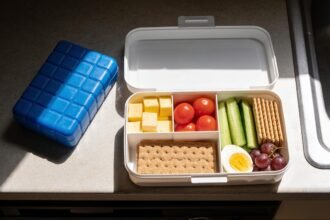
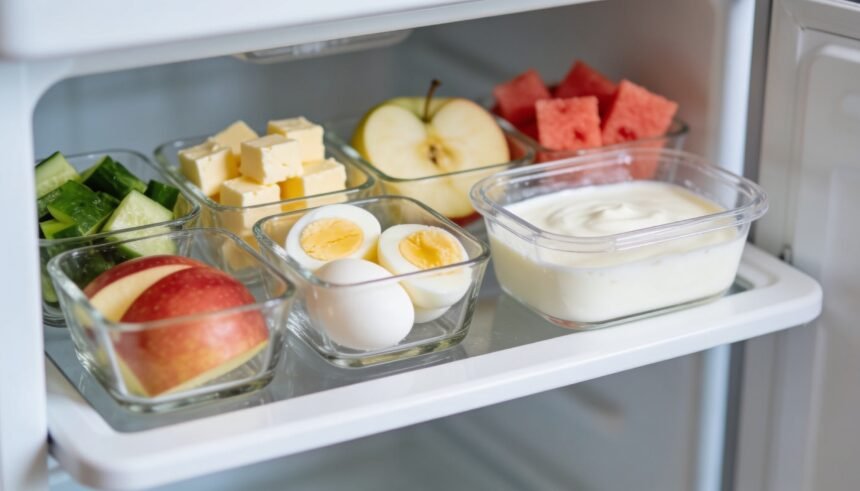
What is in this guide
The afternoon snack has one job: get a child from the end of school to dinner without either a meltdown or a refused meal.
That is a narrower job than it sounds, and it is why the obvious options fail in opposite directions. Something small and sweet is gone in four minutes and they are hungry again by five. Something large is dinner, eaten two hours early.
Most of the problem is solved by what is within reach at 3.30, rather than by anything anyone cooks.
What makes a snack hold
Without getting into nutrition science, which is not what this article is: snacks that keep a child going tend to combine something substantial with something quick, and snacks that vanish tend to be only the quick part.
In practice that means pairing:
- Fruit with cheese, yoghurt or a nut-free spread
- Crackers with something on them
- Toast with a topping that is not only jam
- Vegetables with a dip
The pattern is simply that one thing alone rarely holds, and two things together usually do.
The other half is the size. A snack that is genuinely a small meal will replace dinner in a child who is tired. Keep it modest, and if dinner is late, make the snack slightly bigger deliberately rather than by accident.
The list
Things that require nothing from an adult beyond having bought them:
- Cheese and crackers
- Yoghurt, plain with fruit through it
- Toast with avocado, vegemite and cheese, or hummus
- Apple with a nut-free spread
- Boiled eggs, made on the weekend, peeled
- Cut vegetables and dip, if they are already cut
- A savoury muffin or scroll from the freezer
- Popcorn
- Baked beans on toast, for a child who is genuinely hungry
- Leftover pasta, cold
- Pikelets
- A wrap with whatever is in the fridge
On a hot afternoon, which in much of Australia is most of the school year: frozen fruit, yoghurt, frozen yoghurt tubes, smoothies, cut watermelon, cold cooked pasta. Nobody wants toast in February.
Make it self-serve, which is the actual fix
The system matters more than the food. A child who can get their own snack removes the negotiation entirely, and the negotiation is the exhausting part.
- One shelf in the fridge and one in the pantry that is theirs, at their height
- Everything on those shelves is allowed without asking. That is the whole point, and it only works if you hold it
- You control what goes on the shelves, which is where the actual decision lives
- Portion on the weekend. Crackers into small containers, vegetables cut, eggs boiled, muffins in the freezer
- A whiteboard or a short list of the three or four things available today, if choice paralysis is the problem
Setting this up takes one afternoon and removes a daily conversation for years. It also teaches something useful, which is choosing within a boundary rather than asking permission.
The dinner problem
If the snack is regularly cancelling dinner, the fix is usually timing rather than food.
- Move the snack earlier, straight off the bus rather than an hour later
- Or move dinner earlier. A 5.30 dinner and a small snack often works better than a 7pm dinner and a large one
- Or split dinner. Vegetables and dip at 4 counts as the vegetable component, and a child who has eaten the salad already is a less stressful dinner table
- Serve the snack at the table, not in front of a screen. Eating while distracted means they do not register it and they ask again in twenty minutes
If dinner itself is the flashpoint, that is the 5pm panic rather than a snack problem.
Teenagers
Different animal, same principle.
A teenager comes home hungry in a way a seven year old does not, and trying to hold the line on a small snack is usually a losing position. The realistic approach is to stop treating it as a snack and treat it as a small meal that shifts dinner later, or accept it will be eaten and cook accordingly.
What helps: bulk options they can assemble themselves, leftovers labelled as available, and enough bread and eggs in the house. Trying to ration it tends to produce a second, secret snack.
Keeping the cost down
Snacks are where a grocery budget quietly leaks, because individually packaged things are convenient and expensive per serve.
- Buy the big pack and portion it yourself. The single largest saving available here
- Bake one thing on the weekend and freeze it in portions. Freezer-friendly muffins and slices is exactly this job
- Fruit in season, which is both cheaper and better
- Popcorn from kernels rather than pre-popped
- Use the vegetables you already bought, which otherwise become the ones you throw out on Sunday
The short version
Pair two things rather than serving one. Keep it modest unless dinner is late. Put a shelf at their height, fill it deliberately, and let them serve themselves without asking. Move the timing before you change the food.
The same weekend prep session covers the next morning too, which is where a week of lunchboxes that are not sandwiches comes from.
The one-page family week
One printable page that holds the whole week: meals, school, activities and who is doing the pickup. Free, and we send one useful email a week.
One email a week. No spam, unsubscribe in a click.