What is in this guide
When a payment covers fewer paid hours or days than usual, the earnings lines can shrink, with tax, deductions and take-home pay needing separate checks. Do not assume every figure will fall by the same fraction: first identify the dates and paid time included, then compare each line with an ordinary payslip.
A first payment after starting mid-cycle is a useful reason to do this check. So is a payment after unpaid time away. The aim is to understand what payroll has included and ask about any gap, rather than decide whether a smaller bank deposit looks roughly right.
Establish which part of the cycle was paid
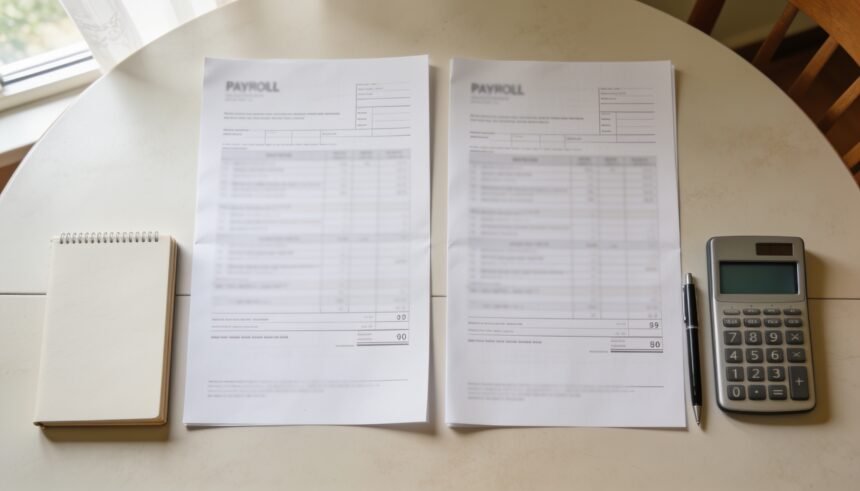
Put the short-cycle slip beside a previous ordinary slip, if you have one. Fair Work Ombudsman’s payslip guidance lists the pay period separately from the payment date. Read both before comparing amounts.
Write down your start or finish date, the dates worked and any approved leave dates. Compare that record with the period printed on the slip. If the printed range does not explain which of those days were included, ask payroll to identify them. A date range alone does not tell you how a salary amount was calculated.
Ask about the payroll cut-off if submitted hours are absent: “Were these dates included in this payment, or are they scheduled for another payment?” Keep that as a question until payroll confirms the answer. Do not assume missing hours will automatically appear next time.
For unfamiliar labels, use the guide to the standard sections on an Australian payslip. Here, the useful comparison is which entries changed and what time each entry represents.
Compare paid units before comparing totals
For an hourly earnings row, place the hours, rate and amount alongside the same row on the ordinary slip. Fair Work’s guidance describes these as distinct pieces of an hourly pay breakdown. Fewer hours at the same rate produces a smaller row amount; a changed rate raises a different question.
Compare ordinary hours separately from any other earnings rows. Check whether a line has disappeared, its quantity has changed or its rate has changed. If several kinds of work were recorded, checking only the total hours can hide which row needs an explanation.
For a salary payment, ask how payroll converted the salary into the amount for the covered period. Useful questions are: “What units did you use?”, “What full-period amount did you start with?” and “Which dates did you exclude?” Do not choose a calendar-day or working-day divisor yourself and treat it as the employer’s method.
Once payroll explains the units, keep that explanation with the slip. It gives you something concrete to compare if a later payment has another partial period.
Separate paid leave from unpaid time
Working fewer days and being paid for fewer days are different situations. Fair Work describes annual leave as paid time off. If the period includes approved paid leave, look for the relevant leave entry rather than treating every day away from work as unpaid.
Compare the leave request with the description and units on the slip. Ask whether the leave is included in the displayed salary amount or shown separately. Do not count it twice when checking earnings, and do not assume an unfamiliar absence code means unpaid leave.
Where a leave balance is shown, examine it separately from the payment. Fair Work explains that annual leave accumulates gradually and continues during paid leave, while certain unpaid leave does not accrue annual leave. Ask payroll which absence category was recorded if the balance movement is unclear. This comparison does not establish your individual entitlement.
Check additions and deductions one at a time
Fair Work’s payslip guidance distinguishes additional payments and deductions from the main earnings information. Use that separation when comparing cycles: an ordinary earnings row, an allowance and a deduction need their own explanations.
For each changed entry, note its old amount, new amount and description. If an allowance is missing, ask which work or event it relates to. If a deduction is unchanged despite lower earnings, ask whether it is a fixed amount or calculated another way. The printed label alone cannot answer either question.
Avoid scaling the entire ordinary slip down as a shortcut. That would assume every row uses the same calculation. Instead, build a short list of changed rows and ask what determines each amount. Keep any unexplained adjustment on that list until its purpose and covered dates are clear.
Read tax and super without using last cycle’s fraction
The official PAYG withholding schedules use payment frequency, earnings and declaration settings. Previous tax withheld is therefore not a reliable shortcut for checking a short payment by simple proportion. Ask payroll which pay frequency and declaration settings were applied if the tax line needs explanation.
Read the current tax entry alongside the current earnings and deductions, then identify the resulting net payment. Match that net amount with the associated bank deposit. This checks the document against the payment received; it does not establish that the underlying payroll calculation is correct.
Keep the super entry separate from that bank comparison. Fair Work says payslip super information can describe contributions made or intended. A smaller or unfamiliar entry is a question for payroll about what it covers, rather than evidence of what has reached the fund.
Record the short payment clearly in household paperwork
When entering the deposit in your family budget, annotate the dates it covers. Avoid replacing your ordinary income entry with a short-cycle amount without that note. Otherwise, someone reviewing the budget later may mistake a one-off partial payment for an ongoing income change.
Keep the confirmed payment date alongside upcoming due dates in your bill calendar. If another payment is expected, record its timing only after the employer confirms it. An assumed catch-up payment is not a useful calendar entry.
Finish with one precise payroll request: “Please confirm the dates and paid units included in this payment, and explain this changed row.” Attach the payslip and relevant work or leave record so payroll can answer the question against the same documents.
How we checked this
Reviewed on 6 October 2026 against Fair Work Ombudsman guidance and the official PAYG withholding schedule. The comparison sequence is an editorial method. Employer-specific calculations and codes require payroll confirmation.
The one-page family week
One printable page that holds the whole week: meals, school, activities and who is doing the pickup. Free, and we send one useful email a week.
One email a week. No spam, unsubscribe in a click.