What is in this guide
A small kids bedroom runs out of floor long before it runs out of wall. Storage that works in a room this size goes up the walls, under the bed and inside the built-in robe, and it holds less than you think because the first step is getting rid of about a third of what is in there.
Buying storage before culling just gives the clutter a nicer box.
Cull before you measure
Storage is the last step, not the first. A small room is usually over capacity because of things that are no longer used, not because it lacks a shelf.
- Clothes that no longer fit go first. In a child’s room this is often a full drawer.
- Toys and games that have not been touched this term go into a box out of the room. If nobody asks for them by the end of next term, they leave the house.
- Paper, which means school work, drawings and party bags. Keep the few that matter, photograph the rest.
- Anything that belongs to the household, not the child. The spare doona, the Christmas decorations and the old printer live in a child’s robe more often than anyone admits.
Do this with the child if they are old enough to have opinions, and without them if they are not. What is left is what the storage has to hold, and it is usually less than half the original pile.
Use the built-in robe as the main unit
In most Australian bedrooms the built-in robe is the biggest storage volume in the room and the worst used. One hanging rail and one high shelf suits an adult wardrobe, not a six-year-old with a few school uniforms and a lot of Lego.
- Drop the rail or add a second, lower one so the child can reach their own clothes. Wardrobe systems kids can reach and use covers the interior layout in detail.
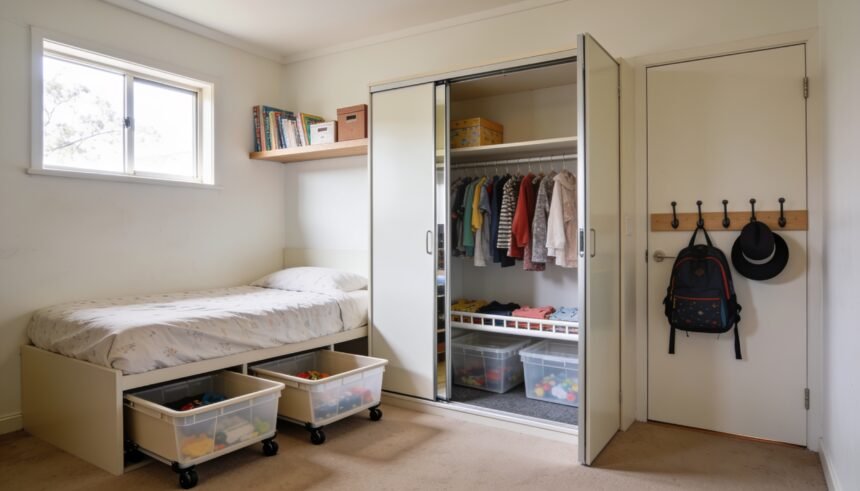
- Put toys in the robe, not on the floor. Clear tubs on the robe floor and on a low shelf take the place of a separate toy unit, which is the piece of furniture a small room can least afford.
- The high shelf is for the out-of-rotation box and the things you do not want reached without asking.
- Sliding doors mean only half the robe is open at once, so keep the everyday things on one side and the rarely used things on the other.
If you rent, the robe interior is usually the one place you can change freely, because tension rails, freestanding shelf inserts and tubs need no fixings.
Go under the bed second
The space under a standard single bed is the second largest storage volume in a small room and costs nothing to use.
- Flat tubs on wheels for toys the child gets out often, because a tub that slides out gets used and one that has to be lifted does not.
- Vacuum bags or a flat box for off-season clothes and spare bedding.
- A bed with built-in drawers does the same job neatly, but check the drawers can open in the room as it is actually laid out. A bed pushed into a corner has one usable side.
- A raised or loft bed frees the whole footprint underneath for a desk or shelving, and works well for older children. The ACCC’s guidance is that a raised bed or top bunk is not recommended for children under nine, so it is not the answer for the younger age group where storage pressure is usually worst.
Then go up the walls
Once the robe and the bed are working, wall storage takes what is left. It stays out of the way of play and does not eat floor.
- One long shelf above head height around one or two walls holds books, boxes and the things that are looked at more than handled.
- Hooks at child height by the door for the school bag, hat and dressing gown. A hook gets used; a hanger does not.
- A tall narrow bookcase in the corner beside the robe uses a strip of floor that nothing else can.
- Renting: ask the agent before fixing shelves or hooks. Adhesive hooks handle the light jobs, and a tall freestanding unit does the rest.
Anchor anything tall. The ACCC’s product safety guidance is that tall or heavy furniture in a child’s room, including bookcases, drawers and wardrobes, should be secured to the wall to stop it toppling. The brackets come in the flat-pack box and are usually the part left in it. If you rent, a wall anchor is worth the conversation with the agent rather than a reason to skip it.
What to leave out
- A big toy chest. Everything ends up at the bottom, nothing gets played with, and it takes the floor a small room does not have.
- A second chest of drawers when the robe could hold the clothes.
- Deep shelves. Anything past about 30cm becomes two rows, and the back row disappears.
- Storage that only an adult can reach. If the child cannot put a thing away, they will not, and the system becomes your job.
Keep it working
Every container holds one category and nothing else, and it has a label the child can read, which for a pre-reader means a picture. When a tub is full, something leaves before something new goes in.
Half the toys in a box out of the room, swapped each term, keeps the room at capacity rather than over it, and the swap day is a natural moment to cull again.
If two children share the room, the same order applies but the zoning matters more, and setting up a shared bedroom for two kids covers how to split it. For the desk and what needs storing around it, see making a kids room work as a study space. For the habits that keep any storage system from silently refilling, family storage that actually gets used is the companion piece.
Next: measure the robe, the wall beside it and the space under the bed before you shop. Most families discover the room already has more storage volume than they were about to buy.
The one-page family week
One printable page that holds the whole week: meals, school, activities and who is doing the pickup. Free, and we send one useful email a week.
One email a week. No spam, unsubscribe in a click.