What is in this guide
Most bedroom desks fail for three reasons, and none of them is the desk. The chair is the wrong height, the light is wrong, and the desk faces a wall in a room the child associates with sleeping.
Fix those three and a small desk works. Ignore them and an expensive desk becomes a place to pile things.
Decide whether it should be in the bedroom at all
For primary-aged children, the kitchen or dining table is often genuinely better. Homework happens near an adult, it gets done rather than avoided, and the room stays a room for sleeping.
A bedroom desk earns its place from around the start of high school, when homework gets longer, needs a device, and benefits from being away from household noise.
If your child is in year 3 and you are buying a desk because it seems like the responsible thing to do, consider a good table routine and a storage system instead. It costs less and works better.
The three things to get right
Chair height before desk height. Feet flat on the floor or on a footrest, forearms roughly level with the desk surface. A dining chair at a desk is too low for most children and is the most common setup error in this whole category. A cheap adjustable chair beats an expensive fixed one.
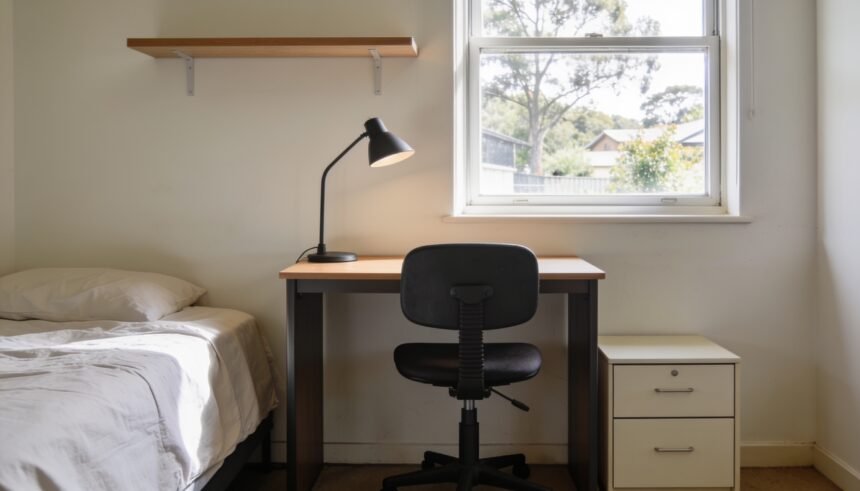
Light from the side, not behind. Light behind the child puts a shadow across the work. Light behind the screen creates glare. A desk lamp on the opposite side to their writing hand solves most of it: on the left for a right-handed child.
Do not face a blank wall if you can avoid it. A window or an open view is better for concentration than a wall thirty centimetres away. Where the wall is unavoidable, a pinboard makes it less oppressive.
Fitting it into a small Australian bedroom
- Measure before buying anything. A 120cm desk in a 2.7m wall with a bed already in it does not fit, and this is discovered after delivery more often than it should be
- A narrow desk, 45 to 50cm deep, is enough for a laptop and a book. Deeper desks eat floor space and collect clutter
- A corner desk uses dead space but blocks the corner permanently
- Wall-mounted fold-down desks work well in genuinely tight rooms
- Go up, not out. A shelf above the desk holds what a wider desk would
- Leave room to pull the chair out. Obvious, frequently forgotten
Storage that keeps the desk usable
A desk becomes a shelf within a fortnight unless everything has a home elsewhere.
- A drawer unit or a caddy for stationery, so the desk surface stays clear
- Vertical file storage for subject folders
- A tray for school notices that would otherwise live on the desk permanently
- A bin, which sounds trivial and is the difference between a clear desk and a paper pile
- One shelf, not four. More shelving means more accumulation
Power, devices and cables
- A powerpoint within reach, or a single extension lead run tidily. Not a cable across a walkway
- Charge devices outside the bedroom if you want them out of the room at night. Set that up when you build the space rather than trying to introduce it later
- A laptop needs airflow, so a solid surface rather than a bed or a cushion
Heat, which is the Australian part
A bedroom desk in a west-facing room in February is unusable in the afternoon.
- Block the afternoon sun with external shading, a blind or a curtain before it heats the room
- A fan is cheaper than cooling the whole room
- Consider where the desk sits relative to the window at 4pm, not just at 9am when you set it up
Setting it up so it gets used
Set it up together. A child who chose where the lamp goes uses the desk more than one who was presented with it.
Clear it every evening, as part of the existing evening routine. A clear desk gets used, a covered one does not.
Start with what you own. A spare table, a borrowed chair and a desk lamp will tell you within a month whether the space works, and where it needs to change, before you spend anything.
Next: first day of high school covers when a dedicated study space starts earning its place, and stationery for high school subjects covers what needs storing.
The one-page family week
One printable page that holds the whole week: meals, school, activities and who is doing the pickup. Free, and we send one useful email a week.
One email a week. No spam, unsubscribe in a click.