
What is in this guide
The cat’s requirements come first, because a tray in a place the cat will not use is worse than no tray at all. A cat that stops using the tray creates a problem that is far harder to solve than an aesthetic one.
Here are the five, in the order they matter.
The cat’s five requirements
1. It can always get there. No closed doors, no route past a dog, no stairs for an older or arthritic cat. A tray behind a door that gets shut at night is a tray that is unavailable when it is most needed.
2. It can see what is coming. Cats are vulnerable while toileting. A position with more than one escape route and a view of the room is used far more reliably than a dead end.
3. It is not beside the food. Cats do not toilet where they eat, and a tray next to the bowls is rejected by many cats outright. This is the single most common placement error in a small home, because both tend to get pushed into the same corner.
4. It is quiet. Not beside a washing machine that starts mid-use, a noisy appliance, a door that slams, or the busiest walkway in the house.
5. It is not somewhere the cat feels trapped. A narrow cupboard, a covered tray in a corner, or a spot with one way in and out.
Every one of these is about the cat feeling safe. Meet them and the cat uses the tray. Fail one and you get the problem covered in why is my cat not using the litter tray.
Where it usually works
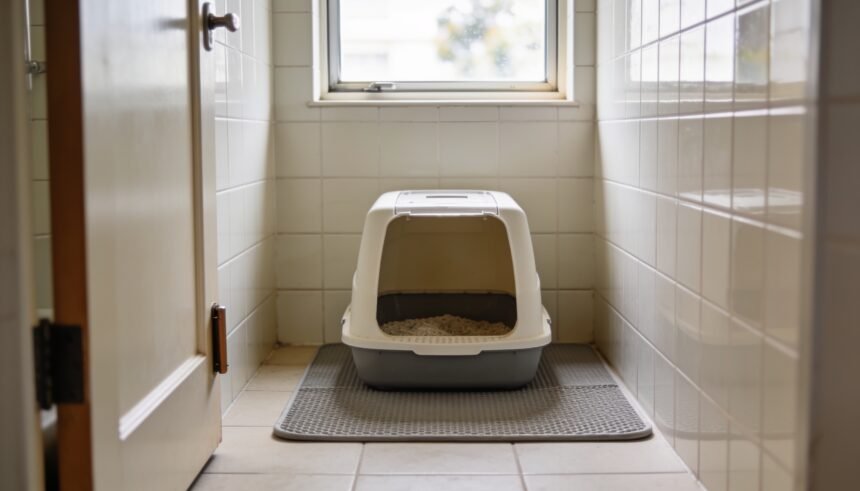
The bathroom. Often the best option in a small home. Tiled, ventilated, easy to clean, and generally quiet. The problem is the door, so a door wedge, a cat flap in an internal door where you are permitted to fit one, or simply leaving it ajar is what makes it viable.
The laundry. Ventilation, hard floors and a door, with the same door problem and the added issue of the washing machine noise. Position it away from the machine rather than beside it.
A hallway corner with a clear line of sight.
A spare room or a study.
A balcony, only if it is fully enclosed and secured, and never where the cat could get out or fall. In an Australian summer a balcony is also too hot for much of the day.
Where it does not work
Beside the food and water.
In a cupboard with the door closed.
In a bedroom, which becomes unpleasant and where the door gets shut.
Somewhere reached only by stairs, particularly with an older cat.
Next to a noisy appliance.
The garage, unless the cat has permanent access and the temperature is tolerable. Australian garages get extremely hot.
Small space and apartment solutions
A furniture enclosure that hides the tray while leaving an entrance. The requirement is that it is large enough for the cat to turn around comfortably and has good airflow, because a small enclosed box concentrates odour and many cats will refuse it.
Under a bench or a desk, with the tray positioned so the cat can see out.
A corner tray, which uses space a rectangular one wastes.
A tall-sided tray rather than a hood if litter scatter is the concern, since many cats dislike hoods and high sides solve the same problem.
A mat under and in front of it to catch tracked litter, which is the main complaint in a small home.
Vertical space nearby so the cat has a route and an exit, which is also part of the wider setup in keeping a cat happy indoors.
The multi-cat problem in a small home
One tray per cat plus one, in different locations, is the widely used guideline, and it is genuinely hard in an apartment.
Different locations is the part that matters. Two trays side by side are one toilet from the cat’s point of view. Two trays at opposite ends of a small apartment are two.
If space is genuinely limited, prioritise separation over quantity: two well-separated trays are better than three in a row.
Watch for one cat blocking another, which happens in tight spaces and is invisible unless you look for it.
Managing smell in a small home
Placement will not solve smell on its own. In a small space, scooping frequency and ventilation do the work, and litter tray smell: fixing it properly covers the seven causes, including the one nobody thinks of, which is that the tray itself has absorbed it.
Ventilation matters more here than anywhere. An open window, an exhaust fan, or a door ajar.
Do not use scented litter or deodorising products as the answer, since many cats dislike them and a cat that avoids the tray is a far larger problem in a small home.
Australian heat and humidity accelerate odour noticeably, so a placement that works in July may need more frequent scooping in February rather than a different product.
Renting
Most Australian families rent at some point and the constraints are real.
No modifications. No cat flaps in internal doors without permission, no fixtures.
Door wedges, freestanding furniture and mats do the job without altering anything.
Protect the floor. A waterproof mat under the tray protects carpet and floorboards, which matters at the end of a tenancy.
Deal with any accident immediately and properly with an enzyme cleaner, because urine that reaches carpet underlay is very difficult to remove and is a bond problem as well as a smell one.
Handling litter safely
Wash hands after handling the tray.
Cat faeces can carry toxoplasma, and Australian health guidance recommends that pregnant people avoid handling cat litter where possible, using gloves and thorough handwashing if it cannot be avoided. Anyone pregnant or immunocompromised should follow their own doctor’s advice.
Do not flush litter unless the product states it is flushable and your water authority permits it.
Next: why is my cat not using the litter tray covers avoidance, litter tray smell: fixing it properly covers odour, and keeping a cat happy indoors covers the wider indoor setup.
The one-page family week
One printable page that holds the whole week: meals, school, activities and who is doing the pickup. Free, and we send one useful email a week.
One email a week. No spam, unsubscribe in a click.