What is in this guide
Keeping a cat indoors is increasingly the default in Australia, partly because it is safer for the cat and partly because a growing number of councils now require containment or a curfew.
An indoor cat can have an excellent life. What it cannot do is provide its own entertainment the way an outdoor cat does, so the environment has to do that work instead.
The things that matter most are spatial rather than purchasable, which is the opposite of what most articles in this category suggest.
1. Height, before anything else
This is the single biggest change you can make and most households never do it.
Cats use vertical space the way people use floor space. A room with nothing above knee height is, from a cat’s point of view, a small room. The same room with three usable levels is a much larger one.
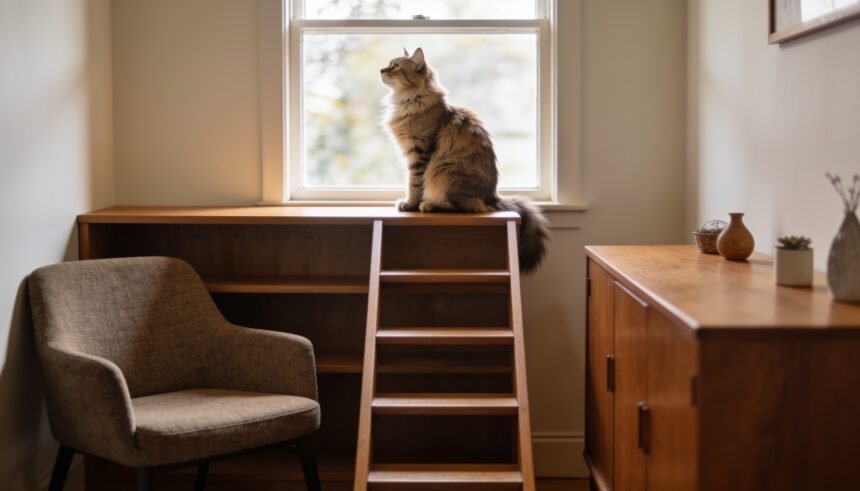
What counts: the top of a bookshelf, a cleared cupboard top, a windowsill, a shelf, a wardrobe top, the back of a sofa against a window.
It has to be reachable in stages. A high shelf with no route to it is decoration. A chair to a sideboard to a shelf is a highway.
A high spot near a window is the best real estate in the house. Sun, a view, and elevation at once.
You can achieve most of this by clearing things off furniture you already own, which costs nothing.
2. Something to look at
An indoor cat with no view has very little happening.
A window with a view of movement is genuinely important. Birds, a street, a garden, washing moving. Make sure there is somewhere comfortable to sit at it.
Australian caveat: watch the heat. A sunny window that is perfect in July is dangerous in January, and an indoor cat needs shaded options and water in summer. Cats can suffer heat stress and it develops quickly.
Secure the window. Flyscreens are not cat-proof and a cat leaning on one at height is a serious risk. If windows are open, they need proper screens or restricted openings.
A safely enclosed outdoor area is the biggest single upgrade available if it is possible. A cat run, an enclosed balcony or a secure courtyard gives outside air, smells and sun with the containment intact.
3. Hunting, in some form
Cats are hunters and the sequence matters: stalk, chase, pounce, catch, kill, eat. A cat that never completes any version of that sequence is a frustrated cat.
Play that ends in a catch. A wand toy that gets dragged away forever is unsatisfying. Let the cat win at the end of a play session, then feed it. Hunt, catch, eat is the natural order and it settles a cat noticeably.
Twice a day, ten minutes. More useful than a cupboard full of toys, and the timing matters more than the equipment: a play session before your bedtime helps considerably with a cat that wakes the house at 4am.
Move the food. Food in a bowl takes ninety seconds. Food in a puzzle feeder, scattered, or hidden in several places around the house is an activity. Feeding a cat from multiple small hidden portions is closer to how a cat naturally eats than one or two large bowls.
Rotate toys rather than accumulating them. Three toys that change weekly beat twenty that are always out, because novelty is the active ingredient.
4. Control over their own environment
Underrated, and the thing that most affects whether a cat is relaxed.
Somewhere to hide that nobody disturbs. A box, a covered bed, under a bed, inside a wardrobe. The ability to withdraw is not antisocial, it is how cats regulate.
More than one of everything, in a multi-cat house. Beds, water, feeding spots, litter trays, high places. Resource competition is a very common and very invisible source of stress, and why is my cat not using the litter tray covers the litter side of it.
Do not force interaction. Let the cat initiate. A cat picked up when it did not ask learns to avoid the person doing it.
Keep things predictable. Cats respond to routine more than most people realise. Feeding times, quiet times and where things live all matter.
5. Scratching, in the right place
Scratching is not damage, it is maintenance and marking and cats will do it. The only question is where.
A scratching surface needs to be tall enough to stretch out fully, stable enough not to move, and positioned where the cat already wants to scratch, which is usually near where it sleeps and near the entrance to a room. Cat scratching: redirect it rather than stop it goes through it properly.
What cats do not care about
Worth saying, because it is where money goes.
The appearance of anything. A cardboard box is a genuinely excellent cat enrichment item and is free.
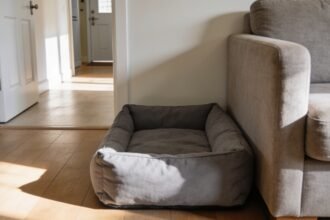
Expensive beds. Cats sleep where it is warm, high and safe, which is frequently not the bed purchased for them.
Large numbers of toys. Rotation beats quantity.
Complicated furniture. A tall stable post and access to existing surfaces does more than a large tower in the wrong part of the house. Position beats product.
No product is named anywhere in this article, because the changes that matter most are spatial and behavioural and none of them requires a purchase.
The Australian containment question
Many Australian councils now have cat containment rules or curfews, and the requirements differ by council and state. Check your own council rather than assuming, since these have changed in a number of areas in recent years.
The wildlife argument for containment is well established in Australia and is the basis of most of these rules. RSPCA Australia supports keeping cats safely contained and publishes guidance on doing it well.
For a cat that has previously gone outside, the transition takes time and needs the environment changes above in place before it starts rather than after.
Cat curfews and council rules in Australia covers the regulatory side.
When it is not a boredom problem
A sudden change in behaviour, appetite, toileting, grooming or activity is a veterinary matter, not an enrichment problem. Cats conceal illness well and behaviour change is frequently the first visible sign.
Straining to urinate, or repeated visits to the litter tray producing nothing, is an emergency in any cat and particularly in a male cat. See a vet immediately.
Over-grooming, hiding constantly, or aggression that is new all warrant a veterinary visit before being treated as behaviour.
Next: cat scratching: redirect it rather than stop it covers the most common complaint, why is my cat not using the litter tray covers the second, and the new kitten checklist covers starting out.
The one-page family week
One printable page that holds the whole week: meals, school, activities and who is doing the pickup. Free, and we send one useful email a week.
One email a week. No spam, unsubscribe in a click.