What is in this guide
The number of minutes is the least useful answer to this question, and it is the one every result gives.
A dog walked for an hour on a lead beside a road, pulled along at a human pace with no opportunity to stop, can arrive home wound up. A dog taken to a quiet park for twenty minutes and allowed to sniff at its own pace frequently arrives home settled and sleeps for the afternoon.
Same dog, same week, third of the duration, better result. Duration is not the variable most people should be adjusting.
Before the detail: exercise needs vary enormously with age, breed, health and individual dog, and a veterinarian is the right source for your specific animal. Puppies, older dogs, brachycephalic or flat-faced breeds, and dogs with joint or heart conditions all have particular requirements, and some of the general advice below does not apply to them.
The three kinds, and why the second one matters most
Physical exercise. Walking, running, swimming, fetch. Builds fitness and burns energy. This is what everybody means by exercise and it is the part most households already do.
Mental work. Sniffing, problem solving, training, novelty, choice. This is what most unsettled dogs are actually short of, and it is the part almost nobody counts.
Social contact. Time with people and, for some dogs, with other dogs. Not all dogs want the second, and forcing a dog that does not enjoy other dogs into a dog park is not enrichment.
A dog that is physically exercised and mentally unemployed will still be difficult. This is the single most common mistake in this whole area, and the usual response to it is to add more walking, which does not address the deficit.
Why sniffing does so much
A dog’s world is primarily olfactory, and sniffing is genuinely demanding work rather than a pause in the walk.
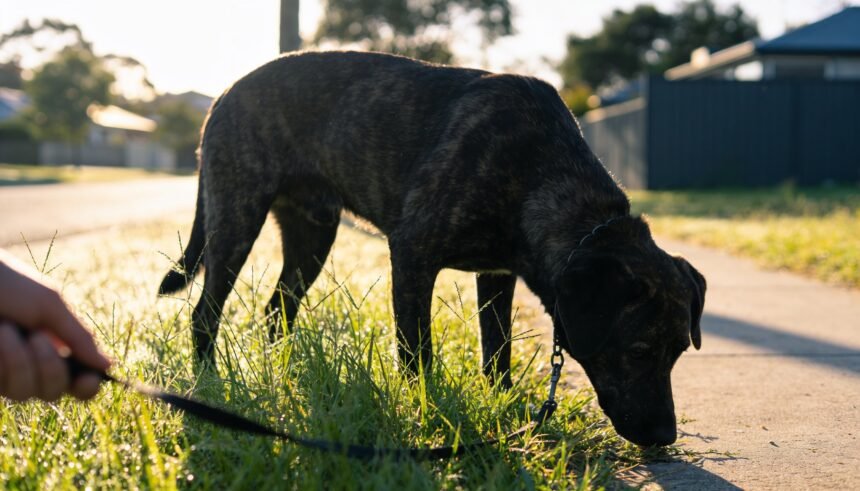
The practical version: let the dog stop. A “sniffing walk” where the dog chooses the route and the pace and stops as long as it likes, covering perhaps two hundred metres in twenty minutes, does more for most dogs than a brisk kilometre.
Owners find this frustrating because it does not look like exercise. It works anyway, and for an older dog, a recovering dog, or a dog that cannot be exercised hard in summer heat, it is often the most valuable thing available.
Other mental work that is genuinely tiring: food scattered in grass to find, a snuffle mat, food given in a puzzle feeder or frozen in something rather than in a bowl, short training sessions of five minutes, and simply going somewhere new. Novelty alone is work.
A rough framework, not a prescription
Treat these as starting points to adjust from, not requirements.
Puppies need much less structured exercise than people assume and a great deal more sleep. Forced or repetitive exercise in a growing dog is a genuine concern and a vet should set the amount for a puppy, particularly for large breeds.
Adult low-energy dogs generally do well with a walk or two plus mental work.
Adult high-energy and working breeds need substantially more, and crucially need a job rather than only distance. A kelpie, a border collie or a working line breed given three hours of walking and no mental work will still be looking for something to do. These breeds are common in Australia and are frequently in households that cannot meet their needs.
Older dogs usually need shorter, more frequent, gentler outings, and they benefit from sniffing more than from distance. A change in what an older dog can manage is a reason to see a vet rather than to push through.
Flat-faced breeds have restricted airways and overheat much faster. Exercise and heat guidance for these dogs is different and should come from a veterinarian.
The Australian problem: heat
For a large part of the year in most of Australia, the middle of the day is not available.
Walk early or late. Before the day heats up and after it cools. In summer this can mean quite early and quite late.
Test the pavement with your hand. Asphalt and concrete hold heat long after the air has cooled and can burn paws. Hot pavement and paw burns covers the test properly.
Dogs cool by panting and it is far less effective than sweating. Heat stress in dogs is a genuine emergency and develops quickly, particularly in flat-faced breeds, older dogs, overweight dogs and thick-coated breeds. RSPCA Australia publishes guidance on recognising and preventing it and it is worth reading before summer rather than during it.
Never leave a dog in a parked car, which in Australian conditions can be fatal in minutes.
Water on every outing in warm weather.
On a hot day, substitute mental work for physical. A twenty minute sniffing session indoors or in shade, a puzzle feeder, a training session, or a frozen treat replaces the walk entirely. This is the single most useful adjustment in an Australian summer and most owners do not make it.
Other Australian considerations: paralysis tick risk in parts of the east coast affects where dogs are walked, snakes are active in warm weather on tracks and in long grass, and bindis and grass seeds are a seasonal nuisance that becomes a veterinary problem when they lodge in paws or ears.
Signs the balance is wrong
Too little, or the wrong kind: destructive behaviour, restlessness in the evening, barking at everything, difficulty settling, weight gain, attention-seeking. Dog barking at everything covers the most common of these.
Too much: reluctance to go out, stiffness or limping, excessive tiredness, sore paws. Over-exercise is less common than under-exercise but it is real, particularly with puppies and older dogs, and limping or reluctance to move is a veterinary matter rather than something to walk off.
Stress rather than energy. Some dogs that look under-exercised are anxious rather than energetic, and more exercise will not help. Dog body language every family should recognise covers reading the difference.
Fitting it into a real week
Split it. Two shorter outings usually beat one long one, and they fit around school and work better.
Attach it to something that already happens. The school run, the morning coffee, taking the bins out. Walking a dog and doing school pick-up covers the logistics.
Use the backyard properly. A backyard is not exercise on its own, because a dog left in a familiar yard does very little. A backyard used for training, scatter feeding or a game is a different thing.
Share it. In a household, a rotating roster means the dog gets out on the day one person cannot.
Five minutes of training counts. On a day where a walk is impossible, five minutes of training and a puzzle feeder is a genuinely adequate substitute, and treating it as a failure is why people give up.
Next: dog body language covers telling stress from energy, dog barking at everything covers the most common symptom, and road trips with a dog covers exercise away from home.
The one-page family week
One printable page that holds the whole week: meals, school, activities and who is doing the pickup. Free, and we send one useful email a week.
One email a week. No spam, unsubscribe in a click.