What is in this guide
Breed charts are the wrong tool. A crossbreed does not appear on one, and two dogs of the same breed can be 8 kg apart.
Measure the dog. It takes a minute and it is the whole decision.
This is an editorial comparison of crate types and sizing. No crate was assembled or used by us, and nothing here is training or veterinary advice.
The two measurements
Length. From the tip of the nose to the base of the tail, where the tail joins the body. Not to the tip of the tail. Add roughly 5 to 10 cm.
Height. From the floor to the top of the head with the dog sitting upright, or to the top of the ears on a dog with upright ears. Add roughly 5 to 10 cm.
Width follows from length on almost every crate on the market, so you rarely have to choose it.
The standard the crate has to meet is that the dog can stand up without ducking, turn around comfortably, and lie down fully stretched on its side. That is the whole test, and it is also what Australian animal welfare guidance describes as the minimum.
Why bigger is not better for a puppy
This is the point that gets missed.
A dog will not usually toilet where it sleeps, and that instinct is what makes a crate useful in toilet training. Give a puppy a crate with room for a bed at one end and a spare corner at the other, and it will use the corner. The crate has then taught the opposite of what it was bought for.
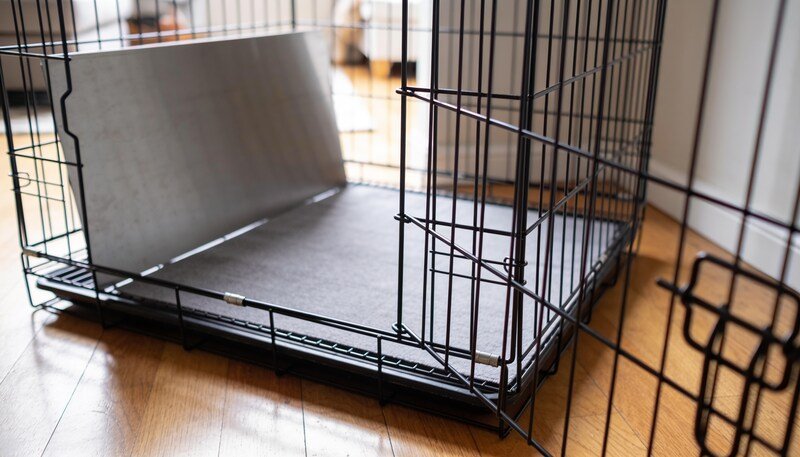
The answer is a divider. Buy the crate for the dog’s adult size and use the divider panel to shrink the usable space to the puppy’s current size, moving it out as the dog grows. Most wire crates in the adult sizes include one, and it is worth confirming before buying rather than after.
Buying a small crate first and a large one later costs more and achieves the same thing.
Toilet training a puppy, including the nights covers how the crate fits into that process, and puppy-proofing a house and garden covers what happens when the puppy is out of it.
The four types
Wire or collapsible metal. The default home crate. Ventilates best, which matters a great deal in an Australian summer, folds flat for storage, and takes a cover if the dog wants a den. Heavier than it looks. This is the right first crate for most households.
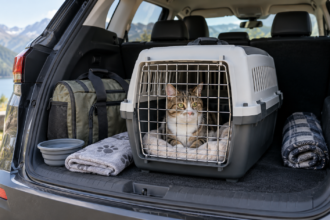
Plastic airline-style. Enclosed, less ventilation, more den-like. The type required for air travel, and the type to look at if the dog will fly or travel a lot. Airline requirements are specific and are set by the carrier, so check with the airline rather than assuming a crate labelled airline-approved will be accepted.
Soft fabric. Light, packable, good for a calm adult dog at an event or in a caravan. Useless for a chewer or an escape artist, and not a containment solution for a dog left alone.
Furniture crates. A crate built into a side table or cabinet. Looks better in a living room, ventilates worse, costs more, and cannot be moved easily. A reasonable choice for a settled adult dog in a house where the crate is permanent.
Playpens are a different product and often the better one. A pen gives a puppy more space without giving it a toilet corner, and it suits a household that is home during the day.
What goes in it, and what does not
In:
- A flat bed or mat sized to the crate, which is covered properly in crate covers, bedding and what goes inside
- Water, in a bowl that clips to the side rather than one that gets tipped
- Something to chew, only if you know the dog handles it unsupervised
Not in:
- A collar, and especially not a collar with a tag. A collar can catch on crate wire and strangle a dog. Take it off before the dog goes in. This is the single most important line in this article
- A harness, for the same reason
- Anything the dog can shred and swallow, including a bed if this dog destroys beds
- Food left down, which turns the crate into a dining room and attracts ants in an Australian summer
Placement and heat
- Out of direct sun, and away from a window that gets afternoon sun. A crate in the sun becomes dangerously hot very quickly
- Not in a garage or a laundry on a hot day, and never in a car
- Somewhere the household is, because a crate in an isolated room is a punishment rather than a den
- Off a draught, and not in a walkway
- On a mat if it sits on a hard floor, for noise and for the dog’s grip getting up
How long a dog can be crated
Australian animal welfare guidance is clear that a crate is a short-term management and training tool, not a place a dog lives. A dog needs space to exercise, company, and regular toileting opportunities, and a puppy needs them far more often than an adult.
If a dog is distressed in a crate rather than settled, that is not a crate that needs to be smaller or darker. Persistent distress, escape attempts that risk injury, or distress that begins as soon as you leave the house is a conversation with a vet, who can refer you to a qualified veterinary behaviourist. A dog that hates the crate: fixing it works through the difference.
What to skip
- Crate-sized memory foam beds for a puppy that will destroy them. A cheap mat now, a good bed later
- A crate cover in summer in most of Australia, because ventilation matters more than a den
- Two crates, one for home and one for the car, unless the dog actually travels often
- A crate you cannot lift if it will ever need to move rooms
- Anything sold as escape proof without a warranty, because a determined dog is a real test and the claim is rarely backed
Before you buy
- Measure the dog, or the adult size of the breed group your puppy is from
- Confirm the divider is included if you are buying for future size
- Choose wire for a first home crate unless the dog will fly
- Plan the placement for heat and for company before ordering
- Take the collar off every time
The one-page family week
One printable page that holds the whole week: meals, school, activities and who is doing the pickup. Free, and we send one useful email a week.
One email a week. No spam, unsubscribe in a click.