What is in this guide
Before any method, one question, because the answer changes everything.
Does the dog hate the crate, or hate being alone?
Crate aversion: the dog is fine alone in the house but resists the crate specifically. It will settle in a room, on a bed, behind a door, just not in there.
Separation-related distress: the dog is distressed whenever you leave, crate or no crate. The crate is not the problem, it is where the problem is happening.
Test it: leave the dog alone in a closed room or a pen instead of the crate, with a camera on. If it is calm, you have crate aversion and the rest of this article applies. If it escalates within minutes with pacing, howling, drooling and attempts to escape, that is distress.
Distress is not a crate problem and confining a panicking dog makes it worse and can cause injury. Stopping a dog from destroying things when left alone covers the diagnostic properly, and the answer there is a veterinarian and a qualified behaviourist, not a training plan.
Everything below assumes crate aversion.
Why the association went bad
Worth identifying, because the rebuild is the same but the thing to avoid is not.
It was used as punishment. The most common cause. A crate used as a time-out becomes a place bad things happen.
It was too much, too soon. Shut in for hours on day one.
Something frightening happened in it. A storm, fireworks, a collapse of the crate, a child poking fingers through the bars.
It is uncomfortable. Too small, no bedding, on a cold hard floor, or in a hot spot. Australian houses have hot corners and a crate in one in February is genuinely unpleasant.
It is in the wrong place. Isolated in a laundry, away from the family, or in a high-traffic corridor with no peace.
It is associated with departure. If the crate only ever happens when you leave, it predicts you leaving.
The six-stage rebuild
Go at the dog’s pace. Moving to the next stage before the current one is genuinely comfortable is how this fails a second time, and a second failure is harder to recover from than the first.
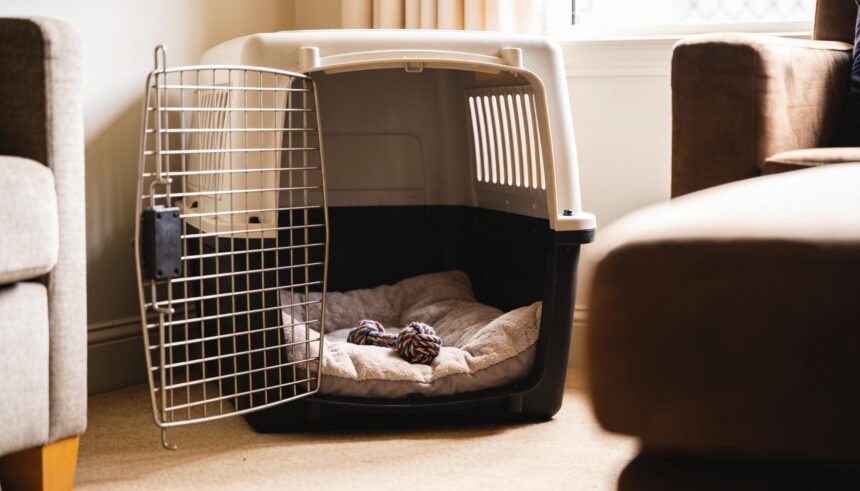
Stage 1: The door comes off, or stays open, for a week. No closing, no shutting in, no asking anything. Prop it open or remove it entirely so it cannot swing shut and startle the dog.
Move the crate into the room where the family actually is. Not the laundry. The living room.
Stage 2: Make it the best place in the house. Feed every meal in it, with the door open. Drop treats in when the dog is not looking so it becomes a place good things appear. Put the best bedding in it. Give the long-lasting chew only in there.
Do not ask the dog to go in. Let it choose. A dog that walks in on its own has made a decision, and that decision is the foundation.
Stage 3: Add duration with the door still open. When the dog goes in voluntarily and stays, sit nearby. Read, work, watch television. The dog learns the crate is a normal place to be while life happens.
Stage 4: Close the door for one second. Closed and immediately opened, while the dog is eating something good. Build to five seconds, then ten, then a minute, over days.
Open the door before the dog asks. This is the important detail. If you only open it when the dog whines, you have taught the dog that whining opens the door.
Stage 5: Leave the room. Door closed, you step out, come back immediately. Then two seconds. Then ten. Then a minute. The dog should be relaxed at every step and if it is not, go back two steps.
Stage 6: Normal use. Short absences first, and never a ten hour day.
Realistically this takes two to six weeks for a dog with a bad association. Rushing it is what created the problem.
Practical details that matter
Size. The dog should stand, turn around and lie fully stretched out. Too small is a common cause of refusal and is a welfare issue in its own right.
Placement. Where the family is, out of direct sun, not in a draught, not in the hottest corner of the house. In an Australian summer, ventilation and temperature are genuine safety considerations rather than comfort ones.
Bedding. Comfortable, and washable. Some dogs remove bedding, and a dog that shreds and swallows it should not have it unsupervised.
Covering it helps many dogs by making it den-like, and must not restrict airflow, particularly in heat.
Remove collars, harnesses and tags before crating. Tags and collars can catch on bars and cause serious injury, and this is a genuine and underappreciated risk.
Never use it as punishment. Once, and the rebuild starts again.
What not to do
Do not force the dog in. Lifting, pushing or dragging a dog into a crate destroys the association permanently.
Do not let it cry it out. A dog screaming in a crate is not learning to settle, it is panicking, and every minute deepens the association you are trying to fix.
Do not use it as the answer to a full working day. A crate is a short-term management tool. Enrichment for a bored dog when you work full time covers the ten-hour problem, and the answer is not a crate.
Do not go back to the closed door because you are in a hurry. If you need containment before the rebuild is finished, use a pen, a gated room or a closed room instead. The crate stays open and positive.
If it never works
Some dogs do not accept a crate, and that is an acceptable outcome.
Alternatives that do the same job: a puppy pen, a gated room, a closed laundry or bathroom with bedding, or simply a dog bed with boundary training taught using marker training as in clicker training in ten minutes a day.
The one situation worth persisting for is travel and veterinary recovery, where confinement may be necessary. If that is the reason, it is worth raising with your vet, who may suggest a plan or, for a specific event, discuss whether anything else is appropriate. That is a veterinary decision and this article offers no view on it.
Next: stopping a dog from destroying things when left alone covers the distress diagnosis, clicker training in ten minutes a day covers marking the moment the dog goes in, and dog body language covers reading whether the dog is actually comfortable.
The one-page family week
One printable page that holds the whole week: meals, school, activities and who is doing the pickup. Free, and we send one useful email a week.
One email a week. No spam, unsubscribe in a click.