
What is in this guide
Every parent has considered doing this while the children are out, and plenty have done it. It is fast, there is no argument, and mostly nothing is noticed.
The honest position is that it works until the day it does not. A child who discovers something specific is gone learns that their things can disappear without warning, and the usual response is to become markedly more protective of everything, which makes every future declutter harder. What was saved once is paid back several times.
That does not make secret disposal never justified. It makes it a cost rather than a free option, and worth knowing before you choose it.
Here is what works instead, by age.
Under three: do it without them
This is the one age where doing it alone is straightforward and reasonable. A toddler has limited attachment to specific objects, no sense of a collection, and will not notice the absence of things they were not playing with.
Do it while they are asleep or out. Be generous. This is also the age where the most volume can be removed with the least consequence.
The one exception is the comfort item and anything that functions like one. Never, under any circumstances.
Three to six: involve them, but structure it
At this age children develop strong attachments, often to unexpected items, and have almost no ability to make a large number of decisions in a row.
Never ask “what can we get rid of?” It is an impossible question and the answer is always nothing.
Ask instead, holding two items: “which of these two do you want to keep?” A binary choice is manageable. Thirty of them in a row is not, so do ten and stop.
Give the discards a destination they like. “This is going to a child who does not have many toys” works genuinely well at this age, and it is true if you are donating. So does giving something to a specific younger cousin.
Let them keep something you think is rubbish. They will. Accept it, because winning that particular argument costs you the next three.
Work in short sessions, fifteen minutes at most.
Seven to twelve: give them the decision and the constraint
Older children can handle the whole process and respond much better to a constraint than to a request.
Use a physical limit. “Everything has to fit in this box or on this shelf.” The constraint does the arguing, not you, and the child does the choosing.
Introduce the idea of selling. From about eight, the prospect of money for outgrown items is a genuinely effective motivator and teaches something real. Selling and donating kids gear in Australia covers what is worth the effort.
Respect the decisions. A child who is overruled after being asked will not participate next time.
The box method
This is the approach that removes most of the conflict and it works at every age above three.
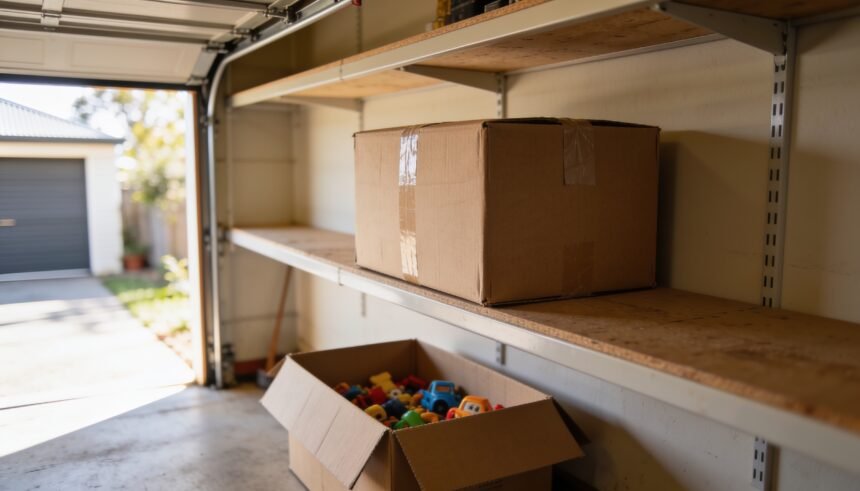
Put the uncertain items in a box. Not the bin, not the charity bag. A closed box.
Store it out of sight for three months. In the garage, under a bed, on top of a wardrobe.
If nothing is asked for in three months, the box goes, unopened, to charity.
If something is asked for, it comes out. This happens less than parents expect and more than children expect, and the fact that it can happen is what makes the whole thing tolerable.
The reason this works is that nobody has to decide that something is gone forever. The decision is deferred, and by the time it is made the attachment has faded on its own.
This also overlaps neatly with toy rotation, where most toys are stored and a small selection is out. Toy rotation: how to make the same toys last covers running that as an ongoing system rather than a one-off purge.
When to do it
Before Christmas and before birthdays, not after. A child asked to make room for what is coming is far more receptive than one whose new things have already arrived. Framed as making space rather than taking away, this is the easiest version of the conversation there is.
The first week of January is the second-best window, while the influx makes the case obvious and before the school year starts.
Not when tired, not when the child is tired, and not in the middle of an argument about tidying, which turns decluttering into a punishment.
What goes where
Broken toys are rubbish, not donations. A cracked or split toy has become a small parts hazard regardless of its original age label, and passing on something broken moves the problem to a charity that then pays to dispose of it.
Incomplete sets and puzzles with missing pieces are generally not saleable and most charity shops do not want them.
Good condition items go to a charity shop, a school fete, a local buy-nothing group or a specific family. Check the shop’s current acceptance list, because policies differ on soft toys and on anything with batteries.
Items with button batteries need care before they leave the house, and the battery compartment should be intact and secure.
What to actually throw out, and what to keep covers the Australian disposal routes for the rest of it.
The part that is actually about the adults
Two honest observations.
A lot of what is kept is kept by the parent, not the child. The first toy, the thing a grandparent gave, the item associated with a stage that has passed. That is legitimate, and it should be a deliberate small collection stored properly rather than an undeclared rule that nothing leaves.
The inflow matters more than the outflow. A household removing two bags a year and receiving four is not decluttering. The conversations with extended family about gifts, and a standing suggestion of experiences or consumables rather than objects, do more than any purge.
Next: what to actually throw out, and what to keep covers where it all goes, toy rotation covers keeping fewer toys interesting, and a drop zone or mudroom in a small entry covers stopping the accumulation at the door.
The one-page family week
One printable page that holds the whole week: meals, school, activities and who is doing the pickup. Free, and we send one useful email a week.
One email a week. No spam, unsubscribe in a click.