Most Australian councils run a hard rubbish or bulk waste collection, usually one or two free collections a year per household, sometimes on a fixed area schedule and increasingly by booking.
They take more than people expect. The problem is the short list they will not take, because a pile containing one excluded item is often left entirely, and then it sits on the nature strip for a fortnight while everyone assumes somebody else will deal with it.
So this article leads with the exclusions.
What gets a pile left behind
These are the items that most commonly cause a collection to be skipped:
- Paint, including tins of dried paint
- Household chemicals, cleaning products, pool chemicals, pesticides
- Batteries of any kind
- Gas bottles, including the barbecue one, empty or not
- Building and renovation waste: bricks, concrete, plasterboard, timber offcuts, tiles
- Asbestos or anything that might be. Fibro sheeting, old eaves, old fencing
- Car parts: tyres, engines, gearboxes, batteries
- Soil, rocks, turf and stumps
- Loose green waste that is not tied into bundles, where green waste is accepted at all
- General household rubbish and anything that belongs in your wheelie bins
- Fencing wire and barbed wire
- Liquids of any kind
If you are unsure about asbestos, stop. Anything fibro, any old sheeting, any pre-1990 eaves or fence sheet is a job for a licensed removalist and your state environment authority has the process. It is not a hard rubbish item and it is not a DIY job.
What they usually do take
The accepted list is broader than most people assume:
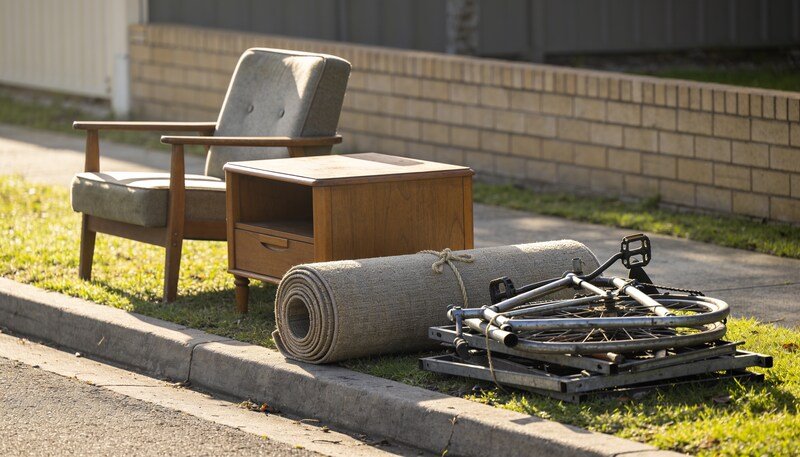
- Furniture. Couches, armchairs, tables, bed frames, bookshelves, desks
- Mattresses, usually with a limit of one or two
- White goods. Fridges, washing machines, dryers, dishwashers, ovens
- Small appliances, microwaves, heaters, fans
- E-waste in many areas, kept as a separate pile
- Carpet and rugs, rolled and tied
- Scrap metal, including bikes and BBQ frames
- Timber furniture, as furniture rather than as offcuts
The physical limits nobody mentions
This is the practical detail that decides whether your pile is collected, and it appears on almost no page in the search results:
- Weight. Commonly a 30 kg limit per item, on the basis that two people have to lift it into a truck
- Length. Commonly around 1.5 metres per item, with mattresses and fridges as the usual exceptions
- Volume. Usually expressed as a cubic metre figure or as a trailer load. Two to three cubic metres is a common entitlement
- Placement. On the nature strip, clear of the footpath, clear of power poles, trees, parked cars and stormwater drains, and not blocking the path
- Timing. Most councils specify no earlier than a set number of days before the collection date, and some fine early placement
Sort it into piles by type. Metal, white goods, mattresses, furniture, e-waste. Many councils collect with different trucks, and an unsorted heap is slower and more likely to be partly left.
Fridges and freezers specifically
Two extra rules, and both are safety rules rather than council preferences:
- Take the door off, or otherwise make it impossible for a child to be shut inside. This is a longstanding safety requirement and some councils will not take a fridge with the door on
- Degassing. Fridges contain refrigerant gas and most councils handle degassing themselves, but some require it to be arranged beforehand. Check when you book
Where the excluded items actually go
The council saying no is not the end of the list, and this is the part the removal companies would rather you did not know:
| Item | Where it goes |
|---|---|
| Paint | Many councils and transfer stations run free paint drop-off; Paintback operates collection sites in every state |
| Household chemicals | Free household chemical drop-off events and permanent sites, run by state waste authorities |
| Gas bottles | Swap-and-go sites, some transfer stations, and some hardware retailers |
| Batteries | Free drop-off at major supermarkets and hardware and office retailers |
| E-waste | Council e-waste drop-off, and retailer take-back for phones and computers |
| Building waste | Transfer station, paid by weight |
| Asbestos | Licensed removalist, then a licensed landfill. Never anything else |
| Tyres | Tyre retailers, usually for a small fee |
| Still-usable furniture | Charity collection, marketplace, buy-nothing groups |
Batteries and e-waste covers the free national battery scheme and the e-waste routes in detail.
Book early and time it around the job
Two practical points that save more than they sound:
- Collections book out. In many councils the wait between booking and collection is weeks, and it is longest in January and after a storm. If a hard rubbish run is part of a move or a renovation, book it before you start, not after
- Do the decluttering first, then book. A booked date is a deadline, and a deadline is the only reason most garages ever get emptied
What to actually throw out, and what to keep and decluttering kids' toys without the tears are the decisions that come first. If this is happening because of a move, what moving house actually costs has the timing and the other costs in one place.
Before you pay someone
Private removal is a legitimate choice when you are out of time, over the volume, or the item is excluded. Before you pay:
- Check whether you have a free collection left this financial year
- Check the transfer station rate. A trailer load at a transfer station is often much cheaper than a removal service, if you can borrow a trailer
- Check whether it is worth something. Working white goods, solid timber furniture and scrap metal all have buyers
- Check the operator disposes of it legally. Illegal dumping is prosecuted and the original owner can be pursued. Ask where it goes and expect a real answer
Common questions
Is hard rubbish free? Usually, for a set number of collections a year. Extra collections are commonly charged.
What if I rent? The service belongs to the property, so it is available to you. Check with the agent about bond and nature strip conditions if a pile is going out around an inspection.
Can people take things from my pile? Scavenging is technically prohibited in many council areas and happens constantly. If you want something reused, a marketplace listing or a buy-nothing group is a better route than the nature strip.
What about the stuff left after collection? If part of the pile is left, it is almost always an excluded item. The council will usually tell you why, and the remainder becomes your responsibility to remove.
Can I put out a TV? E-waste rules vary. Many councils take it, some require a separate e-waste drop-off, and televisions and computers are covered by a national recycling scheme.
The short version
Book early. Sort into piles by material. Keep it under 30 kg and 1.5 metres a piece. Take fridge doors off.
And read the exclusion list before the night before, because paint, chemicals, gas bottles, building waste and anything fibro are the five things that will get the whole pile left behind.
The one-page family week
One printable page that holds the whole week: meals, school, activities and who is doing the pickup. Free, and we send one useful email a week.
One email a week. No spam, unsubscribe in a click.