What is in this guide
Most garage clutter is not too much gear. It is gear with no fixed spot, so it ends up wherever someone last put it down. Start by grouping what the household owns by how often it leaves the garage, then give each group a place that is not the floor.
A car bay that is slowly filling with bikes and balls is a sorting problem before it is a storage problem. The groups below are an editorial starting point to adapt to your own garage and the gear your household actually uses.
1. Sort by how often it leaves the garage
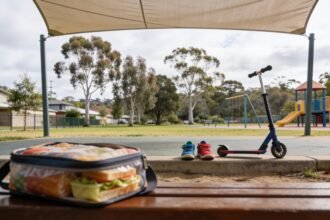
Walk the garage and separate gear into three rough groups: used most weeks, used most months, and used once or twice a year. A school bike and a scooter usually sit in the first group. Cricket gear or a soccer bag might sit in the second. Camping or seasonal sports equipment usually belongs in the third.
Give the weekly group the easiest, lowest spot near the door the household actually uses to leave. Give the occasional group a higher or further spot, since it is retrieved less often. The yearly group can go highest, or behind other things, because reaching it is rare.
This sorting step matters more than any single rack or hook, because it decides where everything else goes. Decluttering kids' toys uses the same grouping idea for toys competing for space indoors.
2. Get bikes and scooters off the floor
Bikes and scooters take up floor area in a way that is out of proportion to how little they weigh, and a bike lying on its side is usually the first thing someone trips over reversing the car in.
Options to compare for everyday bikes and scooters:
- Wall hooks at wheel height. One hook per bike, spaced for handlebar width, keeps bikes vertical against a wall rather than flat on the floor.
- A freestanding rack. Useful where the wall cannot be used, but check it holds the bike upright without someone needing to balance it.
- A hanging strap or pulley. Lifts a bike toward the ceiling, which clears the most floor space but makes the bike slower to get out for a short ride.
- A scooter bin or narrow basket. Scooters and skateboards fall over when leant against a wall. A narrow upright bin holds several standing up in one footprint.
Choose based on how often the bike or scooter is used. A daily school bike wants the fastest option, which is usually a wall hook near the door. A bike ridden twice a term can tolerate the slower pulley or a spot further from the door.
3. Use the wall before the floor
Garage floor space is usually needed for the car, and anything stored on it has to be moved every time the car comes in or out. Wall space, by comparison, is rarely used for anything.
A simple slatted panel, pegboard section or a row of hooks and brackets gives balls, bats, helmets and racquets a fixed spot each, rather than a shared bin everything gets tipped into. Hang the gear used most often at a height every family member, including children, can reach without a step. Put the heavier or less-used items higher.
Shelving above head height is useful for the yearly group: seasonal sports gear, spare helmets outgrown by younger children waiting for a hand-down, or wet-weather gear used only occasionally. Check the shelf is rated for what you intend to store on it and that nothing on it can fall onto a parked car or a person reaching below.
4. Give loose gear a container, not a corner
Balls, shin pads, bike pumps and small accessories tend to end up loose on the floor or the workbench because nobody decided where they go. One open bin or crate per category works better than a single catch-all box, because a catch-all box becomes a place nothing is ever found in again.
A practical starting set:
| Category | Suggested container | Where |
|---|---|---|
| Balls | One open crate or net bag | Low shelf or floor corner, away from the car’s path |
| Helmets and pads | A shallow open tray at reachable height | Near the bike or scooter storage |
| Small parts and pumps | A lidded box, labelled | Shelf, not floor |
| Seasonal or outgrown gear | A larger lidded tub | Highest shelf or furthest from the door |
Open containers suit anything retrieved weekly. Lidded containers suit anything retrieved rarely, since the extra step of opening a lid matters less when it only happens a few times a year.
5. Keep a clear path to the car and the door
Before finishing, walk the planned layout exactly as the household would: reversing the car in, carrying shopping through the internal door, and a child wheeling a bike out alone. Anything that gets in the way of one of these moves in the normal course of using the garage.
Check that nothing hangs low enough to hit a car roof rack, a trailer or a taller adult’s head, and that nothing stored at a child’s reach height is heavy enough to fall awkwardly if pulled rather than lifted. If the garage also stores household overflow, measuring the space properly before adding more storage avoids buying a rack or shelf that does not actually fit once the car and the bikes are both in place.
If the real issue is that the household owns more gear than the garage can hold, more hooks will not fix that. Family storage systems that get used rather than just filled covers the same put-away-friction question for the rest of the house, and it applies here too. Once the garage layout works for daily traffic, local bike paths and walks are the easiest way to keep that bike earning its spot on the wall.
How we checked this
Reviewed on 2 October 2026 as an editorial organisation method. The groupings and layout suggestions describe choices to check in your own garage, not product testing, measured benefits or a market survey. No brands, prices or load ratings are included.
The one-page family week
One printable page that holds the whole week: meals, school, activities and who is doing the pickup. Free, and we send one useful email a week.
One email a week. No spam, unsubscribe in a click.