What is in this guide
Pick two or three things that happen the same way every day no matter who is rostered on or whose house it is, then let everything else flex around them. A routine built on a fixed start and end time falls apart the first week the roster changes; a routine built on a small number of anchors survives it.
This applies whether one parent works rotating or night shifts in an otherwise single household, or children move between two homes on a changing pattern. Either way, the problem is the same: the adults’ availability moves, and the child’s sense of what happens next should not move with it.
1. Choose anchors that do not depend on who is there
An anchor is a part of the day that happens the same way regardless of which parent is on shift or which house the child is in that night: a wake-up time, a particular breakfast, a bedtime story, a bag packed the same way. Raising Children Network notes that a routine helps family members know who does what, when, in what order and how often, and that this predictability helps children feel safe and secure. Pick the anchors first, before trying to fix the rest of the day.
Two or three anchors are usually enough. A long list of fixed points just becomes another schedule to protect, and a shift roster will eventually break it. Choose the ones that matter most to your child, not the ones that are easiest for you to control.
A workable anchor set might be: the same wake-up routine every morning, dinner at the table regardless of who cooked it, and the same three books before lights out. Whoever is on duty that day runs those three, in that order, and everything else is negotiable around them.
2. Write the roster down once, not from memory
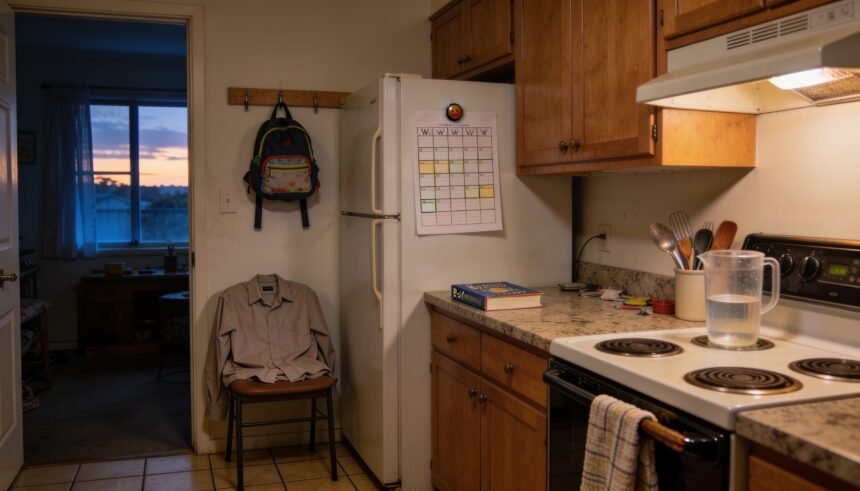
Put the coming week or fortnight’s pattern somewhere both adults and, where appropriate, the child can see: a shared calendar, a printed roster on the fridge, or a note both parents already check. Include who is doing pickup, who is home for dinner, and which nights follow the usual pattern versus a changed one. For a single household running two working parents’ calendars against each other, the morning handover method covers the daily version of this; a shift roster needs the same information set a week ahead instead of each morning.
Mark the exceptions rather than the whole week in detail. If Tuesday and Thursday are identical to last week, you do not need to rewrite them. Flag only what has changed: a swapped shift, an extra night, a different pickup person.
3. Hand over clearly when the roster changes who is on
Whichever parent is coming off and whichever is coming on need the same three things: what is finished, what is still to do, and anything the child needs to know about who is picking them up or where they are sleeping. Sharing the invisible load covers the wider division of this kind of mental work between two adults; the handover itself just needs to happen out loud, not assumed.
Where children move between two homes, the handback point is the same idea applied to a changeover day rather than a shift change. Confirm school bags, any medication, and the next few days’ plan at the point of exchange rather than relying on a message sent earlier in the week that might not have been read.
4. Build in the short-notice version
Shift rosters change. Decide in advance what happens when a shift is extended, swapped or cancelled with little warning, rather than renegotiating from scratch each time.
- A shift runs long: agree beforehand who the backup contact is for pickup, and make sure that person already knows the anchor routine, not just the school’s address.
- A shift is added at short notice: confirm who covers the anchors that night before accepting the swap, not after.
- A changeover day falls on a non-standard roster day: check the arrangement the night before rather than assuming the usual pattern holds.
- The child is unsettled by a changed pattern: keep the anchors exactly the same even when nothing else about the day is normal. Raising Children Network notes that having a ritual to mark the move between work and family time, such as changing out of work clothes or a short walk, helps separate the two; the same idea works in reverse for a child adjusting to a parent arriving home at an unusual hour.
5. Review what keeps breaking
After a few weeks, look at which anchor actually held and which one quietly stopped happening. If the bedtime books survived but the shared breakfast did not, that tells you which one was realistic for this household and which one needs a different owner or a simpler version.
Raising Children Network also suggests calling a partner, carer or child on the way home to catch up on the day and work out who needs attention on arrival. In a shift-work or two-household pattern, that short check-in before walking in the door can do the same job the handover note does elsewhere: it tells the next person what they are stepping into before they are standing in the middle of it.
This week’s step: write down your two or three anchors, pin the coming fortnight’s roster where everyone can see it, and agree out loud who the backup contact is for a shift that runs long.
How we checked this
Reviewed on 3 October 2026 against Raising Children Network’s guidance on family routines and work-life balance. The anchor method, the roster format and the short-notice list are Dovelyne editorial suggestions, not a tested programme or a guarantee of fewer disruptions.
The one-page family week
One printable page that holds the whole week: meals, school, activities and who is doing the pickup. Free, and we send one useful email a week.
One email a week. No spam, unsubscribe in a click.