What is in this guide
Moving day is the part everyone dreads and the part that is actually over quickest. What decides whether a move is hard on children is the fortnight either side of it: how much warning they had, how much say they had, and how fast their own room becomes recognisable again.
Most of what helps costs nothing and happens before the truck arrives.
Tell them early, and tell them properly
The instinct is to wait until everything is confirmed so you do not worry them unnecessarily. The cost of waiting is that they find out by overhearing it, which is worse than any version you would have chosen.
Once it is real, say so. Then give them something concrete: when, where, what stays the same, and what they get to decide.
The Raising Children Network’s guidance on changing schools is the closest authoritative advice to this situation, and its central point transfers directly: discuss it well in advance, and ask your child to talk about, draw or list both the things they are looking forward to and the things they are worried about. Splitting it into two lists matters. A child who is only asked “are you okay about it” says yes.
Younger children need less notice than you think and more repetition. Older children need more notice and more control.
Give them decisions that are actually theirs
Children handle a move much better when some part of it is genuinely their call. It has to be real, though. Offering a choice you intend to override is worse than offering none.
Things that can safely be theirs:
- Which room is theirs, where there is any choice
- Wall colour, or which posters go up first
- What their room looks like on the first night
- Which toys travel in the car rather than the truck
- What happens to the things they have outgrown
That last one is worth taking seriously rather than doing behind their back. A move is the one moment when decluttering kids' toys is an easy sell, because the child can see the boxes. Doing it while they are at school is faster and costs you the trust.
The school question
If the move changes schools, start that earlier than everything else. Enrolment, uniform and the waiting list for the popular local school are all slower than the property settlement.
Practical order:
- Confirm the catchment. Australian public school enrolment is usually tied to your residential address, and proof of address is normally required
- Find out what the uniform actually is before you buy anything, because a new school means a new list and school uniforms cost more than most families plan for
- Contact the new school before you enrol, not after
- Ask the current school to forward records, and ask what they normally send
- Ask both schools about the middle of the term. Moving a child mid-term is sometimes better than moving them at a break, because the class is already running and there is no unstructured playground to survive alone
- Walk the new school grounds with your child before the first day if the school allows it
If the move crosses a state border, allow more time again. Year levels, curriculum sequencing and even the name of the first year of school differ between states, and that conversation is better had with the new school than assumed.
Keeping the friendships
The friendships are the loss children actually grieve, and they are the one thing adults tend to treat as automatic.
Raising Children Network suggests something small and effective: share the new address with your child’s close friends, and give them pre-addressed, stamped envelopes so they can write. Older children and teenagers will use messaging instead, but the principle is the same. Make staying in touch require no effort from the other family, because the other family is not the one who moved.
Set a date for the first visit before you leave. A vague “we will have you over soon” is not a plan a nine year old can hold on to.
The packing order that helps
Pack their room last and unpack it first. That single rule does more than everything else on this page.
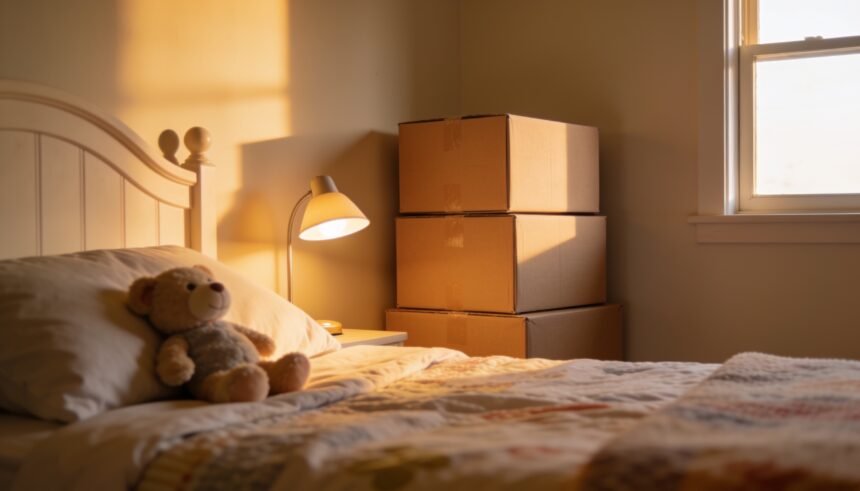
For the last week, their room should look almost normal. On arrival, it should be the first room that looks like a room: bed made, a few familiar things out, the rest still in boxes. A child who goes to sleep in a bed that feels like theirs has had a much better day than one who goes to sleep on a mattress in a room of cardboard.
Everything they need between leaving and bedtime should travel in the car, not the truck. That is the first-night box, and for a family with children it needs a second layer: one comfort item per child, their pyjamas, and enough of their own things that the new room is not blank.
If a dog is moving too, its bed is part of the same rule, and it is worth thinking about where the bed goes in the new house before the first night rather than after a week of the dog sleeping in the hallway.
The week afterwards
Expect the wheels to come off slightly, three or four days in, after the adrenaline goes. Sleep goes first, then behaviour. It usually settles.
What helps:
- Restore the routine before you restore the house. Same bedtime, same order of things, even in a half-unpacked house. The boxes can wait, and the school morning routine is the one worth rebuilding first
- Take them to the everyday places early. The supermarket you will actually use, the park, the route to school. Unfamiliar becomes ordinary faster than you expect once it has been walked once
- Leave something visible undone in their room that they get to finish. It gives them a job in the new house
- Do not ask constantly whether they are okay. Ask at bedtime, once, and then let them raise it
The admin nobody warns you about
Two jobs run in parallel with all of this and both have deadlines attached to them: telling the right organisations you have moved, and getting your bond back if you were renting. Neither can be left until the boxes are unpacked.
Changing your address covers who has to be told and in what order. Getting your bond back covers the inspection at the other end, which is the one with money attached. What moving house actually costs covers the money side of the move itself, which is where the surprises are.
What this actually looks like
Nobody executes this cleanly. The last box sits in the hallway for a month, somebody’s school shoes are in a box nobody can find, and the first fortnight is worse than the second.
The two things worth protecting are the warning and the bedroom. Give children real notice and a real say, then make their room the first thing that looks finished. The rest of the house can take as long as it takes.
The one-page family week
One printable page that holds the whole week: meals, school, activities and who is doing the pickup. Free, and we send one useful email a week.
One email a week. No spam, unsubscribe in a click.