
What is in this guide
Sharing a room does not fail because the room is small. It fails over two things: territory, and sleep.
Territory means each child having something that is unambiguously theirs, which can be as small as a shelf. Sleep means two children with different bedtimes and different tolerances for noise trying to fall asleep in the same space.
Get those two right and a genuinely small room works. Get them wrong and the biggest bedroom in the house still ends up with someone sleeping on the lounge.
Give each child a border
The most useful thing you can do costs nothing: make it obvious where one child’s space ends and the other’s begins.
- Each child gets their own bed, their own light and their own shelf. Not shared versions of those three things. A shared bedside table is a permanent argument
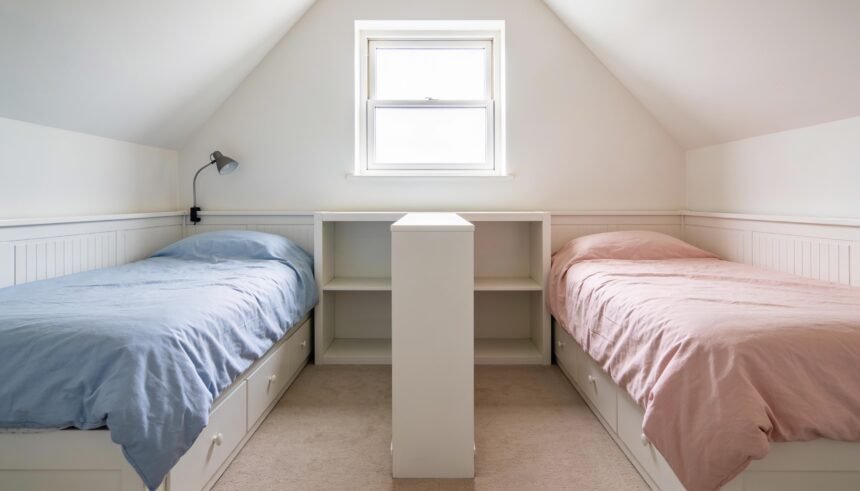
- Draw the line with furniture, not tape. A low bookcase, a chest of drawers or the end of a bed makes a border that is understood without being enforced
- Split the wardrobe explicitly, by side or by shelf, and say which is which
- Each child chooses what goes on their wall. Different choices are fine. Matching rooms are for photographs, not for children
- One drawer or box each that the other is not allowed in, and hold that rule. This matters most for the older child, who usually has more to lose from sharing
Where there is an age gap, the older child generally needs more protection of their space, and the younger one generally needs less than the adults assume.
Sleep, which is the harder half
Different bedtimes are the usual flashpoint, and there is no arrangement that removes it entirely.
What helps:
- Stagger by function, not by room. The earlier sleeper goes to bed in the room. The later one has a wind-down somewhere else and comes in already quiet
- A clip-on reading light for the later child rather than the main light
- Accept some noise. Children who share generally get used to each other, and a household that goes silent at 7pm is not sustainable. White noise, a fan, or a door left slightly ajar to the hallway sound is more realistic than silence
- Block the light. In Australia the bigger sleep problem is often not each other, it is a 5am summer sunrise. That is a different job, covered in getting a kids room dark and cool enough to sleep
- Separate them for a bad patch. If one child is sick or going through a rough few weeks, a mattress in another room for a while is a reasonable answer and not a failure
Bunk beds, and the rule that applies
Bunk beds are the obvious answer to floor space and they carry a real safety obligation in Australia.
Bunk beds sold in Australia have been covered by a mandatory safety standard since 2002. It requires guardrails on the top bunk, prohibits gaps that could trap a child’s head or limbs, and does not allow protrusions greater than 8mm, because those become hanging points. The guardrail requirement is specific: at least 260mm between the top of the guardrail and the top of the mattress base.
On age, the ACCC’s position is that the top bunk or a raised bed is not recommended for children under nine, while noting that the suitable minimum age varies with a child’s maturity and development.
That is the line most often ignored, because a six year old very much wants the top.
Practical points that follow from the standard:
- Do not use a thicker mattress than the bunk is designed for. The 260mm guardrail clearance is measured from the mattress base, so a deep mattress quietly eats the margin the standard exists to provide
- Nothing hangs from the bed frame, ever. Skipping ropes, bags, dressing gown cords and hooks recreate exactly the hanging point the 8mm protrusion limit is there to prevent
- Keep the top bunk clear of ceiling fans and light fittings
- Second-hand bunks may predate the current standard, so check the guardrails, the gaps and the protrusions rather than assuming
Alternatives worth considering: a trundle bed, two singles along one wall in an L, or two beds head to head with a shared shelf between them. All of them avoid the top-bunk question entirely, and the L shape often frees more usable floor than a bunk does.
Storage, because sharing doubles the stuff
Two children in one room means twice the possessions in half the space, and storage is what decides whether the room stays usable.
- Go up. Shelves above the beds, hooks on the back of the door, tall narrow units rather than wide low ones
- Under-bed storage on wheels, one set each, clearly theirs
- Halve the toys in the room. A shared bedroom is not a playroom, and it works much better when most of the toys live somewhere else. Decluttering kids' toys is the precondition for this rather than an optional extra
- A basket each by the door for the clothes that never make it to the wardrobe
- If you rent, favour freestanding and tension-mounted solutions. Anything screwed to a wall needs permission and has to come out again
One safety point on storage: tall furniture in a child’s bedroom should be anchored to the wall. Toppling furniture is a genuine hazard for young children, and anchoring brackets come with most flat-pack units and are usually left in the box. If you rent, that is a conversation worth having with the agent rather than a reason to skip it.
Set the rules once, out loud
Most of the friction is procedural rather than emotional.
- Who gets the room to themselves and when. A standing afternoon slot each is better than negotiating daily
- What happens when a friend comes over
- Lights out, and who controls the main light
- Whether the door is open or closed
- What is shared and what is not
Say it once, in front of both of them, and write it somewhere. A shared room with agreed rules is a much smaller problem than a shared room without them.
When it is genuinely not working
Some pairings do not share well, and persisting with it past the point of usefulness costs more than the bedroom is worth. A study or a sleepout converted into a small bedroom, or swapping which children share, is a legitimate answer.
It is also worth remembering that sharing is normal and not a deprivation. Most of the world does it, most children who share are fine, and the arrangement usually settles within about a month.
If this is happening because of a move, moving house with kids covers the rest of that fortnight.
The one-page family week
One printable page that holds the whole week: meals, school, activities and who is doing the pickup. Free, and we send one useful email a week.
One email a week. No spam, unsubscribe in a click.