For about a decade, a large number of Australian households kept a bag of bread bags and pasta packets by the door and took it to the supermarket. In late 2022 that stopped, abruptly, when REDcycle collapsed and it emerged that a great deal of collected material had been stockpiled rather than recycled.
A replacement has been rolling out since, run as a product stewardship scheme with the supermarkets as collection points. It is genuinely working and it is genuinely not everywhere yet.
So the honest answer to “can I recycle soft plastics again” is: probably, depending where you live, and the way to find out takes about two minutes.
What changed, briefly
The old scheme was a single operator collecting through supermarkets. When it failed, the material had nowhere to go, and the trust damage was the lasting part: several years on, most households assume soft plastics simply are not recyclable.
The replacement is structured differently. It is a stewardship scheme funded by the brands and retailers that put the packaging on shelves, with collection through participating supermarkets, some council kerbside trials, and some council recycling centres. As at 13 September 2026 there are more than 700 collection points across New South Wales, Victoria, Queensland and the ACT, reaching close to 70 per cent of the Australian population.
The two things worth taking from that:
- It is real, and the material has a destination
- Around three in ten Australians still have no convenient drop-off, and pretending otherwise helps nobody
The two-minute check
Before you start collecting again:
- Search your postcode on the scheme’s collection location finder, or check the recycling section of your supermarket’s site
- Check your council’s website for soft plastics, because a small number of councils now run kerbside or recycling-centre collection
- Look for the label. Packaging carrying the Australasian Recycling Label marked “Check locally” for soft plastics is the material the scheme is designed for
If all three come back empty, your area is not covered yet. Put the bag down and read the last section of this article instead, because there is a more useful thing to do than stockpile.
What counts as a soft plastic
The scrunch test is the rule of thumb and it holds up: if you can scrunch it into a ball in your fist and it stays scrunched, it is a soft plastic.
In:
- Bread bags and the clip
- Pasta, rice and cereal bags and liners
- Biscuit and cracker packets, and the plastic tray inside where it is soft
- Frozen vegetable and chip bags
- Chip and confectionery packets
- Bubble wrap and postal satchels
- Plastic shopping bags and produce bags
- Cling film, if it is clean
- The plastic film over a meat tray, if it is clean
Out:
- Anything rigid. If it holds its shape, it belongs in the yellow bin or nowhere
- Anything wet, greasy or with food stuck to it
- Compostable or degradable bags, which are a different material and contaminate the stream
- Silver-lined coffee bags in some areas, which is worth checking locally
- Nappies, wipes and anything that has been in a bathroom
The single most important preparation step is that it must be clean and dry. A greasy chip packet is not recyclable, and a wet bag contaminates what it is stored with. Shake out the crumbs, and if it needs rinsing, rinse and dry it.
How to store it without it taking over the kitchen
This is the part that decides whether a household keeps it up, and it is what the announcements never cover.
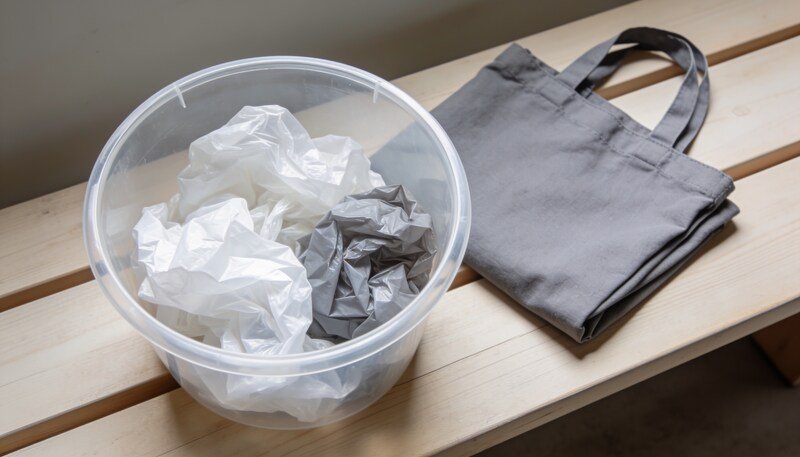
- One container, not a growing pile. A lidded bin, a large tub in the laundry, or a bag hung on the back of a cupboard door
- Size it to your trip frequency. If you shop weekly, you need one week of soft plastics, not a garage corner
- Squash as you go. Air is most of the volume
- Keep it away from the wet bin. The reason households give up is that the collection bag gets contaminated by something damp
- Put it in the car, not by the door. The bag by the door is the bag that never gets taken. The bag in the boot goes because the boot arrives at the supermarket
A household system for four bins and two drop-offs works through where all of this actually lives in a normal kitchen.
What happens if you put it in the yellow bin instead
It is worth understanding, because this is the most common and most damaging recycling mistake in Australia.
Soft plastics wrap around the spinning discs and rollers in a materials recovery facility. Operators have to stop the line and cut them out by hand. It is the single biggest cause of contamination in kerbside recycling, and it is why the answer to “well, I’ll just put it in the yellow bin and hope” is a firm no.
What actually goes in the yellow bin covers the rest of that list, including the other mistakes that cost more than people expect.
If your area is not covered yet
Stockpiling for a scheme that has not reached you is how garages fill up and enthusiasm dies. More useful:
- Reduce the volume at the source. Loose fruit and vegetables instead of pre-bagged is the single biggest change available in a normal shop, and it usually costs less per kilo
- Buy the bigger pack. One large pasta bag instead of four small ones is less packaging and less money
- Reuse what you have. Bread bags are good freezer bags and good bin liners for a small bin
- Check again in six months. The scheme is still expanding, and coverage where you live may change
- Do not switch to compostable bags as a substitute unless your council actually accepts them, because in most places they are neither recyclable nor compostable in practice
Common questions
Does it have to be a supermarket bag? No. Any clean, dry soft plastic that passes the scrunch test, from any brand, is what the scheme collects. The bin is at the supermarket; the material does not have to be theirs.
Do I need to separate different types? No. It goes in together.
What about the little plastic windows in envelopes? Leave them. Paper envelopes go in the paper recycling with the window still in; the facility handles it. Do not try to pick them out.
Is compostable packaging better? Only if you have somewhere for it to go. A certified compostable bag in a landfill behaves much like any other bag. If your council has a FOGO service, check whether certified liners are accepted there, because some do and some explicitly do not.
What about the soft plastic my online shopping comes in? Satchels and bubble wrap are exactly what the scheme is for, and they are usually clean already.
The short version
Check your postcode. If you are covered, keep one lidded container, squash as you go, keep it dry, and put it in the car rather than by the door. If you are not covered, cut the volume at the supermarket instead of stockpiling, and check again later in the year.
And whatever the answer, do not put soft plastics in the yellow bin. That is the one choice that makes things actively worse.
The one-page family week
One printable page that holds the whole week: meals, school, activities and who is doing the pickup. Free, and we send one useful email a week.
One email a week. No spam, unsubscribe in a click.