What is in this guide
These are three jobs that only really work as one, and the order matters more than the technique. Clean the glass first and the grit still sitting in the track blows straight back onto it. Clean the screens last and you drip dirty water down glass you have just done.
The order that works: screens out, tracks, screens washed, glass, screens back.
Most of a year’s dirt on an Australian window is not on the glass at all. It is in the bottom track and in the mesh, and both are the reason the glass looks bad again a fortnight after you did it.
First: is it a flyscreen or a security screen
This decides whether you are doing this at all.
A flyscreen is a light aluminium or fibreglass frame with fine mesh. It sits in the window channel and lifts or clips out. It is designed to be removed.
A security screen is heavy, with a steel or stainless mesh, usually a much thicker frame, and it is fixed with one-way screws or a tamper-resistant fastener. It is a barrier, not an insect screen, and on many Australian homes it is also part of how the house is secured.
Do not take a security screen off. Clean it in place. If a security screen is on a bedroom window it may also be part of an escape route arrangement, and re-fitting it wrongly is a genuine safety problem rather than an inconvenience.
If you are not sure which you have, the test is the screws. Visible, ordinary screws or a simple clip means flyscreen. Anything designed not to be undone means leave it.
Getting a flyscreen out without breaking it
Flyscreen frames are thin aluminium and they bend permanently if you lever them.
- Sliding windows: most screens lift up into the top channel and then swing out at the bottom. Push up, swing the bottom towards you, lower it out
- Awning and casement windows: the screen is usually on the inside and held by small plastic clips that turn
- Older screens may have two spring-loaded plungers on one side that pull inward
Work with two hands, take the weight of the frame, and if it will not come with gentle pressure, stop and look again rather than pulling harder. Put each screen down flat, not leaning, and keep track of which window it came from. They are rarely interchangeable even when they look identical.
The tracks, which are the actual job
The bottom track is where every bit of dust, sand, pollen, dead insect and washing powder has been collecting since the house was built. Water alone turns it into grey paste and spreads it.
Do it dry first.
- Vacuum the track with a crevice tool, end to end, including the vertical channels
- Loosen what is stuck with a dry stiff brush, an old toothbrush, or a paintbrush. Work along the track, then vacuum again
- Now wet it. Warm water with a little dish soap, applied with the brush
- Get into the corners with a cotton bud or the corner of a cloth wrapped over a flat-bladed screwdriver
- Wipe it out dry. Water left in a track is what turns next month’s dust into paste again
- Check the weep holes. Most sliding window tracks have small drainage holes at the outside edge of the bottom channel. Blocked weep holes are the reason water pools in the track and comes inside in heavy rain. Clear them with a cotton bud or a soft wire
The weep holes are the part almost nobody knows about and the part that prevents an actual problem rather than a cosmetic one.
If the window is stiff to slide, that is usually track grit rather than a fault, and it usually fixes itself once the track is properly clean. Do not put oil or grease in a window track. It collects dust and makes the problem permanent. If it still binds afterwards, that is a repair conversation, and in a rental it is a maintenance request, which repairs in a rental sets out properly.
Washing the screens
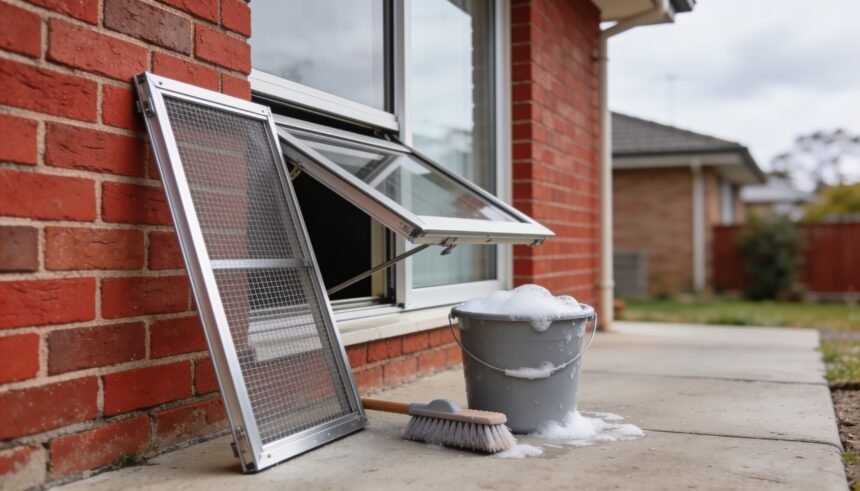
Outside, flat, on a surface you do not mind getting dirty. A driveway, a lawn, or two chairs.
- Hose them gently first. High pressure will push the mesh out of the frame, and a pressure washer will destroy them
- Wash with warm soapy water and a soft brush, both sides, working with the weave rather than across it
- Rinse, then stand them on edge to drain and dry before they go back
- Do not scrub. Mesh stretches, and a stretched screen never sits flat again
Be honest about the result. A screen that is ten years old and faces the weather will come up better but not new. Sun-degraded fibreglass mesh goes brittle and chalky and cleaning does not reverse it. If it tears when you wash it, it was already gone, and a rescreen is cheap relative to a new window.
Coastal and dusty regions: salt spray and fine red dust both load mesh far faster than suburban dust, and both benefit from a plain hose-down several times a year rather than one annual wash.
The glass, last
Now that nothing above it is dirty.
- Wash first, dry second, and use two cloths. Most streaking is one cloth doing both jobs
- Microfibre for the wash, a second dry microfibre or a squeegee for the finish
- Do not do windows in direct sun. The solution dries before you can remove it and every streak sets. Early morning, late afternoon, or an overcast day
- Do the inside strokes vertical and the outside horizontal, or the reverse. When a streak shows up you immediately know which side it is on
- Finish the frames and sills before you put the screens back
The height rule
If a window needs a ladder, that is where this job stops.
Second storey windows, windows above a stairwell, and anything you would be reaching sideways for are not worth the risk of a fall, and falls from ladders at home are among the more common serious household injuries. Do those from inside where you can, and pay somebody for the rest.
How often
Tracks and screens twice a year is enough for most houses: once in spring before the insects, once after summer. More often on the coast, more often on a main road, more often if anyone in the house reacts badly to dust or pollen.
If this is happening because you are leaving a rental, it belongs inside the larger job in end of lease cleaning. If the bathroom window is also the mouldy one, bathroom mould is the other half of that problem, and if you are doing this as part of a seasonal push, drying washing in wet weather is the other job that gets easier when the windows actually open.
The one-page family week
One printable page that holds the whole week: meals, school, activities and who is doing the pickup. Free, and we send one useful email a week.
One email a week. No spam, unsubscribe in a click.