What is in this guide
Washing does not dry because the air around it is already full of water, not because it is cold.
Airflow and moisture removal matter more than heat, which is why a heater in a closed room dries washing badly while a fan and an open window dries it well. Understanding that one thing changes what you do.
It also explains the second half of this problem: water that leaves the washing goes into the house. A load of wet washing dried inside a sealed room puts a substantial amount of moisture into the air, and in a humid Australian house that is how you get mould.
What actually works
In order of effect.
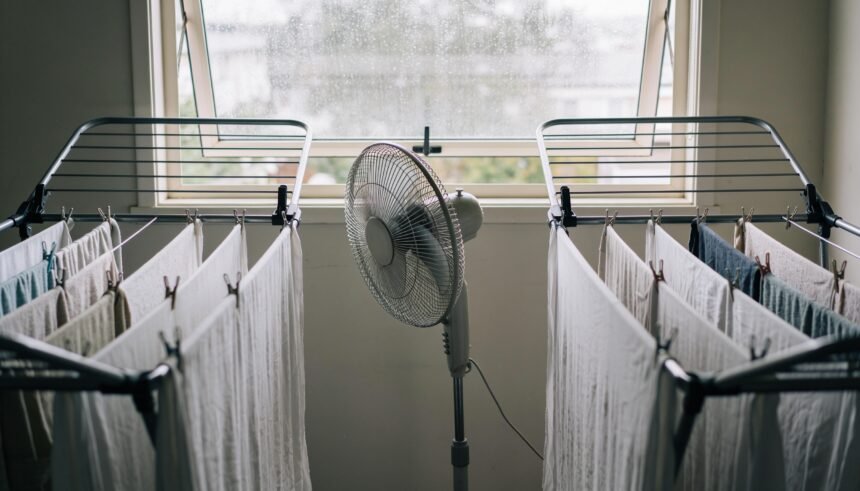
1. Airflow. A fan pointed at the washing does more than a heater. A pedestal fan, a ceiling fan, or a fan in a doorway moving air across the clothes. This is the single highest value change and it is cheap to run.
2. Space between items. Washing hung touching itself does not dry. Doubling the space on the airer roughly halves the drying time, and it is free. Two half-loaded airers beat one crammed one.
3. Ventilation. An open window, even slightly, even in the rain, so the moisture has somewhere to go. Without this you are moving water from the clothes into the room.
4. An exhaust fan, in a laundry or bathroom that has one, running while the washing dries in there with the door shut.
5. A dehumidifier, which is the most effective indoor option because it removes the water rather than moving it around. Running costs apply and are covered in laundry running costs and cheaper cycles, and do dehumidifiers stop mould covers what one does and does not fix.
6. A spin, then another spin. Running an extra spin cycle removes a surprising amount of water before the washing ever reaches the line, and it costs very little.
7. Under cover outside. A verandah, a carport, a covered pergola. Outdoor air in a wet week is still usually drier and more moving than indoor air.
8. Heat, last. Useful in combination with airflow and ventilation. Useless on its own in a closed room.
The mould problem
This is the part most drying advice omits and it matters in Australian houses.
Drying washing indoors releases the water from the clothes into the room. In a poorly ventilated house, that moisture condenses on the coldest surfaces: windows, external walls, behind wardrobes, in corners.
The results are mould, a musty smell, and damage to the building.
Three rules that prevent it:
Never dry washing in a bedroom with the door and window shut. It is the worst combination available: the room is used at night, the moisture has nowhere to go, and the surfaces are cold.
Always ventilate the room you dry in, or run a dehumidifier in it with the door shut.
Wipe condensation rather than leaving it, particularly on windows. Condensation in bedrooms and wardrobes covers the rooms where it does the quiet damage.
If mould has already appeared, mould in Australian bathrooms and how to stop it covers dealing with it and the ventilation principles are the same.
Why washing smells after a wet week
Washing that takes too long to dry develops odour, and once it has, drying it does not remove it.
Do not leave wet washing in the machine. Even a few hours in warm weather is enough. This is the single most common cause.
Wash it again if it has gone sour, and dry it faster the second time.
Leave the machine door open between loads so the drum dries out, and clean the machine’s seal and filter periodically, following the manual, because a machine that smells makes every load smell.
In persistent humidity, smaller more frequent loads dry better than one large weekend load that sits damp for two days.
The two different Australian problems
The northern wet season is humidity, not cold. Air temperature is high and the air is saturated, so evaporation is slow and outdoor drying can be worse than indoor.
What works in the north: dehumidifier, air conditioning on dry mode where available, fans, and accepting that a dryer may be the practical answer during the wet.
The southern winter is cold and damp, with short days and low sun.
What works in the south: the spin-twice technique, airflow, drying in the sunniest room, and getting washing out on the rare clear day even if it is cold, because cold dry moving air dries washing well.
Both share the same rule: the moisture has to leave the house, not just the clothes.
Using a dryer sensibly
Clean the lint filter every single load. A clogged filter reduces efficiency and is a recognised fire risk. Australian fire services publish guidance on dryer safety.
Vent it outside if it is a vented dryer. Venting a dryer into a laundry is the equivalent of drying the washing in the room, with the same moisture consequences.
Do not run it unattended overnight or when out, which is standard Australian fire service advice for appliances of this type.
Do not overload it, which increases run time and cost.
Follow the appliance manual.
What not to do
Do not dry washing over a portable heater, a column heater or any heating appliance. This is a genuine fire risk and Australian fire services warn about it specifically every winter. Clothes touching or draped over a heater can ignite.
Do not use an unflued gas heater in a closed room to dry washing, since unflued gas heating adds both moisture and combustion products to the air and ventilation requirements apply.
Do not run extension leads or power boards across a wet laundry floor. Electrical work, new outlets and any modification is a licensed electrician’s job.
Do not leave it on the airer for days hoping. Rewash it.
The practical household answer
Two airers, spaced out, in a ventilated room with a fan, plus an extra spin cycle, handles most wet weeks in most Australian houses for very little cost.
A dehumidifier is the upgrade that makes the biggest difference if wet weeks are a regular feature where you live.
And keep two of every uniform, which is the point made in school uniform stains and how to shift them and which removes the urgency from the whole problem.
Next: school uniform stains and how to shift them covers the other laundry problem, mould in Australian bathrooms covers what happens when the moisture stays inside, and what to actually throw out, and what to keep covers the linen that is finished.
If the airer itself is the weak point, how to size a clothes airer for a family wash explains the drying line figure that compares two of them honestly.
The one-page family week
One printable page that holds the whole week: meals, school, activities and who is doing the pickup. Free, and we send one useful email a week.
One email a week. No spam, unsubscribe in a click.