What is in this guide
Rewash musty towels using the care label’s wash instructions and the correct detergent dose, then dry them completely before putting them away. Check when the smell returns before changing anything else: towels that smell straight from the machine need a different investigation from towels left damp after a shower.
Find the point where the smell starts
Use the next towel load to narrow the problem. Check a towel when you unload it, once it is dry, and after its next use. This is a household troubleshooting exercise, not a test for mould or proof that a towel has been disinfected.
| What you notice | What to check first |
|---|---|
| Several towels smell as soon as the wash finishes | Detergent dose, wash setting and whether other laundry smells too |
| Towels seem fine at unloading but smell later on the rack | Whether they became fully dry before you folded them |
| The smell returns after a shower | How the used towel hangs and whether it dries before the next use |
| Towels are fine until they have been stored | Whether they went away dry and whether the cupboard itself smells |
These observations tell you where to look; they do not establish a single cause. If shirts and sheets also emerge smelling unpleasant, pause the towel experiments and check why the washing machine smells, using your appliance manual for its cleaning instructions.
Give the towels a properly measured wash
Read the towel label before choosing a hotter setting. There is no one temperature that suits every towel, decorative border or fibre blend. Sheridan’s current towel care guide, for example, recommends a gentle 40 degree wash for its towels. That is a manufacturer’s care recommendation, not a universal prescription for a musty load.
Leave room in the drum rather than wedging in the last bath sheet. Sheridan advises against overloading towel washes. If the whole household’s towels will not fit comfortably within the machine’s instructions for the selected programme, split the load.
Measure detergent against its directions for your load and water conditions. The American Cleaning Institute notes that both too much and too little detergent can reduce cleaning performance. Automatically halving the dose is no more useful than pouring in extra because the washing smells.
For this wash, leave out fabric softener. Sheridan warns that it can leave a waxy build-up and reduce absorbency. Keep the process simple enough that you can tell what you changed: an appropriate load, a measured dose and a label-compatible cycle.
Arrange the wash to finish when somebody can unload it. Bosch identifies laundry left in the drum after a programme, incorrect detergent dosing and regular low-temperature washing as possible contributors to unpleasant smells. If you normally start a load before leaving for a long shift, choose a different washing window for this attempt.
Use sun as a drying opportunity
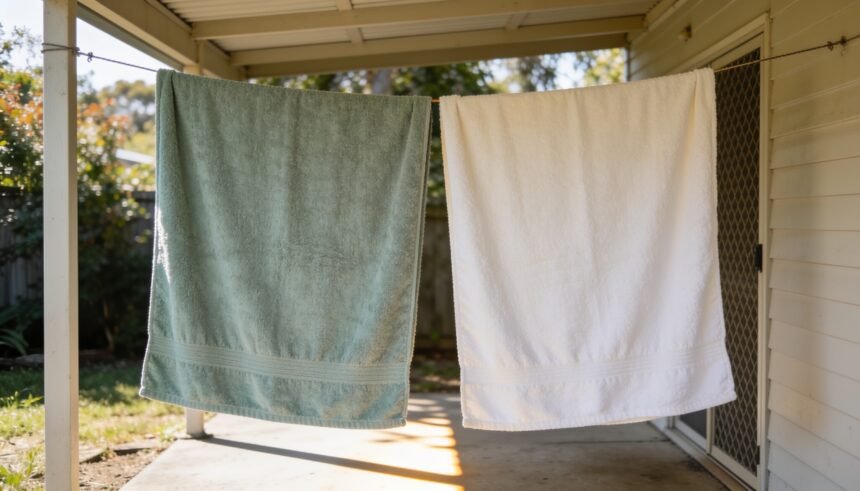
You do not need to leave a towel baking in direct sun to follow good towel-care guidance. Sheridan recommends line drying in the shade and says towels should be completely dry before storage. A shaded line is therefore a reasonable option where your towel’s label allows it.
For this troubleshooting wash, choose a drying arrangement you can check. Spread towels individually, leave space rather than layering one over another, and inspect the folded-over part and thick edges before taking them down. If part of a towel still feels damp, it is not ready for the linen cupboard.
Do not make a sunny afternoon your mould treatment plan. The care guidance used here does not establish a sun-exposure time that disinfects a household towel. Use the line to dry a washed towel, without assuming that sunshine has corrected an inadequate wash.
In an apartment, or during a run of wet days, work with the drying space you actually have. Wash fewer towels together if that is all you can spread out. If using a tumble dryer, follow both the towel label and appliance instructions. For the wider household drying problem, see drying washing through wet weather.
Change what happens after the shower
The American Cleaning Institute recommends hanging towels after use and allowing them to dry between uses. Look at the rail when everyone has finished in the bathroom: can each towel hang separately, or is one sitting over another?
A practical adjustment is to give each person a distinct hanging space. If the existing rail cannot accommodate the towels, use another suitable drying spot rather than treating the crowded rail as the only option. The useful check is whether the towel actually becomes dry before it is used again.
For a towel already due for washing, avoid making the laundry basket its damp waiting place. Hang it to dry while it waits for the next load. Keep it separate from the clean towels so nobody mistakes it for one ready to use.
Know when to stop repeating the same wash
If one towel remains unpleasant while the others washed and dried alongside it are fine, contact its manufacturer for care advice or consider replacing it. That is a practical stopping point, not a claim that every persistent smell means permanent damage.
If the room or cupboard smells even without towels in it, investigate that separately. Visible marks on walls or grout belong with the guidance on dealing with bathroom mould, rather than another change of laundry detergent.
Start with one manageable load. Note the cycle and detergent dose, unload promptly, and check the towels at drying, storage and next use. That gives you something specific to change if the smell returns.
The one-page family week
One printable page that holds the whole week: meals, school, activities and who is doing the pickup. Free, and we send one useful email a week.
One email a week. No spam, unsubscribe in a click.