What is in this guide
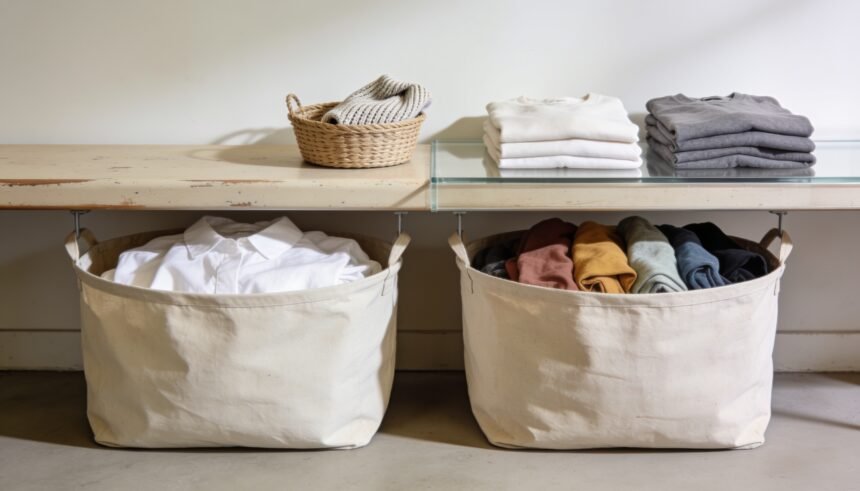
Build your laundry sorting system around compatible wash loads, with a separate place for anything that needs a label check or attention before washing. Keep clean clothes on a different route back to their owners, so the same basket does not become a mixture of dirty, waiting and finished washing.
The layout below is an editorial starting point. Adapt the number of baskets and the handover routine to your space; there is no measured promise about how much time it will save.
Start with the baskets and space you have
Use existing baskets, a clear place to sort and somewhere separate for clean washing. You do not need a matching set of containers or a permanent sorting bench.
Choose where dirty clothes enter the system. That might be beside the bathroom, in a bedroom or in the laundry itself. For a compact rental, one collection basket and a temporary sorting surface may be more practical than several floor-standing baskets.
Decide which approach fits before moving anything:
| Approach | Choose it when | The trade-off |
|---|---|---|
| Sort at collection | There is room for clearly labelled groups and everyone understands them | Uses more collection space; still needs a final garment check |
| Sort before washing | Space is tight or clothing care needs vary considerably | Keeps collection simple but leaves the sorting to whoever starts the load |
| Collect by person, then sort together | Bedroom collection points suit the household | Preserves ownership initially, but a person’s clothes are not automatically one compatible load |
Pick one collection method for now. Adding a separate container for every possible fabric is optional, not a requirement.
Step 1: Decide what can actually share a wash
Read care labels before assigning wash groups. CHOICE advises following garment care instructions and notes that a delicate machine cycle is not necessarily a substitute for handwashing. A basket marked “delicates” is therefore a place to check items, not permission to wash everything in it together. [S1]
Bosch’s laundry guidance sorts by fabric, colour, soiling and care instructions. It says to separate whites from colours and wash new coloured items separately the first time. [S2]
For the household layout, begin with collection groups such as whites, colours and “check first”. Split these further at wash time wherever care instructions or soiling differ. Colours is a collection category, not a promise that every coloured garment belongs in the same cycle.
Put unfamiliar garments in “check first” until someone reads the label. If a garment needs handwashing or another specific process, give it that process rather than leaving it permanently at the bottom of the basket.
Step 2: Give exceptions an action
Use “check first” for items with an unread label, a visible mark needing attention or an uncertain washing requirement. Make this a decision point whenever you prepare a load, not an indefinite holding area.
For each item, choose the next action: check its instructions, deal with the mark using appropriate guidance, or schedule the separate care it needs. Keep stain treatment outside the sorting routine itself; the basket label cannot tell you which treatment suits a fabric.
If clothes remain inside school or sport bags, make emptying those bags part of the collection step. The existing guide to a drop zone in a small entry covers where bags land. Here, the task is simply to get washing from the bag to its agreed collection point.
Step 3: Choose the next load by need
At each wash session, identify what is needed next: a school shirt, work clothes or the next set of bed linen. Use that to choose which compatible group goes first.
Urgency does not change the care label. An urgently needed shirt can set the order of loads without turning incompatible clothes into one load.
Before loading, empty pockets and check the machine’s load limit for the selected programme. Bosch’s manual includes pocket checks and maximum-load limits in its preparation instructions. Use your own appliance manual for the applicable capacity. [S2]
Do not treat a full collection basket as a machine-capacity measure. Split the contents as needed after checking the garments and programme.
Step 4: Name the handover after washing
Choose who will move the completed load to its drying stage before starting it. For shift workers or shared households, use a short handover such as “coloured clothes washed; ready for you to hang”. The aim is a clear next action, not a detailed household tracking system.
Keep drying and putting away as separate tasks in the routine. If nobody can handle the next stage, reconsider the timing of that load rather than adding it automatically to the queue.
Step 5: Sort clean clothes by destination
Once clothes are dry, change the sorting rule. They no longer need wash groups; they need destinations.
Make a pile per person, with separate piles for shared linen and towels. Put them straight into their storage places if practical. Where people put away their own clothes, agree where each person’s clean pile waits and who clears it.
A single shared basket can carry those piles in turn. Separate return baskets are optional, particularly when storing empty baskets would use space you need for something else.
Change the stage that keeps stalling
If the system still produces a mountain, locate the unfinished action:
- Clothes beside the collection basket: try moving the collection point to where clothes are removed.
- Several tiny categories waiting indefinitely: reduce permanent collection groups, while retaining the care-label checks before washing.
- An overflowing “check first” pile: decide the next action for those items before preparing another ordinary load.
- Clean washing waiting in heaps: focus on the return-to-owner step before adding more dirty-washing storage.
- Repeatedly missed handovers: agree who owns the next stage when the load starts.
These are adjustments to try, not evidence that one layout suits every household.
Set up the next load
Choose the collection point, name the “check first” place and sort one load using its care instructions. Before starting it, agree who handles drying and where the clean clothes will go.
The one-page family week
One printable page that holds the whole week: meals, school, activities and who is doing the pickup. Free, and we send one useful email a week.
One email a week. No spam, unsubscribe in a click.