What is in this guide
Almost no Australian house has a mudroom. What most have is a hallway a metre wide, or a door from the garage straight into the laundry, and a pile on the floor that appears every afternoon at 3.40.
A drop zone still works in that space. It needs less room than the photographs suggest and the thing that determines whether it succeeds is not the storage, it is the height.
The one measurement that matters
Hooks must be at the height of the person using them, not at adult height.
A hook at 1600mm is unusable for a seven year old, so the bag goes on the floor. The parent concludes the child is careless. The child is being asked to do something they physically cannot do well.
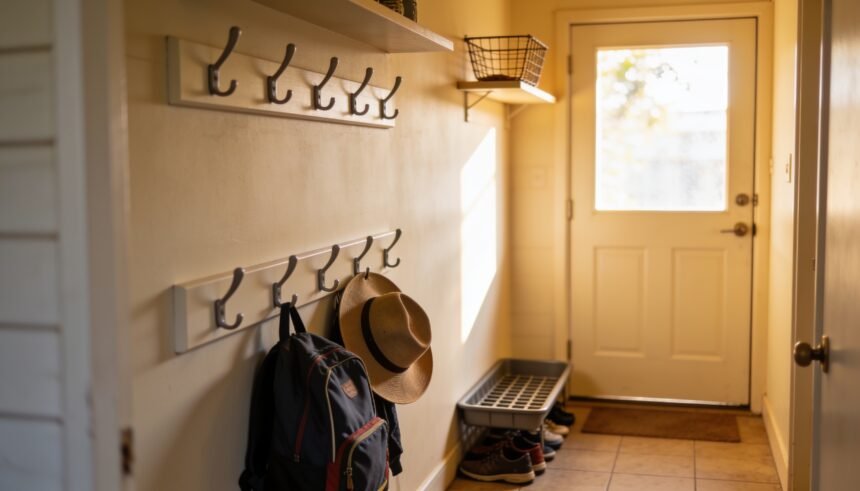
Put a row of hooks at roughly the child’s shoulder height, and move them up every couple of years. A second row higher for adults.
This one change fixes more hallway piles than any amount of storage furniture, and it costs a few dollars.
What the zone actually needs
Five things, in priority order. If you only do the first two, it still works.
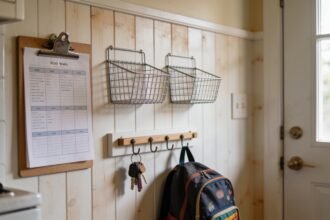
1. Hooks, at the right height. For bags, hats and jackets. Hooks beat a cupboard because they require no opening, and anything requiring an extra action does not happen at 3.40.
2. Somewhere for shoes. A shallow tray, a low shelf or a basket per person. The tray is worth having in its own right: Australian entries get mud in winter and grass seeds and sand in summer, and a contained spot stops it travelling through the house.
3. A landing spot for the things that come out of the bag. Notes, forms, drink bottles, readers. A single tray or basket that gets emptied. This is the physical end of the pipeline in the school-year calendar setup that stops missed notices, and without it the notices stay in the bag.
4. A keys and wallet spot for adults, which prevents the five minute search and stops those items migrating to the kitchen bench.
5. Somewhere to sit, if there is room. Useful for shoes and usually the first thing to be cut in a narrow space. Not essential.
Making it fit a narrow hallway
Go vertical. A narrow hallway has very little floor and plenty of wall. Hooks and a high shelf take almost no depth.
Use the back of a door. Over-door hooks or a hanging organiser add storage with zero footprint, and the back of a laundry or garage door is usually completely unused.
A shallow shelf at about 1200mm clears heads, holds keys and mail, and does not narrow the walkway.
Do not put a bench in a corridor under 1.2 metres wide. It will be walked into daily and eventually moved.
Use the wall in the garage instead, if that is the door everyone actually uses. The drop zone belongs where people enter, which in a great many Australian houses is not the front door.
The garage entry version
Worth its own treatment because it is so common.
Hooks on the wall beside the internal door, at the right heights.
A shoe tray on the garage side, so dirt never comes in.
Be careful what is stored at child height in a garage, since chemicals, tools and equipment are usually there. The drop zone should be a defined section, not a general use of garage shelving.
Light matters. A garage entry is often dim and nobody hangs a bag on a hook they cannot see. A sensor light is the fix.
Australian specifics
School hats. A daily item in most Australian primary schools and the single most commonly lost one. Hats need their own hook or basket at the entry, not a shelf they get pushed off. If a hat is not at the door, it will not be found in the morning.
Sun and heat. An entry that gets direct afternoon sun will degrade anything left there and makes the space unpleasant to stand in. This affects which door people actually use.
Wet season and mud. In much of the country the entry problem is seasonal and intense rather than constant. A tray that seems excessive in October is essential in July.
Rentals. Most Australian families rent at some point and cannot drill holes. Adhesive hooks rated for the weight, over-door hooks, a freestanding coat stand, a narrow shelf unit and a shoe rack all work without fixings. Check the weight rating honestly, because an adhesive hook holding a loaded school bag is a different proposition to one holding a jacket.
Fixing things to the wall
Follow the product’s instructions and weight rating, and use the right fixing for the wall type, which in Australian homes is commonly plasterboard, brick or fibre cement.
A loaded school bag is heavier than people estimate, and a hook pulling out of plasterboard takes a chunk of wall with it.
If you are unsure about a wall, a stud or anything structural, get a professional. This is not a job to improvise on a wall you do not understand.
Making it get used
One hook per person, and it is theirs. Shared hooks produce a pile on the hook nearest the door.
Label or colour by person for younger children, using a picture rather than a name for pre-readers.
Empty the landing tray daily, or it becomes a pile with a container around it, which is the most common way these fail.
Do the unpacking with them at first. Getting kids to pack their own bag covers building it into a routine rather than supervising it forever.
Accept it will not be perfect. A drop zone that catches the bags and the hats and misses the jumpers is doing its job.
Next: what to actually throw out, and what to keep covers the pile that has already built up, decluttering kids' toys covers the room it spreads into, and the school-year calendar setup covers what happens to the notices once they land in the tray.
For the furniture rather than the layout, family storage that actually gets used sorts the options by how many actions it takes to put something away.
The one-page family week
One printable page that holds the whole week: meals, school, activities and who is doing the pickup. Free, and we send one useful email a week.
One email a week. No spam, unsubscribe in a click.