What is in this guide
A family command centre is one place in the house where the week lives: the calendar, the school notices, the meal plan and the things that need signing. Build it near the door you actually use, keep it to four zones, and make updating it a two-minute job rather than a weekly project. That last part is what separates the ones still working in November from the ones quietly buried under junk mail by March.
Most command centres fail for the same reason. They are designed for a calmer, tidier household than the one that exists, so they demand more upkeep than anyone has. The version that survives is smaller, uglier and closer to the front door than the ones you have seen on Pinterest.
Put it where the traffic already is
The single biggest predictor of whether a command centre gets used is whether people walk past it without trying.
Good spots, roughly in order:
- The wall between the back door and the kitchen, if that is how everyone enters
- The side of the fridge, which is already where paper ends up
- Inside a pantry door, if you want it hidden but still central
- The end of a hallway bench where bags land
Bad spots, however much nicer they look: the study, a spare bedroom, the formal entry nobody uses, and anywhere you have to open a cupboard and move something first.
If your household comes in through the garage and drops everything on the kitchen bench, the command centre goes above that bench. Fighting the existing traffic pattern is a losing move.
The four zones, and nothing else
Keep it to four. Every extra zone is another thing to maintain.
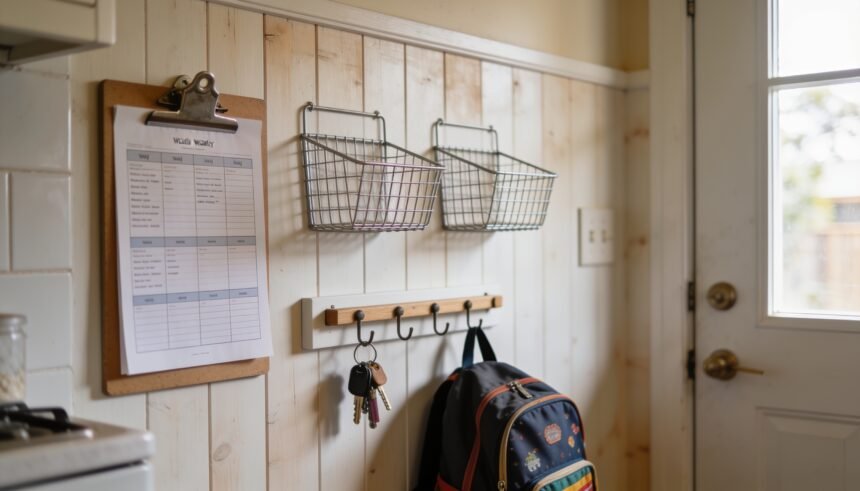
1. The week ahead. One view of the next seven days. This is the part people actually look at, so give it the most space and the clearest layout. A whiteboard works. A printed weekly sheet in a clip works better, because a fresh sheet each week forces a reset and a whiteboard slowly becomes a smear.
2. Incoming paper. A single tray or wall pocket for notices, permission slips and anything needing a signature. One tray, not one per person. The rule is that paper goes in the tray or in the bin, never on the bench.
3. Outgoing and actioned. A second pocket or a clip for things that need to leave the house: signed forms, library books, the thing that has to go back to school on Thursday. Physically separating in from out is what stops signed forms sitting in the house for a fortnight.
4. This week’s meals. Even a single line for each night is enough. The meal plan sitting next to the calendar is what stops the 5pm question, because whoever gets home first can see both what is on tonight and who is out.
That is it. No chore charts, no motivational quotes, no colour-coded tabs on day one. Add those later if the basic four survive a term.
What to put on the wall
You can do this with what is already in the house. If you would rather buy, the whole setup costs well under a hundred dollars.
- Something to hold the week. A clipboard, a magnetic A4 pocket, a cheap clip frame, or a small whiteboard. If you go printed, a clip frame lets you slide a new sheet in each Sunday without any fuss.
- Two wall pockets or trays. In and out. Acrylic, wire, fabric, it genuinely does not matter.
- A pen that lives there. On a string if you have to. The most common failure point in the whole system is that the pen wanders and then nobody updates anything.
- A small hook rail. For keys, the bag that always goes missing, and the library bag.
- A wall calendar, only if you are not already using a shared digital one. Running both is the fastest way to have neither be correct.
The Sunday reset, which takes six minutes
The build is the easy part. The habit is the actual system.
Once a week, at a fixed time, do these four things in order:
- Clear the in-tray. Sign what needs signing, bin what is done, move anything that needs to leave the house into the out pocket.
- Write the week. Fill in the seven days: who is where, what is on, who is picking up. Include the things that are easy to forget, like an early finish or a sports uniform day.
- Write the meals. Five weeknight dinners is plenty. Leave two blank on purpose so the plan can absorb a bad day without collapsing.
- Check next week’s first three days. This is the step most people skip and it is the one that catches the excursion payment due Monday.
Six minutes, at a time you will actually be standing in the kitchen. Sunday evening works for most households. Friday afternoon works better if your weekends are unpredictable.
Make it survive other people
A command centre maintained by one person is a chore. One maintained by the household is a system.
- Put it at the right height. If a seven-year-old cannot read their own week, they will keep asking you instead.
- Give each person a colour or a row. Not a full colour-coding scheme, just enough that someone can find their own line at a glance.
- Let kids write on it. The handwriting will be terrible. The engagement is worth more than the neatness.
- Say it out loud once a week. Thirty seconds at dinner on Sunday, running through who is where. This is what turns the wall into shared knowledge rather than something one person maintains and everyone else ignores.
Add the pet, because they are part of the week too
If there is a dog or cat in the house, the command centre is the right place for their week as well: worming and flea treatment dates, when the food was last bought, who is doing the morning walk, and the boarding booking for the holidays. These are exactly the jobs that get forgotten because nobody owns them, and they are trivial to track once they are on the same wall as everything else.
One line at the bottom of the weekly sheet is enough.
What to do when it stops working
It will stop working at some point. That is normal and fixable.
The paper tray is overflowing. The weekly reset is not happening. Move it to a different day rather than trying harder on the same one.
Nobody looks at it. It is probably in the wrong place, or too high, or too far from the door. Move it before you redesign it.
The whiteboard is illegible. Switch to a printed sheet. A fresh page each week is self-cleaning in a way a whiteboard never is.
It has become decorative. Too many zones. Strip it back to the four and see what you actually miss.
One person maintains all of it. Give someone else a single specific job: the meals line, or the pet row. Shared ownership beats a better design.
Start this weekend
You do not need to buy anything to begin. Pick the wall, stick up a sheet of paper for the week ahead, put a tray under it for paper, and do one Sunday reset. If it is still there in three weeks, then buy the pockets and the clip frame.
The command centre that works is the one you can rebuild in ten minutes after it falls apart, because it will, and rebuilding it is part of running a household rather than a sign that the system failed.
Next: the one-page family week planner is the printable sheet this whole setup runs on, and the school morning routine is what it looks like on a Tuesday at ten past seven.
The one-page family week
One printable page that holds the whole week: meals, school, activities and who is doing the pickup. Free, and we send one useful email a week.
One email a week. No spam, unsubscribe in a click.