What is in this guide
Storage is bought on capacity and judged on capacity, and neither is the thing that decides whether a house stays tidy.
What decides it is how long it takes to put one thing away. A basket you drop a jumper into is used. A lidded box on a high shelf behind a door is not, however much it holds.
This guide compares published specifications and Australian retailer listings. Nothing here was assembled, loaded or lived with by us.
Put-away friction, measured in actions
Count the actions between holding the object and it being away:
- One action. Drop it in an open basket or on a hook. Always used
- Two actions. Open a door, put it in. Used by adults, mostly
- Three or more. Open a door, lift a lid, move something else first. Not used, and the object stays on the bench
The design rule that follows: use the fewest actions for the things that move daily, and save the closed, stacked, lidded storage for things that move seasonally.
In practice that means open hooks and baskets at the door, closed storage in the same unit for the things nobody needs to see, and the roof space or the top shelf for camping gear and Christmas.
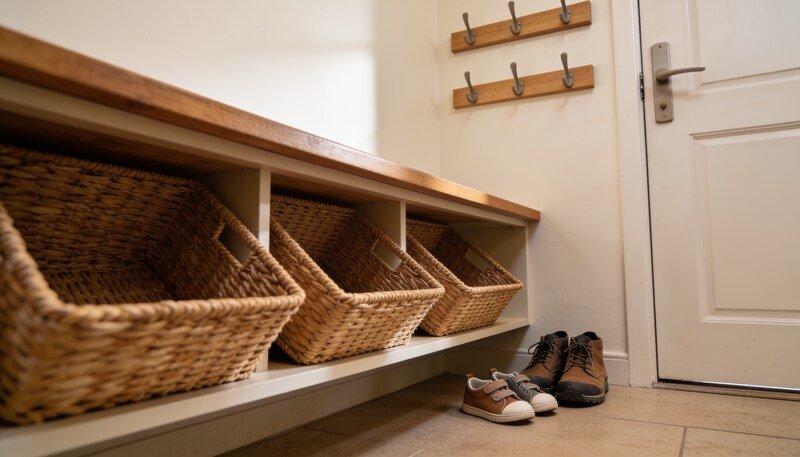
Buy for the drop zone first
The highest-value storage in any family house is within two metres of the door the family actually uses. Not the front door.
What it needs:
- A hook per person at that person’s height. A hook at adult height is not storage for a six-year-old
- A basket or tray per person, open topped
- A shelf or ledge for keys, wallets and the things that get put down
- Somewhere for shoes that is not the middle of the floor
- A bin for the things that go back out: library books, returns, sports gear
Mustard Made’s Australian range prices this kind of unit from $69 for a pair of baskets and $89 for a small ledge, up to $229 for a short two-door locker and $419 to $499 for full-height single and double lockers, all checked on 13 September 2026. That is one brand and one price tier; the point is the shape of the category rather than the figures.
A drop zone or mudroom in a small entry covers the layout when there is no room for furniture at all.
Open or closed
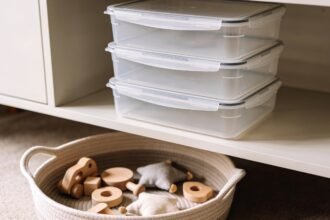
Open storage wins for anything used daily and by children. You can see what is there, nothing needs opening, and putting away is one action. It also looks messy, permanently, because it is honest about what the household owns.
Closed storage wins for visual calm and for anything that should not be a decision every day. It costs an action, and it hides things so effectively that they stop existing.
The practical split: open at child height, closed above it. That gives a room that looks tidy from standing height and works from a child’s.
The measurements that matter
- Child reach. A primary-age child reliably reaches around their own shoulder height. Anything above that is adult storage, whatever it is labelled
- Depth. Deep shelves store two rows and lose the back row. For anything but bedding, shallow beats deep
- The gap under it. Furniture with a clear gap underneath is easier to clean around and instantly becomes shoe storage
- Door swing. A cupboard door in a hallway needs the hallway. Sliding, roller or curtain fronts exist for a reason
- Whether it comes apart. Flat-pack storage moves house. Assembled steel and timber units often will not fit back through the door
Anchoring, which is not optional
This is the part most buying guides put in a footnote and it is the most important paragraph here.
Tall or top-heavy furniture can topple, and children climbing drawers and shelving is a recognised cause of serious injury in Australia. The ACCC runs an ongoing product safety campaign on toppling furniture and advises anchoring furniture to the wall.
What that means when buying:
- Check whether an anchoring kit is supplied. Many units include one and many do not
- Check whether your wall can take it. Brick, timber stud and plasterboard all need different fixings, and the right fixing is the one specified for your wall type
- Renting does not exempt you. Anchoring usually needs the landlord’s consent as an alteration, and it is a reasonable request. Ask in writing
- Where you cannot anchor, buy low. A wide low unit that cannot topple is safer than a tall one that is not fixed
- Weight the bottom. Heavy things low, light things high, always
This article stops at “follow the supplied instructions and use the fixing specified for your wall”, because the fixing itself is a job with a wrong answer.
What no listing tells you
- Load rating per shelf is published by almost nobody in this category
- Whether the unit can be disassembled and reassembled without losing rigidity
- How it behaves on an uneven floor, which most older Australian houses have
- Finish durability against scuffing at kick height, which is where family storage actually wears
Nothing here is ranked on durability, because no published durability data exists.
Before you buy
- Measure the wall, the door swing and the ceiling height
- Decide the child reach line, and put open storage below it
- Count the actions for the three things that get dropped most and buy for one action
- Check whether an anchoring kit is included, and whether your wall type is covered
- Buy for what the household owns now, not for what it should own
If the problem is genuinely too much stuff rather than too little storage, buying furniture will not fix it. What to actually throw out, and what to keep and decluttering kids' toys without the tears come first, and making a kids room work as a study space is the version of this problem where two functions share one room.
Pick 2
The Ledge in Slate - Small
Mustard Made
Pick 3
The Shorty in Slate to the Left
Mustard Made
The one-page family week
One printable page that holds the whole week: meals, school, activities and who is doing the pickup. Free, and we send one useful email a week.
One email a week. No spam, unsubscribe in a click.