What is in this guide
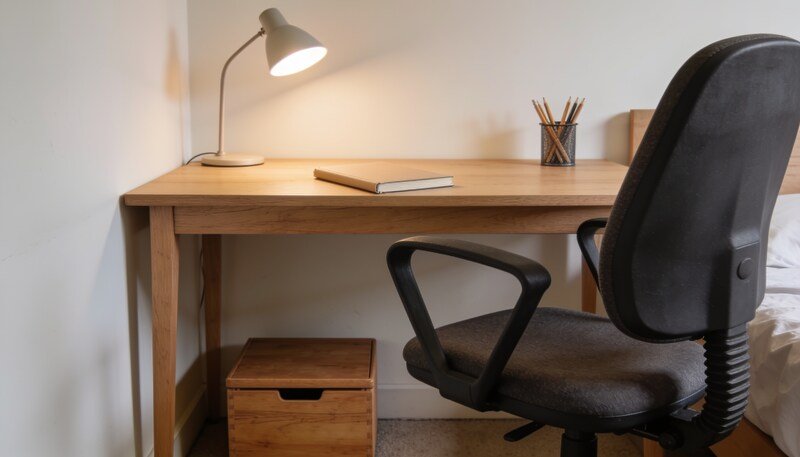
Standard desk height in Australia is set for an adult, somewhere around 720 to 750 mm. A nine-year-old at that desk has their shoulders up around their ears and their feet in the air, and no amount of reminding them to sit properly changes the furniture.
The desk is the fixed thing and the child is the variable, which is why the money belongs in the chair and the footrest rather than in the desk.
This is an editorial comparison of formats and geometry. No desk or chair was assembled or used by us.
The three measurements
Do these with the child, before shopping. They take five minutes and they decide everything.
1. Seat height. Sitting, with feet flat on the floor, knees at roughly a right angle. The seat should be at about the height of the back of their knee. If their feet dangle, that is a footrest, not a lower chair.
2. Desk height. Sitting at that seat height, elbows at roughly a right angle with forearms level. The desk surface should be about at that elbow height. For most primary-age children that is well below a standard desk.
3. Screen or book distance. Roughly an arm’s length, with the top of a screen at about eye level. On a laptop that is impossible without either a stand or an external keyboard, which is a real cost to plan for.
The practical conclusion: you are almost never buying a child-height desk. You are buying an adult-height desk and raising the child to it with an adjustable chair and a footrest.
Why the chair, not the desk
An adjustable chair covers a range of child heights for years. An adjustable desk costs several times more and solves a problem the chair already solves.
What to look for in the chair:
- Gas-lift height adjustment across a real range, not two positions
- A back that supports the lower back at the height the child actually sits
- A seat depth that does not dig in behind the knee. Some children’s chairs offer seat depth adjustment; most do not, and a firm cushion behind the back achieves the same thing
- Stable base. Five castors, not four legs, and castors appropriate to the floor
- Castor lock or no castors at all for a child who will spin. This is not a trivial point in a small room
- No arms, or removable arms. Fixed arms usually stop the chair going under the desk
What a footrest does: it gives the feet somewhere to push against, which is what stops a child sliding forward off the front of the seat. A box, a stack of books or a purpose-made rest all work. This is the cheapest component and it is the one that makes the geometry work.
Desk formats for a small room
A plain rectangular desk. Widest useful surface per dollar. 1000 to 1200 mm wide is enough for a laptop and an open book; 800 mm is not once a device is on it.
A corner desk. More surface for the same floor, and the corner itself is dead space you cannot use. Good where two walls are free.
A wall-mounted fold-down desk. Excellent in a small or shared room, disappears when not in use, and requires a proper fixing into studs or masonry. In a rental that is a conversation with the landlord.
A desk that is part of a bed frame or loft. Space-efficient, and the desk is usually undersized and badly lit.
A shared long bench for two children. Often the best answer in a shared room. Cheaper per child, and it forces the lighting and power to be sorted once. Two kids sharing a bedroom covers the rest of that layout.
Depth matters more than width. A desk under 500 mm deep cannot hold a screen at arm’s length. 600 mm is the usable minimum with a monitor.
The things that get forgotten
- Light. A desk against a wall in a bedroom is usually the darkest spot in the house. A task lamp is part of the purchase, not an extra
- Power. One device charging, one lamp, occasionally a second screen. Where the power comes from decides where the desk goes, and a trailing lead across a bedroom floor is a trip hazard rather than a solution
- Where the schoolbag goes. If it goes on the desk, there is no desk
- Cable management. A hook or a clip under the desk stops the charger falling behind it twice a day
- Wi-fi reception in that corner of the house, which is a real constraint in brick Australian homes and is covered in home wi-fi that reaches the whole house
Stability and anchoring
A desk with a hutch, a bookshelf above it, or drawers on one side is top-heavy, and a child leaning on an open drawer is how furniture tips. The ACCC advises anchoring furniture that can topple, using the fixing specified for the wall type and following the supplied instructions.
Buy low where you cannot anchor, put heavy things in the bottom drawer, and treat a tall shelf above a desk as something to be fixed rather than something to be stood up.
When not to buy a desk
Worth saying, because a desk is often bought to solve a problem it does not solve.
- Under about eight, most homework is short and happens better at the kitchen table where an adult is. A desk in a bedroom at that age is usually furniture rather than a study space
- Where homework is the battle, the room is rarely the cause. Homework battles: what to change first works through that properly
- Where the room is genuinely too small, a shared family study spot beats a desk that blocks the door
- Where the child will not be in that room next year, wait
Making a kids room work as a study space covers the layout question when the room has to do both jobs.
Before you buy
- Measure seat height, desk height and reach with the child sitting
- Budget for a chair with real height adjustment and a footrest before budgeting for the desk
- Choose 600 mm depth or more if a screen is involved
- Plan the light and the power before the furniture
- Check whether a hutch or shelf above needs anchoring, and whether your wall allows it
The one-page family week
One printable page that holds the whole week: meals, school, activities and who is doing the pickup. Free, and we send one useful email a week.
One email a week. No spam, unsubscribe in a click.