
What is in this guide
Before buying anything, work out which of two completely different problems you have.
A connection problem means the internet coming into the house is slow or unstable, and it is slow everywhere, including standing next to the modem. No amount of extra hardware inside the house fixes it.
A coverage problem means the connection is fine near the modem and bad in the back bedroom. That is the one you can usually solve yourself, often for nothing.
The test takes two minutes. Run a speed test standing next to the modem, then run the same test in the room that drops out. If both are bad, it is the connection. If only the far room is bad, it is coverage.
Everything below assumes coverage. If it is the connection, the conversation is with your provider, and knowing your NBN connection type tells you what is realistically available at your address.
Move the modem first, because it is free
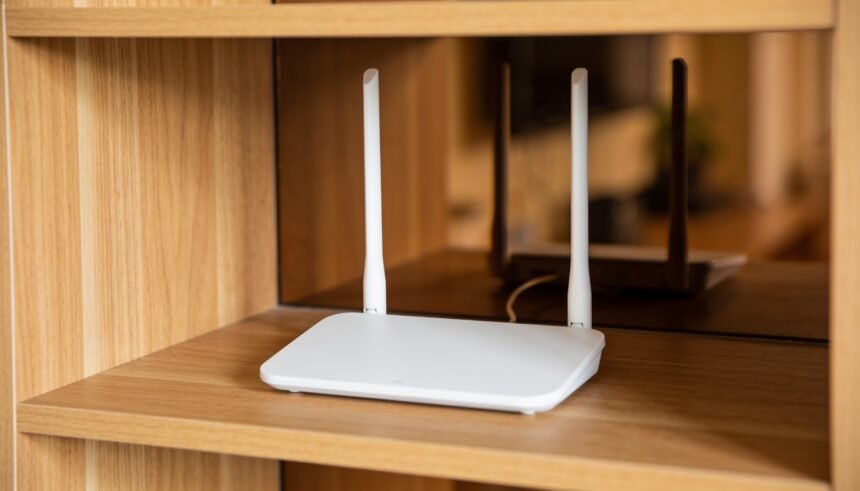
Most Australian homes have the modem where the phone socket happened to be, which is usually the worst possible place: a corner of the house, behind a television, in a cabinet, at floor level.
Wi-fi radiates outwards in all directions. A modem in a corner sends half its signal into the neighbour’s yard.
- Central, not cornered. As close to the middle of the house as you can manage
- Up high, not on the floor. Signal spreads down more easily than up. A shelf beats a floor
- Out in the open. Inside a TV cabinet or behind a screen costs you real coverage
- Away from the microwave, cordless phone base, baby monitor and fish tank. Microwaves and some older cordless phones sit in the same frequency band, and water absorbs the signal
- Away from large metal. The fridge, a steel filing cabinet, a metal-framed mirror
If moving it means a long cable across the lounge room, that is still cheaper than a mesh system, and most modems can be relocated to a different data point.
What Australian houses do to wi-fi
Construction matters more than people expect, and a lot of Australian housing is built the hard way for wireless.
- Double brick and rendered brick are the worst common offenders
- Foil-backed insulation and foil sarking, standard in a lot of newer builds, behave like a mirror to wi-fi
- Concrete slab floors between storeys stop signal going up almost entirely
- Tiled bathrooms and wet areas with cement sheet and tile can block a whole wing
- Mirrors and large glass reflect rather than transmit
None of that is fixable, and it is the reason a house that looks small can still have a dead room. It also means a single access point genuinely will not do some houses, no matter where you put it.
The free settings worth changing
Use the 5GHz band for anything close, and 2.4GHz for anything far. 5GHz is much faster and travels much less well through walls. 2.4GHz is slower and goes further. Many modems publish both under one name and choose for you, which is usually fine, but if a device in a far room keeps dropping, forcing it onto 2.4GHz often fixes it outright.
Change the wi-fi channel if you live in an apartment or a dense street. Everyone’s default is the same, and on 2.4GHz that means everyone is shouting over each other. Most modem apps have an automatic channel selection option worth running once.
Restart the modem properly. Off at the wall, thirty seconds, back on. It is a cliché because it works.
Update the modem firmware. Usually a button in the provider’s app. Skipped by almost everyone, and it fixes both stability and security problems.
Check what is actually using it. A television updating itself or a cloud backup running in the middle of the day will flatten a household connection. Backups are better scheduled overnight, which is also the point at which backing up family photos stops being a chore.
When hardware is genuinely the answer
If the modem is well placed and a room is still bad, you have a coverage problem that needs more coverage.
An ethernet cable is the best answer and nobody wants to hear it. If the problem room is the one where someone works or studies, a cable to that room is faster, more stable and cheaper than anything wireless. Flat cables run under carpet edges and along skirting boards.
A mesh system is two or more units that work as one network, handing devices between them as you move. This is the right answer for most houses that need something. Devices keep the same network name and do not have to be told to switch.
A wi-fi extender repeats the signal from one point. It is cheaper than mesh and noticeably worse: it typically halves throughput, often creates a second network name you have to switch to by hand, and it amplifies a weak signal rather than replacing it. It is a reasonable answer for one distant room that only needs light use, and a poor answer for a house.
Powerline adapters send the network through the electrical wiring between two power points. They work well in some houses and badly in others depending on the wiring, and they need both points on the same circuit to perform. Worth trying if a cable run is impossible.
The rule of thumb: mesh for a house, extender for a room, cable for the room that actually matters.
Put the mesh units in the right place
The most common mistake with a mesh system is putting the second unit in the dead room. It needs to be roughly halfway between the modem and the dead room, where it can still hear the modem clearly. A satellite in a dead spot has nothing to relay.
Before you spend anything
- Speed test next to the modem and in the bad room, to confirm which problem you have
- Move the modem central, high and clear
- Restart it and update its firmware
- Run the automatic channel selection
- Re-test the bad room
- Only then decide between a cable, a mesh system or an extender
Most households get to step 5 and find the problem is gone.
If this started because someone in the house is working or studying from a difficult room, working from home with school-age kids and BYOD device rules cover the other half of that problem, which is rarely technical.
The one-page family week
One printable page that holds the whole week: meals, school, activities and who is doing the pickup. Free, and we send one useful email a week.
One email a week. No spam, unsubscribe in a click.