What is in this guide
Read a utility bill by separating what you used, what it cost to stay connected, and what was added or deducted from the account. Then check the dates, quantities and rates behind each charge before treating the amount due as the cost of this billing period alone.
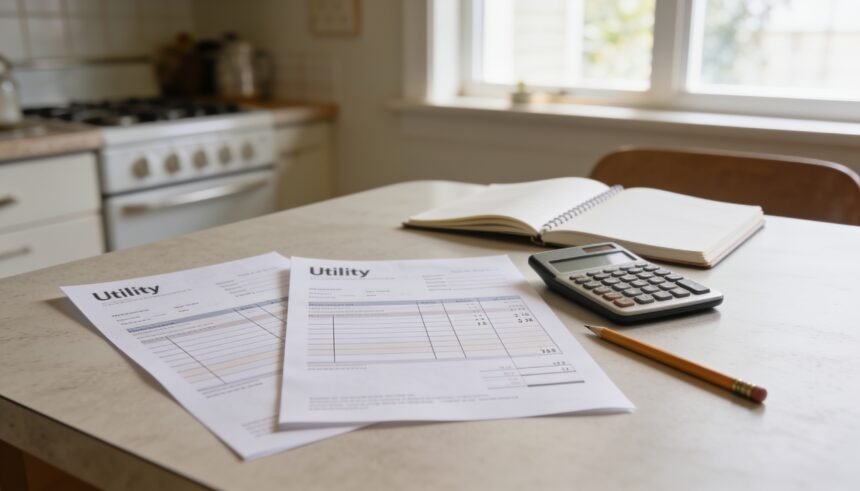
Keep the current bill and the previous one beside you. A calculator and a short note are enough. Start with one service, such as electricity, rather than trying to reconcile every household account at once.
1. Match the bill to the property and period
Check the service address, account reference and billing dates first. Put the due date in a separate note: it tells you when payment is due, while the billing period tells you when the service was supplied.
Record the number of billed days shown in the charge breakdown. Use that number for your arithmetic check rather than counting calendar dates in your head and potentially counting an endpoint twice.
Next, locate the account summary. Energy Made Easy explains that this can include recent payments, overdue amounts, adjustments, discounts and rebates. That means the headline balance and the new service charges need separate attention.
Write two headings on your note: “charges for this period” and “account balance”. Leave space under each. This prevents an old unpaid amount or a payment credit from getting mixed into your reading of current consumption.
2. Sort each line by what it charges for
Energy Made Easy distinguishes a daily supply charge from a usage charge. Supply pays for connection even when no energy is used; usage pays for consumption. Electricity usage is usually expressed in kWh, while gas charges commonly use MJ.
Use this worksheet to classify the lines on your bill:
| Line to find | What to record | Question to check |
|---|---|---|
| Supply or fixed service charge | Days or service period, rate, line total | Does the period match the bill? |
| Usage or consumption | Unit, quantity, rate, line total | What quantity was charged at this rate? |
| Additional tariff charge | Label and calculation basis | Is it another usage category or a separate charge? |
| Fee or adjustment | Description and amount | What event or correction does it relate to? |
| Credit or discount | Label, amount and period | What has been deducted, and where? |
| Previous balance or payment | Date and amount | Does it belong to an earlier period? |
For water, follow your provider’s labels rather than forcing every line into the electricity pattern. Sydney Water’s bill guide, for example, identifies fixed charges for water, wastewater and stormwater connections where applicable. These are distinct service lines, not several names for water consumed through the tap.
3. Check the quantity multiplied by the rate
Choose one straightforward usage line. Read across it in order: quantity, unit rate, amount charged. The basic check is:
Usage line cost = billed quantity multiplied by the price per unit.
If the rate is printed in cents and you want a dollar result, divide the calculated cents by 100. If it is already in dollars, do not divide again. For a daily supply line, multiply the billed days by its daily rate, with the same attention to cents or dollars.
Use the bill’s stated tax basis when comparing your calculation with the printed amount. If the bill identifies a subtotal before tax and a total after tax, compare like with like. Do not add a tax amount again when the displayed total already includes it. Ask the provider to explain the presentation if it is unclear.
Small differences may need a rounding explanation. A larger mismatch deserves a note showing the exact line, quantity and rate you used. You do not need to reconstruct the entire bill before asking about one unclear calculation.
4. Read repeated usage lines before assuming duplication
Energy Made Easy explains that time-of-use plans can divide consumption into peak, shoulder and off-peak periods. Tariff blocks instead apply different rates to portions of usage. Controlled load can be a separate charge for a particular appliance, such as electric hot water.
For every repeated line, inspect its dates and label. Does it represent another time band, another block of consumption or a different part of the billing period? Sydney Water notes that a price change within a billing cycle can produce prorated charges based on days.
If electricity has a demand-charge line, keep it separate from ordinary kWh consumption. The Australian Energy Regulator explains that demand charges can depend on maximum demand during a specified period or on a threshold, and their calculation varies by plan. Ask which measurement and period produced your charge rather than applying the usage formula to it.
Do not infer your tariff from a single word such as “peak”. Find the plan details or ask the retailer what that label means on this account.
5. Separate fees and credits from consumption
The AER lists possible additional energy fees, including paper billing, payment-method and special meter-reading fees. A fee line needs its own explanation; it is not extra electricity or gas usage.
Likewise, Energy Made Easy identifies solar feed-in and government concession credits on electricity bills. Record each credit separately so you can see the service charges before the deduction and the account balance afterwards.
Follow the bill’s own sequence from opening balance through payments, new charges and adjustments to the amount due. Check the sign beside each entry. If a credit is already included in the displayed subtotal, subtracting it again on your worksheet will produce the wrong result.
Write an unresolved entry as a question: “What does this adjustment cover?” is more useful than “Bill seems wrong”. Include the line label and amount when contacting the provider through the details on your bill.
6. Check the reading basis before comparing bills
Look for “actual” or “estimated” beside the meter information. Energy Made Easy explains that an estimated electricity reading can lead to a later credit or additional charge when reconciled. Treat that label as part of the comparison, not a minor footnote.
Compare billed days, consumption quantities, unit rates and credits separately. A bigger total does not identify which component changed. For a rough consumption check, divide the period’s usage by its billed days; keep the unit attached and avoid comparing different services or meter categories as though they were equivalent.
If your question turns out to be about consumption, continue with a seasonal check of appliances that run all day, or review standby power without unplugging everything. Those guides address household use after you have identified what the bill actually charges for.
Finish by checking one unclear line with the provider and recording the due date in your household bill calendar. Keep the bill reference and your question together so the next conversation starts with a specific charge.
How we checked this
Reviewed on 6 October 2026 against Energy Made Easy, the Australian Energy Regulator and Sydney Water guidance. The reading order and worksheet are Dovelyne editorial methods. Labels and calculations vary by provider and plan; no household tariff, savings result or payment obligation has been assessed.
The one-page family week
One printable page that holds the whole week: meals, school, activities and who is doing the pickup. Free, and we send one useful email a week.
One email a week. No spam, unsubscribe in a click.