
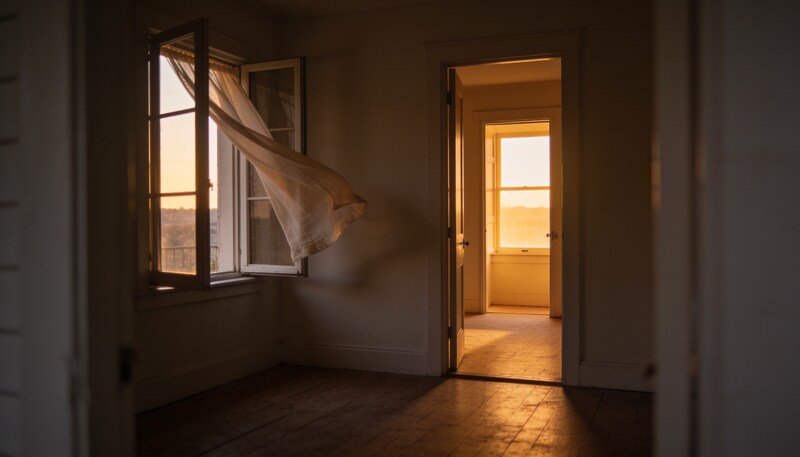
It is 24 degrees on the back step and 29 in the lounge room. The windows have been open for an hour and nothing has changed.
This is not your imagination and it is not a broken air conditioner. It is stored heat, arriving late.
What is actually happening
Three things, and they compound.
The roof cavity. On a hot Australian day a roof space can reach 60 to 70 degrees. It is a large volume of very hot air sitting directly above your ceiling, separated from you by a sheet of plasterboard and whatever insulation is or is not up there. It does not stop being hot at sunset. It radiates downward into the rooms below for hours.
Thermal mass. Brick, concrete and tile absorb heat all day and release it slowly. A brick wall that has had afternoon sun on it is still warm at midnight and it is warming the room from the inside. This is the same property that makes a well-designed masonry house comfortable; it just works against you when the mass has been allowed to charge up.
Everything inside. The oven you used at six, the fridge running harder than usual, downlights, a television, chargers, and people. It is a small contribution each and it is real in a closed-up room.
The result is a lag. The hottest part of the day outside is mid-afternoon. The hottest part of the day inside an Australian brick veneer house is often three to five hours later, which is exactly when you are trying to go to bed.
Tonight, at no cost
In order of effect:
1. Open the right windows, not all of them. Ventilation works when air has somewhere to go. Open a low window on the cool side of the house, usually the south or the side away from where the sun was, and a high window or a window on the opposite side. That creates a path. Opening one window in each room creates very little.
2. Put a fan in the window, not in the room. A fan in a window facing out, on the warm side, pushes hot air out and pulls cool air in behind it. A fan in the middle of a room moves hot air around and makes you feel better without cooling anything. Fans: what actually cools a room explains that distinction properly, because it changes what you buy.
3. Open the internal doors. Including the ones to rooms you are not using. Closed doors stop the path.
4. Shut down the heat sources. Lights off in rooms nobody is in, the oven off long before bed, and the dishwasher run overnight rather than at seven.
5. Close it all again before it gets warm. This is the half people skip and it is the half that decides tomorrow.
The rhythm that actually works
The whole technique is one sentence: open the house when it is cooler outside than in, and shut it when it is not.
- Late evening: open up, get as much air through as possible
- Overnight: leave it open if it is safe to do so
- Early morning, before the sun is on the house: close the windows and pull the blinds. Usually before 8am in summer
- All day: keep it shut. Resist the urge to “air it out” at 2pm, which fills a cool house with hot air
- Evening again: open once the outside temperature has dropped below the inside
It feels counter-intuitive to close a house on a hot day. It is the single biggest free improvement available.
Free and cheap, in order of what actually works
Free
- The open-and-close rhythm above
- Close blinds and curtains on the sunny side before the sun reaches them, not after
- Close doors to unused rooms during the day, open at night
- Move the clothes drying outside, because a load drying indoors adds both heat and humidity
- Use the exhaust fans in the bathroom and kitchen after cooking or showering
Cheap
- Block the outside sun before it hits the glass. This is the biggest single gain available to most households. Once sunlight is through the window, the heat is inside and a blind only stops it radiating further. An external awning, a shade sail, an outdoor blind or even a temporary shade cloth clipped outside beats any internal treatment
- Heavier curtains with a pelmet or a closed top. An open-topped curtain lets a convection loop run behind it, carrying heat into the room. Closing the top of the curtain track is a surprisingly large improvement for very little money
- Draught seals on external doors, which help in both directions
- A pedestal or box fan for the window, which is the cheapest real cooling in the house
- Plant or shade the west wall. Afternoon western sun on a brick wall is the biggest single heat source in most Australian houses
Worth paying for, if you own
- Ceiling insulation, checked rather than assumed. Many Australian homes have insulation that has been compressed, displaced by tradespeople, or never fully installed. It is the highest-value thing in this list and it is also the most commonly assumed to be fine
- Roof space ventilation, which reduces the temperature of the cavity above the ceiling
- A lighter roof colour at the point the roof is being replaced anyway
- External shading as a permanent structure
- Double glazing or secondary glazing, which is the most expensive item here and rarely the first one to do
If you rent, everything in the free and cheap lists is available to you, and external shade cloth, portable fans, door seals and heavier curtains all come with you when you move.
Where the money goes
An air conditioner is not the enemy and it is worth being clear about the trade-off. Running one in a house that has been closed up properly all day and flushed with cool air overnight costs a fraction of running one in a house that has been absorbing sun since eleven.
The order matters: do the free things first, then run the air conditioner less, rather than treating the air conditioner as the solution and the free things as optional.
Cooling costs and running air conditioning sensibly covers the settings and the running cost side, and heating a house cheaply through an Australian winter is the same logic in reverse.
Bedrooms specifically
Bedrooms are usually the worst room in the house for this, because they are small, often on the western side, and used at exactly the wrong time of day.
- Close the bedroom blind in the morning and keep the door shut all day
- Open the window and the door in the evening, with a fan pulling through
- A fan aimed at a person is the most effective cooling per dollar in the house
- Getting a kids room dark and cool enough to sleep in covers the rest, including the practical problem of blockout blinds and heat
What does not help much
- Opening every window in the house. Without a path, air does not move
- Airing the house out in the middle of the day
- A fan running in an empty room. It cools people, not spaces
- Internal blinds after the sun is already through the glass. Better than nothing, much worse than outside shade
- A bowl of ice in front of a fan, which does something measurable for about ten minutes
- Roof sprinklers and misting, which use a lot of water for a small effect and are restricted in many areas
Common questions
Why is upstairs so much worse? Heat rises, and the upper floor sits directly under the roof cavity. Both effects stack.
Does a dark roof really matter? Yes, substantially, and it is one of the few things you cannot change cheaply. It matters most at the point of replacement.
My house is new. Why is it hot? New does not mean shaded or well-oriented. Large areas of unshaded glass in a new house can outweigh good insulation.
Should I leave the ceiling fan on when I go out? No. It cools people, not rooms, so it is doing nothing except costing money.
Is it worth insulating if I have air conditioning? That is when it is most worth it, because it reduces how hard and how long the air conditioner works.
The short version
The heat you feel at 10pm arrived hours ago and is stored in your roof cavity and your walls.
Shut the house and the blinds before the sun gets on it, keep it shut all day, then open it up in the evening with a fan in a window and the internal doors open. Shade the glass from outside before you buy anything. Check the ceiling insulation rather than assuming it is fine.
The one-page family week
One printable page that holds the whole week: meals, school, activities and who is doing the pickup. Free, and we send one useful email a week.
One email a week. No spam, unsubscribe in a click.