What is in this guide
Store leftovers in clean containers, divide them into portions you will actually use, and label each with its contents and original cooking date. Keep separate components separate where practical, and follow Australian food safety guidance for cooling and refrigeration; good packaging does not create extra safe storage days.
The useful question at packing time is what the food needs to become next. A lunch for one needs a different container from a family dinner. Keeping every scrap in one large tub leaves that decision for someone opening the fridge later.
Start with the food’s handling history
Before choosing a lid, consider whether the food has been handled appropriately. Food Standards Australia New Zealand’s Food safety basics explains cooling, refrigeration, thawing and reheating. Its guidance takes priority over any plan to save a meal.
Use the guide to how long leftovers keep for the separate question of storage limits. This packing routine is about organisation and food quality. It does not establish that an unknown container is safe to eat or make an older meal suitable for another day.
Make space and find clean containers before you begin packing. FSANZ recommends shallow containers for quickly cooling food intended for later use. Do not let searching for a matching lid turn into an excuse to leave dinner sitting out.
Choose the portion before the container
Decide who is likely to eat the leftovers and at which meal. If there is enough curry for two individual lunches, pack two lunch portions. If the whole household will share it, use containers that suit that serving plan rather than dividing everything into tiny tubs.
For a small amount, be specific. A little pasta sauce might be an addition to lunch rather than dinner for everyone. Label it accordingly so the next person does not build a meal plan around an amount that is not there.
You do not need a matching storage set. Start with containers you already own and check their manufacturer’s instructions for food storage, freezing and reheating suitability. A container being suitable for the fridge does not establish that it belongs in the microwave or freezer.
Select a shape that fits the portion without forcing food against the lid. Allow any expansion space required by the container instructions when freezing liquids. Avoid relying on an overfilled tub to stay closed when someone moves the shelf around.
Keep components separate when it helps the next meal
Before combining everything, ask whether you would want it mixed when serving again. As an editorial packing choice, try these arrangements:
| Leftovers | Suggested packing arrangement | Reason for the choice |
|---|---|---|
| Roast dinner | Meat and vegetables in separate portions, gravy in its own suitable container | Lets you choose which parts to use and how to prepare each |
| Wrap or taco fillings | Filling, salad and sauces stored separately | Leaves the next person able to assemble their own portion |
| Pasta with sauce | Separate containers if the components have not already been mixed | Keeps options open for the next meal |
| Soup with bread | Soup in a suitable container, bread packed separately | Avoids storing bread immersed in liquid |
These are options, not reasons to pull an already mixed dinner apart. If the pasta and sauce are combined, portion them together. If separating a few spoonfuls creates more washing-up than benefit, keep the practical choice.
Likewise, do not promise that storage will restore a freshly cooked texture. Decide whether you want the leftover version before allocating scarce fridge space to it. Saving something nobody intends to eat only postpones the decision.
Cover food and leave room around it
CSIRO recommends covering cooked foods and prefers closed glass or plastic containers for controlling food odours. Choose a lid that belongs to the container and closes properly. For cooling-stage handling, follow the official guidance rather than treating a sealed lid as the whole process.
Keep the packaging modest. A serving bowl under a dinner plate may occupy the space needed for several smaller portions. Once suitable for covering, transferring food to a fitted container can make the available shelf space easier to manage.
Do not fill every gap. CSIRO advises leaving room for air circulation around stored items. Its guidance also explains that warmer and colder areas differ between refrigerator models, so consult your appliance instructions rather than assuming one shelf position suits every fridge.
For a crowded kitchen, organising a full family fridge covers the wider layout. Here, the immediate task is to give the packed food an accessible place without squeezing it between unrelated groceries.
Write a label that answers the next person’s questions
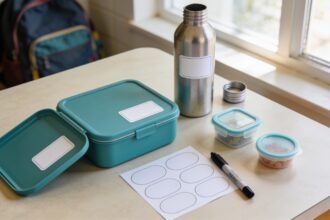
Record the food name and original cooking date. Add the intended use if that would help: lunch for one, sauce only or family dinner. Put the label where it can be seen from the front, particularly if the container itself is opaque.
If you freeze a portion, record the freezing date separately from the cooking date. Keeping both avoids turning a later packing action into an apparent new cooking date. When transferring food between containers, transfer the information too.
Use removable labels or tape you can write on clearly. Remove old labels when washing the container so there is no ambiguity about which date applies. A detailed system is unnecessary if a food name and two clearly identified dates answer the question.
Choose fridge or freezer with a meal in mind
Check the official handling guidance, then decide whether there is a realistic meal planned within the appropriate refrigerated storage window. If not, consider freezing suitable portions promptly under that guidance, rather than repeatedly postponing the decision. Freezing is not a remedy for food that has been mishandled.
Check that both the food and its container suit freezing. For the storage system beyond this packing step, see freezer organisation and labelling. Put the portion somewhere you can identify it without unpacking everything around it.
If the recurring problem is that containers remain untouched, getting leftovers eaten addresses the meal-planning side. For tonight, keep the next step small: choose the next use, pack that amount, and write down what it is before putting it away.
The one-page family week
One printable page that holds the whole week: meals, school, activities and who is doing the pickup. Free, and we send one useful email a week.
One email a week. No spam, unsubscribe in a click.