What is in this guide
An organised freezer stays organised for exactly as long as the labelling takes less effort than not labelling. A system with four zones and a label that takes five seconds to write survives; a system that needs a marker pen search and a decision about wording every time does not.
Four zones, not a filing system
Divide the freezer into zones by how soon something needs to be used, not by food type. This matters more than category-based sorting because it puts the answer to “what needs eating soon” in one place rather than scattered across shelves.
| Zone | What goes here | Where |
|---|---|---|
| Use this week | Leftovers, anything defrosting soon, small portions | Eye level, front |
| The regular rotation | Meals you make often, bread, everyday staples | Middle shelves |
| Long-term stock | Bulk meat, batch-cooked meals for later, backup staples | Bottom or back |
| Odd shapes and small items | Herbs, grated cheese, small sauce portions, ice packs | Door or a bin/basket |
The “use this week” zone is the one that does the most work. If something is going to be forgotten, it is usually because it never had an obvious place to sit while it waited to be remembered.
A drawer, a labelled basket or even a taped-off shelf section is enough to create the zone. The freezer does not need new hardware, just a rule about what lives where.
Contain, then label
Loose bags and unlabelled containers are the two things that turn a freezer into a guessing game. Two small habits fix most of it:
- Group like items in one bin or basket rather than letting them float free among everything else. A single “sauces and stock” container is easier to search than six loose bags.
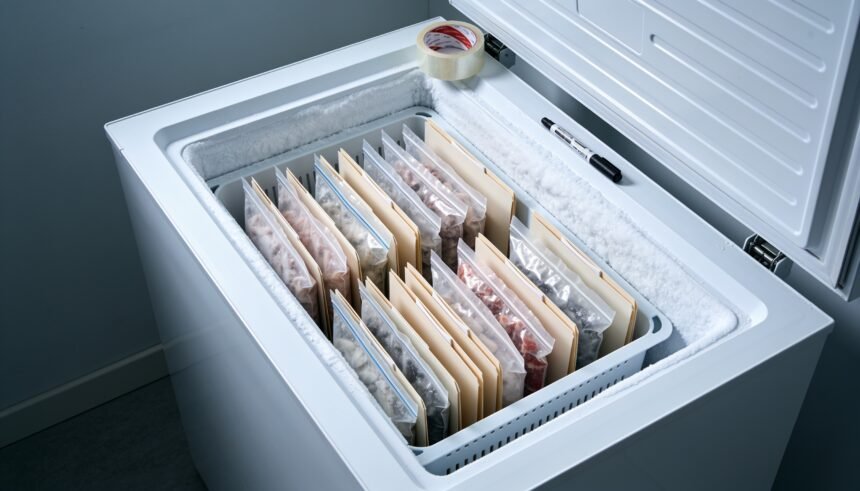
- Flat-freeze bags before they go into long-term storage. A bag frozen flat stores upright like a folder and is far easier to identify at a glance than a frozen lump.
The two-line label
A label works if it takes five seconds to write and answers two questions: what is it, and when does it need to be used or reviewed by. That is:
“ Bolognese sauce Made 14 Sep - use by mid Oct “
Keep both lines. “Bolognese sauce” alone still leaves the question of how old it is; a date alone does not tell you what you are looking at once it is covered in frost. Use a system that suits your storage times and food type, or the guidance of an Australian food safety authority, rather than a fixed rule here: the point of this package is the habit of labelling, not a specific duration for a specific food.
Masking tape and a permanent marker work as well as anything sold specifically for the job. Keep both inside the freezer door so the tool is never the reason a label does not happen.
Making it a habit rather than a project
A freezer clean-out gets everything organised once, then drifts back to chaos within a month if the labelling step is the first thing to be skipped when someone is in a hurry. Two things keep it going:
- Label while something is still warm from cooking, immediately before it goes in, rather than “later” once it is already frozen and harder to identify without opening the bag.
- Do a five-minute zone check at your regular shopping or meal-planning time, moving anything that has drifted out of its zone back and noting what is heading toward the back of the “use this week” spot.
If the freezer runs a genuine backlog of unidentified items, treat that as a one-off reset rather than evidence the system failed: work through it once, label everything as it is identified, and restart the habit from a clean state.
When the system breaks down
- Everyone uses a different label style. Agree on the two-line format as a household rule, not a personal preference, so anyone can read anyone else’s label.
- The “use this week” zone becomes the “forgot about this” zone. That is a sign the zone is too full or too far from eye level; make it smaller and easier to scan, not bigger.
- Nobody labels bulk-cooked batches because there are too many at once. Label as each portion goes in, not after the whole batch is bagged, so the job never becomes one big task at the end.
Set up the four zones next time the freezer is even partially empty, and start labelling the very next thing that goes in rather than waiting to reorganise everything at once.
How we checked this
Reviewed on 27 September 2026. This package is Dovelyne editorial organisation method based on ordinary household freezer use, not a tested or measured program, and makes no food-safety storage-duration claims for any specific food.
Related reading: How to Organise a Spice Cupboard That Actually Stays Organised.
Related reading: How to organise a pantry so nothing expires unnoticed.
The one-page family week
One printable page that holds the whole week: meals, school, activities and who is doing the pickup. Free, and we send one useful email a week.
One email a week. No spam, unsubscribe in a click.