What is in this guide
To keep leftovers for three weeks, freeze suitable portions promptly rather than leaving them in the fridge. NSW Food Authority allows up to three months for frozen leftovers, but only three days for refrigerated leftovers and two for cooked rice or pasta. Freezing does not promise fresh-cooked texture.
The practical task is to save a meal you will want in week three, then make it easy to find and finish. A tub without a serving plan can remain untouched even when everyone is looking for dinner. Use the steps below to give the food a destination before it disappears behind the frozen peas.
1. Choose the later meal before putting food away
Pick an actual occasion: lunch on a work-from-home day, dinner after sport or a meal for the person arriving home late. Write that occasion into the calendar roughly three weeks ahead. The date is a household planning choice, not a new storage limit.
Decide whether you are saving a complete meal or one part of it. Two portions of pasta sauce are not two complete dinners if there is no pasta in the cupboard. Record the missing component while you still remember what is in the container.
If you only need tomorrow’s lunch, this longer plan is unnecessary. How long leftovers actually keep covers the short-term storage question. Reserve the week-three plan for food you deliberately want to put aside, rather than giving every scrap a distant appointment.
2. Check that the food belongs in this plan
Start with food whose cooking and handling history you know. NSW Food Authority advises cooling and covering leftovers and getting them into the fridge or freezer within two hours. Its advice also says smaller portions aid cooling. Follow that guidance before thinking about a later dinner.
Do not use a calendar entry to justify saving food with an uncertain history. A forgotten takeaway container is not equivalent to a portion set aside from tonight’s cooking. Refer uncertain handling decisions to the Food Authority’s leftover guidance rather than assuming the freezer makes the question disappear.
Check any recipe or manufacturer instructions relevant to freezing. Choose containers explicitly suitable for the job and follow their instructions. For detailed portioning and container decisions, use the leftover packing guide; the extra task here is connecting each saved portion to a future meal.
3. Save the part you actually want to eat again
Think through the later plate before combining the components. Would you want the salad mixed into the sauce? Does everyone want the same accompaniment? Could a single-person portion be more useful than a family-sized block on the evening you have chosen?
These are serving decisions, not claims that one arrangement guarantees better preservation. You can keep an already mixed dish together. There is little value in creating several tiny containers if they all need to be opened for the same meal.
Use a short planning note such as this:
| Saved portion | Intended meal | What still needs arranging |
|---|---|---|
| Two portions of vegetable curry | Dinner for two after an evening shift | Choose and buy an accompaniment |
| One portion of soup | Work-from-home lunch | Check whether bread is wanted |
| Family portion of pasta sauce | Dinner after sport in week three | Add pasta to that week’s shopping list |
These are illustrative allocations, not tested recipes or promises about how particular dishes will taste after freezing. If you already dislike a dish when reheated, choose another meal for the calendar rather than storing it out of obligation.
4. Label for the person opening the freezer
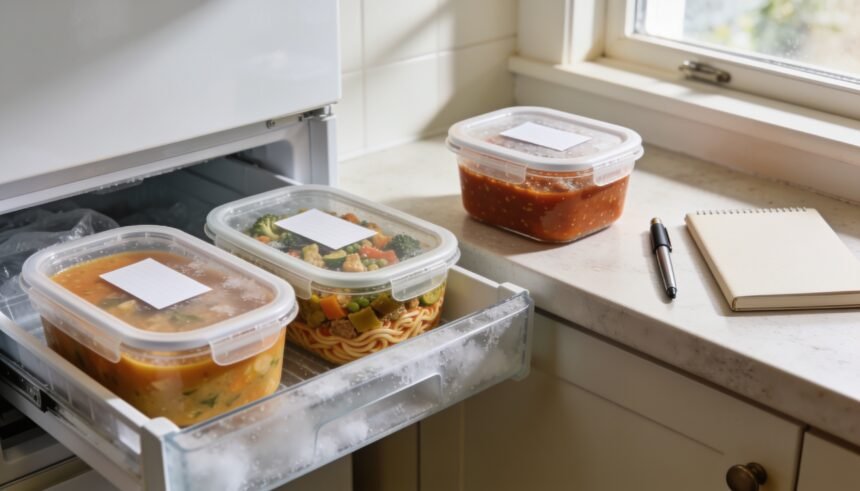
NSW Government’s Love Food Hate Waste recommends labelling frozen leftovers so you can identify them when choosing a meal. Build on that with four useful details: the dish, number of portions, cooking date and freezing date. Keep the dates separately named if they differ.
Add the planned use in your calendar or meal list. The container label identifies the food; the calendar tells you when you intend to use it. Neither replaces the other. If someone else cooks on the chosen evening, make sure they can see the plan too.
Avoid a label saying only “dinner”. It leaves the next person guessing about both contents and quantity. Likewise, changing containers should not erase the original dates. Transfer the information along with the food.
5. Make a retrieval plan that suits your freezer
Choose an accessible place for the portion and note it beside the meal entry if necessary. “Curry, lower drawer, two portions” is enough. You do not need to reorganise the entire appliance to reserve one dinner.
If finding anything requires emptying every drawer, freezer organisation and labelling covers the wider system. For this meal, keep the commitment small: everyone should be able to identify the right container without opening several others.
During the shop before the planned dinner, check that the portion is still there. Someone may already have eaten it, or the household schedule may have changed. Confirm the serving count and buy only the missing accompaniments. This check makes the saved food part of the next shopping decision.
6. Plan the thawed meal as carefully as the frozen one
NSW Food Authority says to defrost leftovers in the fridge and use them within 24 hours of defrosting. It also advises reheating until steaming hot and stirring during microwave heating. Follow its food-specific cautions, including not reheating rice or pasta more than once.
Allow for thawing when you schedule the meal; do not assume a large frozen portion will be ready whenever dinner starts. Keep the meal plan flexible enough to follow safe handling instructions rather than rushing because a calendar says tonight.
If the real obstacle is that nobody wants the saved dinner, getting leftovers eaten addresses meal choices and reuse. For your next suitable portion, write the intended eater and week-three meal first, then label and store it under the official guidance. That gives the food a practical purpose beyond occupying freezer space.
The one-page family week
One printable page that holds the whole week: meals, school, activities and who is doing the pickup. Free, and we send one useful email a week.
One email a week. No spam, unsubscribe in a click.