What is in this guide
Organise your kitchen pantry by matching food to its labelled storage conditions, keeping it away from heat and direct sunlight, and making opened packaging easy to close properly. Start with the cupboard and the packets you already have. A row of matching jars is optional; following each food’s instructions is the priority.
1. Check the cupboard before rearranging the food
Open the pantry during an ordinary cooking session and look at where the food sits. Does sunlight reach an exposed shelf? Is the cupboard beside the oven? Where do packets end up when someone is in a hurry? Sketch the shelves on scrap paper and mark the positions you want to reconsider.
NSW’s Love Food Hate Waste guidance advises keeping pantry items away from direct sunlight and heat sources such as the oven, because these can make food deteriorate more quickly. Use that guidance to choose between the storage spaces available in your kitchen.
In a rental or small kitchen, changing cupboards may be more realistic than changing fittings. Consider whether a cupboard currently holding serving dishes would give everyday groceries a better position. Check the food labels before making the swap. A shelf’s convenience does not override a product’s storage directions.
If access is the main problem, the guide to pantry organisation that works for a family covers broader shelf layout. Here, the first decision is which available position suits the food’s stated conditions.
2. Sort by storage instructions before making categories
Work through one shelf, putting each packet on the bench with its instructions visible. You can still group breakfast foods, baking ingredients and dinner staples later. First, establish what the packaging says about storage and what changes after opening.
Food Standards Australia New Zealand says suppliers must state specific storage conditions needed for a product to keep until its date mark. It also advises following the supplier’s directions. Look for the actual wording on the item in your hand rather than borrowing instructions from a similar product.
Make three temporary groups: unopened items staying in the pantry, opened items whose directions still allow pantry storage, and items whose instructions require another location. Move that last group according to its label instead of assigning everything a pantry basket.
Keep any unclear item separate from the arrangement until you can check its instructions with the manufacturer. An attractive label you add yourself should never become the only information available about a food.
3. Decide which foods need a container
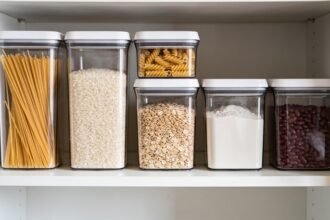
NSW Love Food Hate Waste recommends airtight containers for dry staples including rice, flour, cereal, grains, nuts, sugar and pasta. Start with one frequently opened ingredient and decide how you will store it between uses.
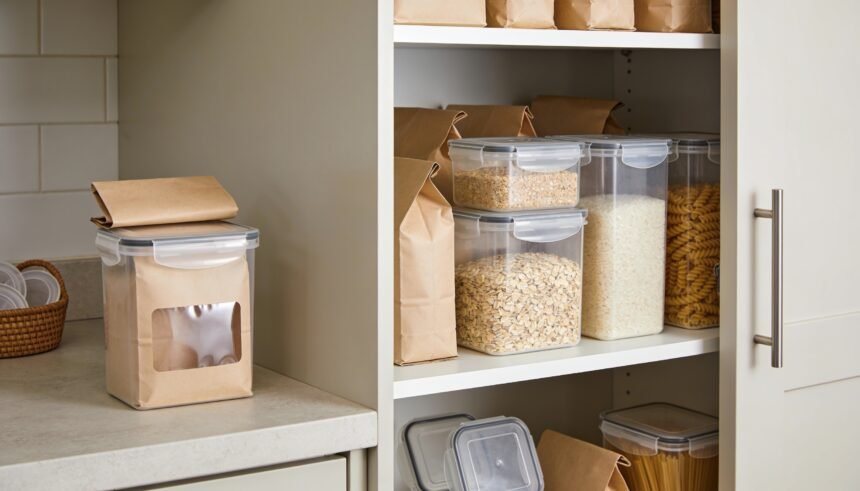
There are two practical arrangements to consider. You might place the original packet inside a suitable container, retaining its information in place. Alternatively, you might decant the ingredient and keep the packaging record separately. The second arrangement adds a labelling job every time you change batches, so choose it only if someone will maintain that record.
Before transferring food, check the container manufacturer’s intended use and care instructions. For detailed help with lids and closures, use the guide to operating and caring for airtight food containers.
Avoid buying a full set before trying one container on its intended shelf. Open it, lift it out and put it back. If this takes several awkward movements, change its position before committing the rest of the pantry to the same arrangement.
4. Keep the packet information with each batch
FSANZ’s storage guidance advises keeping date markings readable after opening packaged food. Preserve the original information when reorganising, including the food name, date wording, printed date and storage directions. Keep ingredient and allergen information accessible too.
For a decanted ingredient, a clearly identified photograph of the packaging is one option. A retained packet panel is another. Choose a method that another household member can find without asking which photograph belongs to which jar. Label opening dates separately so they cannot be mistaken for the manufacturer’s printed date.
Keep a new batch separate while finishing the previous one. This is an editorial record-keeping choice: it lets each saved label describe a known batch rather than a mixture of purchases. You may need a little extra space for the unopened packet.
Do not add extra weeks or months to the printed information because the food has moved into a container. This arrangement does not establish a new shelf life.
5. Make closing the food part of normal use
Rehearse the job the pantry needs to support. Take out the breakfast ingredient, open it, serve from it, close it and return it. Leave enough room that the lid can be operated without moving a stack of unrelated groceries.
Give scoops and measuring cups an obvious home rather than balancing them where they obstruct a closure. If several people use the kitchen, show them where the opened packet belongs and how its container closes. A complicated arrangement creates more steps for everyone who uses it.
Keep unopened spares in a distinct position so they do not crowd the ingredient currently in use. For detailed date ordering and stock checks, follow the guide to keeping pantry dates visible and rotating stock. That routine complements this check of location and packaging.
6. Review conditions when you write the shopping list
Use shopping-list time to look at the storage arrangement as well as quantities. Has a packet been returned without being closed? Has food migrated to the sunny end of the bench? Is the saved packaging still identifiable? Correct the specific problem before adding another basket or jar.
If an ingredient is rarely used, reconsider the quantity you keep. For example, an occasional baking project might leave a large packet occupying the most convenient shelf. Put ingredients you regularly reach for in accessible positions and consider a smaller purchase next time if that suits your cooking.
Turn existing ingredients into meals through planning around what is already in the pantry. Storage and meal planning work together, but neither supplies a universal freshness deadline.
Start with one ingredient used most days. Read its directions, choose its position, settle its packaging and make sure everyone can return it properly. Once that arrangement works, repeat it on the next shelf.
How we checked this
Checked on 26 October 2026 against NSW Love Food Hate Waste and FSANZ guidance. Shelf arrangements and household routines are editorial recommendations. No storage system was tested, and no additional shelf life is claimed.
The one-page family week
One printable page that holds the whole week: meals, school, activities and who is doing the pickup. Free, and we send one useful email a week.
One email a week. No spam, unsubscribe in a click.