What is in this guide
Keep the food you intend to use next at the front, leave its date readable and give unopened spares a separate place. Check those three things before writing the shopping list and when unpacking groceries. This makes forgotten packets easier to spot without turning the pantry into a record-keeping project.
Start with one shelf and find the duplicates
Take out one shelf at a time so you can finish a section even if the rest has to wait. Put matching foods together on the bench: all the pasta, all the breakfast cereal, all the tins of the same ingredient. Keep opened packets separate from unopened ones while you sort.
Read each packet’s date wording and storage instructions. Food Standards Australia New Zealand distinguishes use-by dates, which concern safety, from best-before dates, which concern quality. It says food should not be eaten after a use-by date; a best-before date is not an automatic discard deadline. For a fuller explanation, use the guide to reading use-by and best-before dates.
Do not treat the pantry reset as a reason to guess whether an unidentified food is suitable. Set aside anything with information you cannot read or interpret and ask the manufacturer. Keep it out of the rotation you are building until the question is resolved.
For the remaining packets, choose which you intend to use first within their labelled instructions. This is a stock check, so there is no need to rearrange the whole kitchen. If access and family zones also need work, setting up a pantry for a family covers that broader layout.
Put earlier dates in front of later dates
Within each group of matching unopened foods, place the earlier date at the front and later dates behind it. Check the actual dates rather than assuming the latest purchase has the longest remaining time.
For example, imagine two unopened packets of the same pasta. The packet bought this week has a November best-before date; the one already at home has a December date. Put the November packet first. The shopping sequence does not tell you which date comes first.
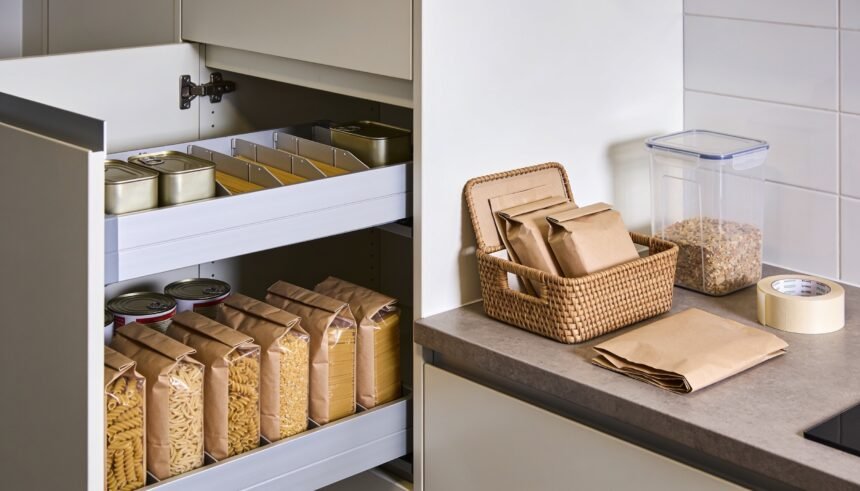
Face date panels towards the cupboard door where practical. If the date is on a base or awkward seam, arrange the packet so you can lift it out without dismantling a stack. You need to be able to check the information, even if every date cannot face forward.
In a deep cupboard, use a tray you already own to hold a single group of spares. Pulling out the tray lets you check the back row. Avoid stacking unrelated foods in front of it, or checking dates becomes a separate unpacking task.
Give opened packets a clear home
Choose a front position within each food group for the packet currently in use. Keep unopened duplicates behind it or in the spare-stock area. Ask everyone to look there before opening another packet.
An opened-packet position is a reminder, not a rule that overrides the label. FSANZ advises retaining readable date markings after opening and following manufacturer instructions. Read any opening and storage directions before deciding where a product belongs. If its label requires refrigeration after opening, its place is no longer the pantry.
Where the manufacturer gives an instruction based on time after opening, add an opening date without covering the original wording. Write the full calendar date rather than just a weekday. A note saying “opened Tuesday” becomes ambiguous once another Tuesday passes.
If two packets are already open, keep both visible and check their instructions separately. Do not pour them together just to make the shelf look tidy. Separate packets let you retain each one’s date and identity while deciding what to use.
Keep the packet information when decanting
You can organise stock in its original packaging. Decant only where the extra handling suits your household, and decide how to retain the label before throwing the packet away.
For a decanted product, keep a record of its name, date wording, printed date and relevant instructions. A photograph can work if it clearly identifies the food and is easy to find. Give the container and its record the same simple identifier when similar products could be confused.
Leave the original date wording in the record. A note that says only “November” loses both the precise date and whether it was use-by or best-before. Keep purchase dates and opening dates separately labelled, too.
Finish one batch before refilling the container, or keep incoming stock separately with its own information. Topping up repeatedly makes it harder to know which packet a saved label describes. The trade-off is an extra packet to store, but the records remain clear.
Make a small use-next spot that leads to meals
Set aside a visible spot for foods you have checked and intend to use soon. It might hold an opened cereal packet, a tin selected for dinner and a baking ingredient you want to finish. Keep this selection small enough to inspect at a glance.
Do not move a food there if the location conflicts with its storage instructions. The spot is a planning cue, not a substitute for the information on the packet.
Give each item a job before adding more. The tin might become part of Thursday’s dinner; the cereal goes on the breakfast shelf where it will be reached first. Planning around food already in the pantry helps turn that short selection into meals rather than another collection of neglected ingredients.
Check backstock before shopping and rotate on arrival
Before writing the list, inspect the opened positions, the use-next spot and the spare-stock area. Add ingredients you actually need for the planned meals. Avoid adding an item just because the front packet looks low when another full packet is behind it.
Keep any inventory modest. A note showing unopened spare quantities can help if several people shop, but skip a detailed catalogue if nobody will update it. Building a shopping list from the meal plan connects this check with what you buy next.
When groceries arrive, compare dates with matching stock already at home. Place each new packet in date order and keep opened packets visible. Tell other household members where spares belong so the arrangement does not depend on one person remembering it.
Use the next shopping-list session to check whether the layout is working. If a packet was missed, change its position or reduce the depth of that group. Start today with the shelf holding the most duplicates: find the dates, choose the next packet and make room for its spares.
How we checked this
Checked on 9 October 2026 against FSANZ guidance for date wording and retaining manufacturer information. Shelf arrangements and review routines are editorial suggestions. No pantry system was tested and no storage periods or savings are claimed.
The one-page family week
One printable page that holds the whole week: meals, school, activities and who is doing the pickup. Free, and we send one useful email a week.
One email a week. No spam, unsubscribe in a click.