What is in this guide
Most pantry systems fail for one reason: they are organised by food type, and the people using the pantry are not.
A child getting a snack does not think “dry goods”. A person making school lunches at seven in the morning does not want to visit four shelves. When a system does not match how it is used, it survives about two weeks.
Zone by user and by task instead, and it holds.
Zone by who uses it
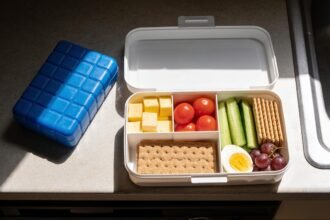
The lunchbox zone. Everything that goes into a lunchbox, in one place, at a height the person packing them can reach in one movement. If children pack their own, that is their height, not yours.
The kids zone. Snacks they are allowed to take without asking, low down. This single change ends a surprising amount of daily negotiation and makes children more independent, which is the same principle as kitchen setup so kids can help themselves.
The breakfast zone. Cereal, spreads, anything used before seven in the morning, together.
The cooking zone. Oils, flours, tins, rice, pasta. At adult height.
The occasional zone. Baking supplies, party things, the appliance you use twice a year. Top shelf or the back, because these are the things that should be hardest to reach.
Whatever is left over. Every pantry has some.
Five zones, not twenty categories. A system with too many rules is a system nobody else follows.
The rules that make it hold
Nothing behind anything. A second row behind the first is invisible, and invisible food is not eaten, which is the largest source of household food waste as covered in feeding a family of four on a weekly grocery budget.
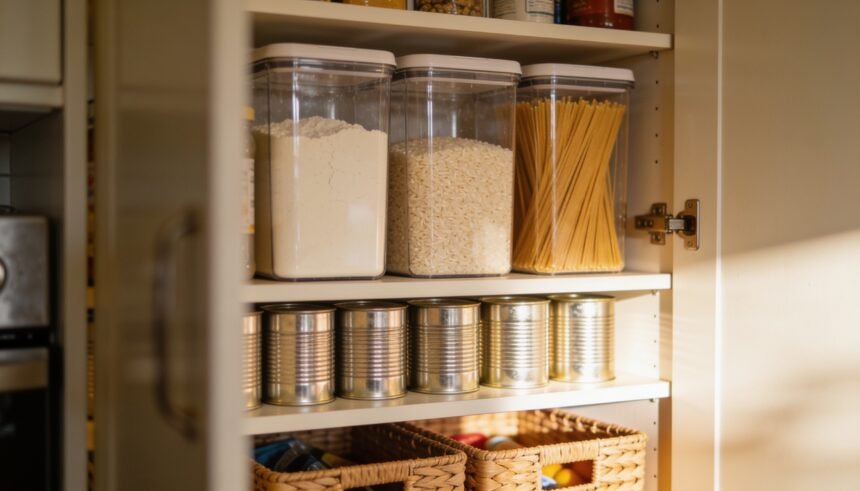
Use shelf risers or tiered inserts for tins, or simply keep tins one deep.
Clear containers if you use containers at all. Opaque ones recreate the invisibility problem, and a container you cannot see into is a container someone buys a duplicate of.
Do not decant everything. Decant the things that need it, which are flour, rice, pasta, cereal and sugar, for pest reasons below. Decanting everything adds a job between shopping and storing and is the main reason elaborate pantries revert.
Keep the packet instructions. Cut off the cooking directions and drop them in the container when you decant, because a container of unfamiliar grain with no instructions gets ignored.
Label anything not obvious, with the date it was opened for things that age.
One shelf or basket as the eat-first spot, mirroring the fridge approach in fridge organisation for a full family fridge.
The Australian pantry problems
Pantry moths and weevils. The dominant Australian pantry problem, and they arrive inside packaged flour, grains, rice, pasta and cereal rather than flying in.
Two things control them:
Sealed containers rather than opened packets, which stops an infestation spreading from one product to everything else.
Freeze flour, grains and rice for a few days after purchase before transferring them, which deals with anything already present.
If you find them: empty the pantry completely, check every packet including sealed ones, discard anything infested, vacuum the shelves and the corners including the screw holes and shelf supports, and wipe out. State agriculture and health departments publish guidance and it is the reference for anything persistent. Ants are the other pantry visitor with a food source behind them rather than a nest problem, and ants in the kitchen covers finding the trail before reaching for a spray.
Heat. Australian kitchens frequently put the pantry beside or above the oven, which is the worst storage in the house. Oils go rancid faster, everything ages faster, and chocolate and similar items will not survive summer there. Use the coolest cupboard for the things you keep longest.
Humidity, particularly in the north, which affects crackers, biscuits, sugar and anything that clumps. Sealed containers again.
Setting it up
Empty it completely. One afternoon, everything out.
Check dates and bin what has gone, honestly and quickly.
Wipe the shelves, and check the corners while you are there.
Group into the five zones on the floor, then load back in with the most-used zones at the most reachable heights.
Put the occasional things at the top and the back.
Do not buy containers before you do this. You will not know what you need until it is sorted, and buying first is how people end up with a cupboard of empty containers, which is the same mistake as buying storage before deciding what needs storing.
Keeping it
Shop the pantry before you write the list, which is the habit that does most of the work and is a step in the 30-minute weekly meal plan method.
Five minutes when the shopping is unpacked. Put things in their zone rather than on the nearest shelf. This is the whole maintenance requirement.
Front the shelves once a week, pulling everything forward.
Tell the household where things are. A system only one person knows is a system that one person maintains forever.
Expect it to drift and reset it quarterly, which takes fifteen minutes rather than an afternoon if the zones are holding.
Food safety, briefly
Follow the storage guidance on the label, and FSANZ publishes Australian guidance on food storage and safety.
Store food off the floor and away from cleaning products.
Keep cleaning chemicals out of the pantry entirely, and out of reach of children.
When in doubt, throw it out.
Next: freezer and pantry staples worth always having covers what should be in there, fridge organisation for a full family fridge covers the other half, and feeding a family of four on a weekly grocery budget covers why visibility matters to the bill.
When it comes to buying the containers themselves, pantry and fridge containers that actually get used covers how to choose ones the household will keep refilling.
The one-page family week
One printable page that holds the whole week: meals, school, activities and who is doing the pickup. Free, and we send one useful email a week.
One email a week. No spam, unsubscribe in a click.