
What is in this guide
There is a short list of changes that genuinely reduce an Australian grocery bill, and a very long list of changes that feel productive and save almost nothing.
The long list is what most articles in this category contain. Making your own stock, growing herbs, taking a calculator to the shop and buying yellow-stickered items at closing time all work, in the sense that they save a small amount. Doing all of them takes several hours a week and will not move a household’s bill meaningfully.
Here are the four that will, in order of size.
1. Stop throwing food out
This is the largest saving available to almost every household and the least popular answer, because it is not a shopping technique. It is a storage and planning problem.
Food waste in Australian households is significant enough that federal and state governments run programs specifically to reduce it, and the food that gets thrown away was paid for at full price. A household that halves its waste has effectively cut its bill without changing what it buys. What food waste actually costs a household puts numbers to that and covers the handful of habits that move it.
What actually causes it, in order:
Buying for an imagined week. The week where you cook every night from scratch and everyone eats vegetables. The real week has a late meeting, a sport night and a takeaway, and the produce bought for the imagined week rots. Buy for the week you will actually have.
Nothing having a designated meal. Ingredients bought without a plan become ingredients nobody uses. Every perishable item in the trolley should have a meal attached to it before it goes in.
Leftovers with no plan. Leftovers that go into the fridge without a decision about when they are eaten become archaeology. Decide as you pack them: tomorrow’s lunch, or the freezer.
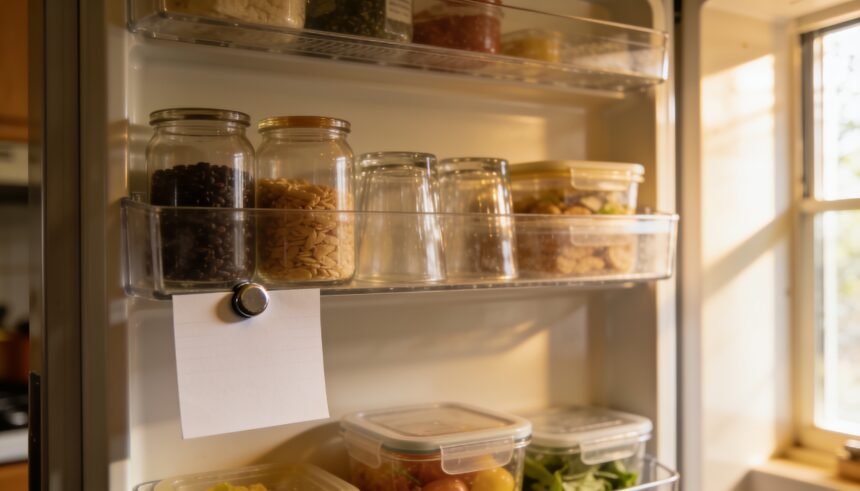
Bad fridge order. Things at the back are not seen and not eaten. One shelf as the “eat this first” shelf, at eye level, fixes more waste than any app.
Over-buying fresh at the start of the week. Buy the salad and the soft fruit for the first three days and top up mid-week. A second short shop reduces waste more than it costs in time.
2. Plan meals and shop to the list
The second largest lever, and it works for two separate reasons.
It prevents the waste described above, because everything has a purpose.
It prevents the second shop, which is where unplanned spending happens. A household that shops three times a week spends more than one that shops once plus a short top-up, and the difference is not groceries. It is the things that go into the trolley on the way past.
You do not need an elaborate system. Seven dinners, written down, with the ingredients checked against what is already in the house. Fifteen minutes.
The single most useful planning habit is shopping the pantry first. Look at what is already there, build two or three of the week’s meals around it, and only then write the list. Most households have a week of food in the cupboard and a full trolley coming in the door.
Freezer and pantry staples worth always having covers what should be in there.
3. Change where you shop, not just what you buy
Use the discount chain for the staples and the majors for what you cannot get there. Australian households that split their shopping this way typically report a meaningful reduction, and the effort is a single extra stop.
Buy home brand on the things where it does not matter. This is the highest ratio of saving to effort on this entire list, because the change is invisible in almost every category. Mince, chicken and lentils: stretching protein covers the other half of this, which is making the expensive part of the meal go further.
Butchers, markets and greengrocers beat supermarkets on some things and not others. Meat in bulk from a butcher and seasonal produce from a market are usually cheaper. Everything else usually is not, and a trip that saves $8 and costs forty minutes is not obviously a win.
4. Restructure the meals themselves
The largest structural change and the one that needs the most buy-in from the household.
Make meat a component rather than the centre. Meat is typically the largest single line in an Australian family food budget. Halving the meat in a bolognese, a curry, a stir fry or a soup by adding lentils, beans or extra vegetables is close to undetectable and is a large saving repeated weekly.
Run two or three genuinely cheap meals a week. Not every meal has to be cheap, and trying to make every meal cheap is how families abandon this in a fortnight. Two or three reliable low-cost dinners that everyone actually eats does most of the work.
Cook once, eat twice. Double the batch and freeze half. This saves money, time and the Wednesday takeaway, which is frequently a larger saving than the ingredients.
Buy seasonal produce. Out of season produce in Australia is either imported or grown at cost, and the price difference is large. Seasonal is cheaper and better, and the swap is usually straightforward.
What saves almost nothing
Worth stating plainly, because these absorb effort that would be better spent on the four above.
Coupon and catalogue chasing. Australian supermarket promotions are weekly and cyclical. Buying what is on special when you need it is sensible; driving between stores to chase specials is not.
Making things from scratch that are cheap anyway. Bread, stock and pasta sauce from scratch are satisfying and better, and the saving per hour of effort is small. Do them because you want to.
Bulk buying without the storage or the consumption. Bulk is only cheaper if it gets eaten. A five kilogram bag that goes stale is more expensive than the small one.
Growing vegetables to save money. Herbs genuinely pay for themselves. A vegetable garden is a good thing to do for other reasons, and it is rarely a net saving in the first few years.
How to actually start
Do one thing, for a month. Households that attempt all of this at once revert within a fortnight.
Start with waste, because it is the biggest and it requires no change to what anyone eats. For one month: everything perishable gets a meal assigned before it goes in the trolley, and one fridge shelf is the eat-first shelf.
Then add planning. Then add the shop split. Then look at the meals.
Track the actual number. Three months of real grocery transactions, averaged, is your starting point, exactly as in a family budget that survives a real month. Without it you cannot tell whether any of this worked.
Next: freezer and pantry staples worth always having covers what to keep in, and mince, chicken and lentils covers stretching the most expensive item in the trolley.
The one-page family week
One printable page that holds the whole week: meals, school, activities and who is doing the pickup. Free, and we send one useful email a week.
One email a week. No spam, unsubscribe in a click.