
What is in this guide
Here is the fact that decides everything else: a fan does not lower the temperature of a room. The motor actually adds a very small amount of heat.
What a fan does is move air across skin, which speeds up evaporation and carries heat away from a person. The room is the same temperature. You are cooler.
Three things follow immediately:
- A fan running in an empty room does nothing at all except cost money
- Point it at people, not into space
- Comparing a fan to an air conditioner on temperature is the wrong comparison. They do different jobs and one is roughly a tenth of the running cost of the other
The four types
Pedestal fans
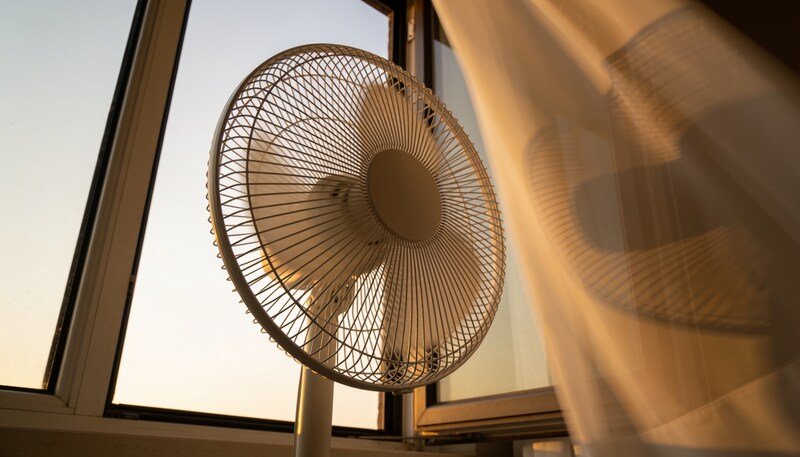
Cheapest, most flexible, and the best value per dollar in the house. Adjustable height, tilts, oscillates, moves between rooms, comes with you when you move.
Bad at: floor space, tipping over, cable across a floor, and noise at the higher speeds.
Best for: renters, bedrooms, anywhere you want the air aimed at a specific person, and the window trick below.
Tower fans
Narrow footprint, quieter at low speeds, usually better looking, and typically more expensive than a pedestal fan of similar output.
Bad at: moving a large volume of air, and reaching a bed at height. Many are less powerful than a basic pedestal fan costing half as much.
Best for: small rooms, tight corners, households where the appearance matters.
Ceiling fans
The most efficient cooling per watt in the house and, over a summer, the cheapest way to feel cooler.
Bad at: being moved, being installed in a rental, low ceilings, and doing anything for you in another room.
Best for: owner-occupiers, bedrooms and living rooms used every day, and any house trying to reduce air conditioner hours.
Bladeless and desk fans
Bladeless units are quieter, safer around small fingers, and expensive for the air they move. Desk fans are excellent at a desk and irrelevant anywhere else.
What to look for
- Speed range, especially the lowest speed. A fan that cannot go quiet enough to sleep next to is a fan you will not use in a bedroom. Cheap fans commonly have a loud low speed
- Oscillation, and whether it can be turned off. Some people cannot sleep with air arriving in waves
- A remote, which sounds like a luxury and is the difference between adjusting it at 2am and not
- A timer, so it does not run all night in a room that has cooled
- Height adjustment on a pedestal fan. A fan aimed at a mattress from floor level is aimed at the mattress
- Tilt, so you can aim it upward for circulation or across for a person
- Blade span on a ceiling fan, matched to the room. A fan too small for the room does not move usable air at the edges
- Reverse switch on a ceiling fan. Covered below
- The Regulatory Compliance Mark, and buy from an Australian retailer
The window trick, which is the best use of a cheap fan
The highest-value thing a portable fan does has nothing to do with pointing it at yourself.
Put it in an open window facing outward, on the warm side of the house, in the evening. It pushes hot indoor air out, and cool evening air is drawn in through windows on the other side. This actually lowers the temperature inside, which is the one thing a fan aimed at a person does not do.
Open a window at the other end of the house for it to draw from, and open the internal doors. Why the house is still hot at 10pm explains the physics of the stored heat this is clearing.
The winter reverse switch
Most ceiling fans have a small switch on the housing that reverses the blade direction.
- Summer: blades push air downward, creating the breeze that cools people
- Winter: blades pull air upward, gently circulating warm air that has collected at the ceiling back down the walls, without a draught
Run it on the lowest speed in winter. It is a small effect and it is free, and it matters most in rooms with high or raked ceilings where a lot of heat sits above head height. Heating a house cheaply through an Australian winter is the wider picture.
Running cost, honestly
Fans are among the cheapest appliances in the house to run. A ceiling fan typically draws in the range of tens of watts; a pedestal fan somewhat more; an air conditioner is an order of magnitude above both.
That is the argument for fans: not that they replace air conditioning, but that they let you run it less, later, and at a higher thermostat setting. Moving air makes a given temperature feel cooler, so a room with a fan running is comfortable at a higher setting than the same room without one.
Cooling costs and running air conditioning sensibly covers the settings side, and what it costs to run an air fryer, slow cooker and oven is the same arithmetic applied to the kitchen.
The rule that follows: turn fans off when you leave the room. There is no benefit at all to a fan in an empty room, and this is the single most common waste with them.
Renting
Everything except a ceiling fan is available to you, portable, and comes with you.
If you want a ceiling fan installed in a rental, that is an alteration requiring the owner’s consent and licensed electrical work. It is a reasonable request to make in writing, particularly in a bedroom in a hot climate, and some states have minimum standards that touch on cooling. Your state tenancy authority is the place to check.
Safety
- Ceiling fan installation is licensed electrical work in every Australian state and territory. It is not a DIY job, and it involves both wiring and anchoring a spinning mass to a ceiling
- Blade clearance matters. Ceiling fans need clearance from the floor and from walls, and a fan over a bunk bed or a raised deck is a genuine hazard
- Pedestal fans tip. On carpet, near a toddler, or with a cable running across a walkway, they are a trip and injury risk. Cable along the skirting, base on a hard flat surface
- Finger guards. Check the grille spacing on any fan that will be at a small child’s height, and consider bladeless in a room used by toddlers
- Do not run a damaged fan or one with a frayed cord
Before you buy
- Decide whether you want to feel cooler, in which case aim it at people, or to cool the house, in which case put it in a window in the evening
- Check the lowest speed noise if it is for a bedroom
- Buy height adjustment and tilt on a pedestal fan
- Buy a ceiling fan if you own, use the room daily and have the ceiling height
- Check for the RCM mark and an Australian retailer
- Budget for installation separately on a ceiling fan, because the electrician is a real cost
Common questions
Is a tower fan better than a pedestal fan? Usually quieter and usually less powerful for the money. Buy a tower for a tight space or for appearance, and a pedestal if you want air moved.
Will a fan make a hot room worse? If the air is hotter than skin temperature, moving it over you stops helping and can feel worse. In an extreme heat event, health authorities advise that fans alone may not be sufficient and that cooler environments and hydration matter.
Should I leave the ceiling fan on for the dog? Only if the dog is in that room. Same rule.
Do bladeless fans cool better? No. They are quieter and safer around children, and they move less air per dollar.
Where should the fan point at night? Across the bed rather than directly at a face, on the lowest speed that works, on a timer.
The short version
Fans cool people, not rooms. Aim them at people, turn them off when the room is empty, and use a cheap one in a window in the evening to actually clear the day’s heat.
Ceiling fan if you own and use the room daily, pedestal if you rent or want flexibility, tower for tight spaces and quiet. Check the low speed before you buy anything destined for a bedroom.
The one-page family week
One printable page that holds the whole week: meals, school, activities and who is doing the pickup. Free, and we send one useful email a week.
One email a week. No spam, unsubscribe in a click.