What is in this guide
Most dogs that slip a collar or back out of a harness were not being difficult. They were wearing something a bit too loose, in a specific place, and the dog simply reversed out of it.
This takes ten seconds to check and almost nobody does it after the first week.
The two-finger rule, and where it applies
Collar: you should be able to slide two fingers flat between the collar and the dog’s neck, comfortably, without forcing them. Not one, not four.
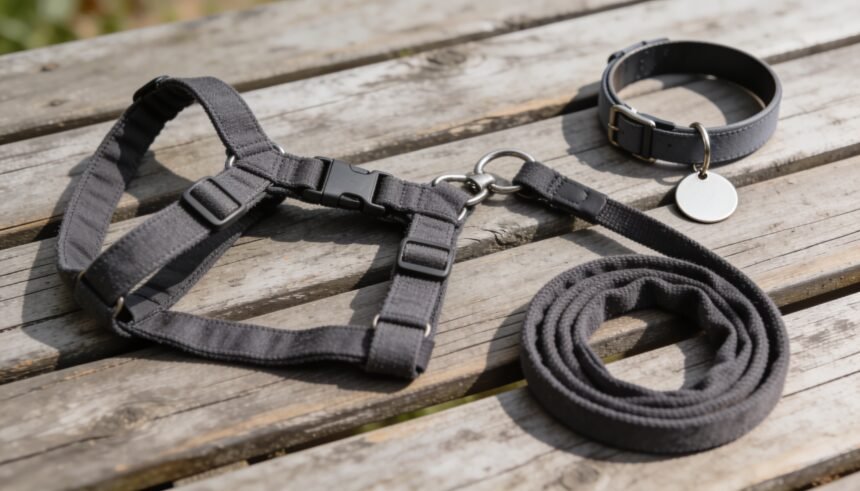
Harness: the same two fingers, checked at the chest strap and at the girth strap behind the front legs, separately. A harness can be correct at one strap and wrong at the other, which is exactly how escapes happen.
Too loose is the common error and it is the dangerous one. Too tight causes rubbing, hair loss and sores, and on a growing dog it can happen within weeks.
Check it standing, with the dog in a normal posture, not sitting and not while they are pulling.
Why dogs back out of harnesses
The escape almost always happens the same way: the dog plants its feet, pulls backwards, and the harness slides forward over the shoulders and off.
What prevents it:
- The girth strap sits behind the front legs and snug, not halfway down the ribcage. This is the strap that actually stops a reverse escape
- The chest strap sits across the front of the chest, not up on the throat
- The Y-shape at the front sits on the breastbone, with the straps clear of the shoulder joints so the dog can move normally
- Nothing sits in the armpit. A strap rubbing there will cause a sore within a couple of walks
- Both sides even. A harness pulled around so the back clip sits off to one side is not fitted, it has twisted
If a dog has escaped once, it knows it can. Refit the harness properly and consider a design with an additional strap, and until you are confident, use a lead attached to both the harness and the collar so there are two points of failure rather than one.
Collar or harness
Both, usually, for different jobs.
The collar carries the identification. In Australia that matters legally as well as practically: councils require registration and a dog in a public place generally must carry identification. ID tags and what Australian law requires covers the detail, and the short version is that the collar is where that lives.
The harness is for walking, particularly for a dog that pulls. Pressure across the chest and shoulders is spread across a larger area than pressure on the throat, which matters for any dog and matters a great deal for small breeds and for flat-faced breeds where airway pressure is a real concern.
Attach the lead to the harness rather than the collar for walking, in most cases. A collar is for identification and for holding a dog briefly, not for being pulled against for an hour.
Front-clip harnesses reduce pulling by turning the dog toward you rather than by causing discomfort, and they are the humane answer to a puller. They are not a substitute for teaching the dog not to pull, which is covered in lead pulling.
What to avoid
- Anything that works by hurting. Choke chains, prong collars and electronic shock collars. Australian animal welfare organisations advise against aversive collars, some are restricted or prohibited in parts of Australia, and reward-based training achieves the same results without the fallout
- A collar left on a dog that is crated or unsupervised outdoors, where it can catch. Many owners remove the collar for crate time
- Extendable leads near roads. They give a dog several metres of momentum and offer very little control
- A worn-out harness. Check the stitching and the buckles, particularly where they have been chewed or sun-damaged. Australian sun degrades webbing faster than people expect
Re-check on a schedule
This is the part that gets skipped.
- Puppies: weekly. A growing puppy can outgrow a correctly fitted collar in a fortnight, and a collar left on through a growth spurt can embed painfully
- Adult dogs: monthly, and after any significant weight change
- After a haircut. A clipped double-coated dog is suddenly much thinner and everything that fitted is now loose. This catches out a lot of owners in spring
- Seasonally. Winter coat on and off changes the fit measurably
- After it gets wet a few times. Webbing and leather both change
Getting a nervous dog used to it
- Put it on, feed something good, take it off. Repeat over a few days before ever attaching a lead
- Let a puppy wear a lightweight collar for short supervised periods indoors first
- Never wrestle it on. A dog that learns the harness is a fight will start avoiding the hallway
When it is a vet question
- Rubbing, redness, hair loss or a sore under any strap
- Any sign of pain when it goes on
- Coughing or laboured breathing on lead, particularly in a flat-faced breed
- A collar that has become tight on a dog you did not notice growing
Those are veterinary matters and not fit adjustments, and this article stops there.
The short version
Two fingers, checked separately at the neck, the chest and the girth. Girth strap snug behind the front legs. Lead on the harness, ID on the collar. Re-check weekly for a puppy, monthly for an adult, and always after a haircut.
If you are heading out with it, the rules about where the lead has to stay on are set by your council, and taking a dog to the beach or the park covers how to find yours.
The one-page family week
One printable page that holds the whole week: meals, school, activities and who is doing the pickup. Free, and we send one useful email a week.
One email a week. No spam, unsubscribe in a click.